


 USA
USA Canada
 Mexico
 Brazil
 UAE
UAE Saudi Arabia
 Iraq
Iraq Nigeria
 Ghana
Ghana Côte d’Ivoire
 Kenya
Kenya Uganda
 Tanzania
 DR Congo
 Angola
 South Africa
 UK
UK Germany
 France
 Netherlands
 Spain
Spain Australia
Air Shipping from China to South Africa: 2026 Rates, Transit Times & Clearance
September 17, 2026
← All Articles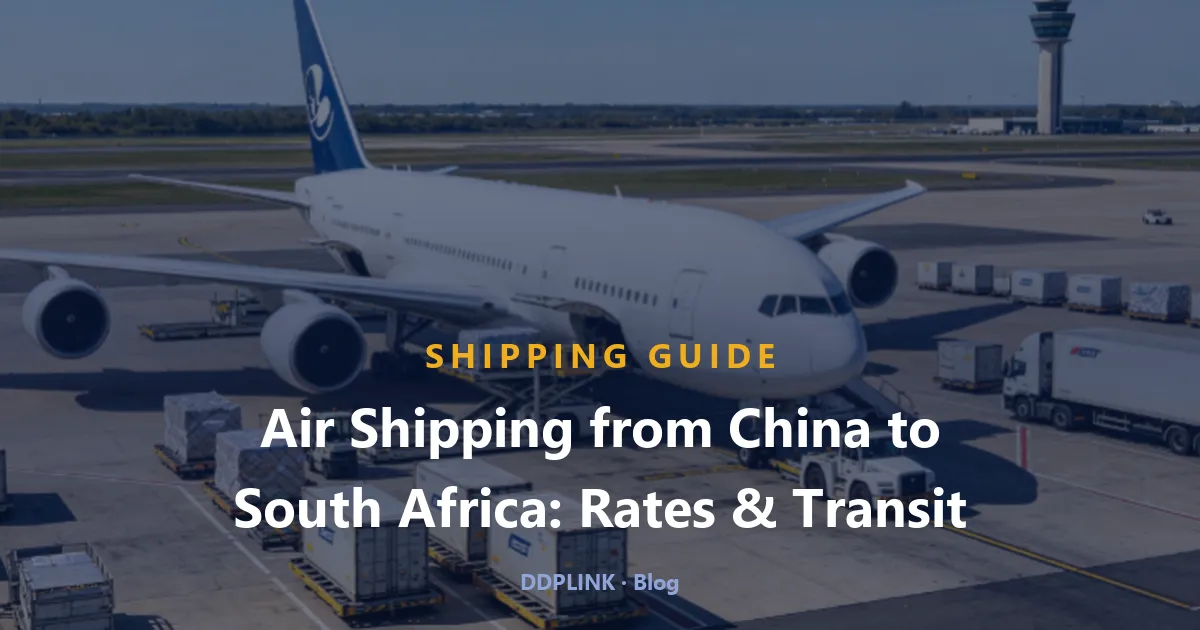

Air shipping from China to South Africa in 2026: rates by weight break, transit to Johannesburg, Cape Town and Durban, and the SARS duty and 15% VAT stack.
Air shipping from China to South Africa answers one question well: how do I get goods onto a Johannesburg shelf in under a week instead of in six weeks? The short answer is 4–6 days door-to-door to OR Tambo on a normal week, at an all-in cost that starts around $4.80–$8.20/kg — and the long answer is that three separate numbers decide what you actually pay: your weight break, the SARS assessment (duty plus 15% VAT), and how fast your documents clear the airport once the flight lands.
This one dates every figure to Q4 2026, shows our own weight-break rates, works a 300 kg shipment through the full SARS calculation, and explains the 48-hour storage clock at OR Tambo. For the country-level view first, our China to South Africa shipping guide covers the same market from the destination side.
Quick Answer: Air Shipping from China to South Africa in 2026
There are three air options on this lane, and they are priced on completely different bases. Comparing a per-kg figure from one column with a total from another is the most common mistake importers make on this route.
| Service | Door-to-Door Transit | Cost Basis (Q4 2026) | What It Covers |
|---|---|---|---|
| Express courier | 2–4 days | Retail per-parcel pricing | Parcels up to roughly 30 kg; duty and VAT usually billed to the recipient on delivery |
| Air freight (airport-to-door) | 4–6 days to Johannesburg, 5–7 days to Cape Town or Durban | Freight-only, priced by weight break | Pickup in China, export declaration, AWB, airline space, arrival handling — excludes clearance, duty, VAT and delivery |
| DDP air (all-in, door-to-door) | 6–9 days | $4.80–$8.20/kg all-in, plus cargo-based duty | Everything above plus SARS clearance, duty and VAT handling, and delivery to your address |
| Sea, for reference | 25–40 days | 20ft from about $1,650; LCL $180–$260/CBM | The cost-efficient option for volume cargo |
Air freight from China to South Africa is billed on chargeable weight, and we publish two different figures for a reason: the all-in DDP band above ($4.80–$8.20/kg) is a door-to-door number on consolidated weekly space for typical general cargo from around 300 kg upward, while the freight-only rates in the next section are what the cargo alone costs by weight break, before SARS duty, VAT, storage and delivery are added. Neither is wrong; mixing them is.
Air Freight Rates from China to South Africa (2026 Rates by Weight Break)
Airline rates are quoted in weight breaks, not as a flat per-kg price, and the fixed charges in a shipment — AWB and documentation, screening, terminal handling at both ends, minimum charges — do not shrink with the shipment. That is why a 100 kg consignment costs far more per kilogram than a 1,000 kg consignment on the same flight.
Our current booked ranges on the main lane, freight and origin charges only, as of Q4 2026:
| Chargeable Weight (CAN → JNB) | Freight Total | Effective Per Kg | Transit |
|---|---|---|---|
| 100 kg | $1,480–$1,920 | $14.80–$19.20/kg | 4–6 days |
| 300 kg | $3,120–$4,050 | $10.40–$13.50/kg | 4–6 days |
| 500 kg | $4,680–$6,080 | $9.36–$12.16/kg | 4–6 days |
| 1,000 kg | $8,750–$11,350 | $8.75–$11.35/kg | 4–6 days |
These are freight figures before SARS duty, VAT, destination terminal handling and delivery. They also assume general cargo; dangerous goods, oversized pieces and temperature-controlled shipments are priced separately.
The per-kg bands you see quoted around the market — roughly $4.30–$7.00/kg from Guangzhou (CAN), $4.50–$7.50/kg from Shanghai (PVG) and $5.00–$8.00/kg to Cape Town — are usually carrier rates at a large weight break, before surcharges, origin charges and destination handling. Useful as a market reference, not as a bookable quote. The warehouse, cut-off and consolidation side of the Guangzhou lane is covered in our shipping from Guangzhou guide, and service-level detail sits on the air freight from China service page.
Chargeable Weight: Why an 80 kg Carton Bills as 140 kg
Airlines charge the greater of actual weight and volumetric weight, at a standard ratio of 1 CBM = 167 kg — the formula is length × width × height in centimetres ÷ 6,000. A pallet of assembled furniture, foam packaging or plastic components can measure 0.85 CBM while weighing 80 kg, which bills as 142 kg.
On a 4–6 day lane that gap is the difference between a $700 shipment and a $1,150 one. Run your dimensions through our volumetric weight calculator before you ask for a quote, and compare the result with the actual weight — the higher number is the one you are buying.
What Is Included in an Air Quote — and What Is Not
A complete air freight quote has four blocks: the base rate for the weight break, fuel and security surcharges, origin charges (export declaration, terminal handling, weighing, AWB documentation) and destination charges (terminal handling at OR Tambo, release, delivery). Our ranges above cover freight plus origin charges.
What sits outside almost every air quote, and lands on the importer instead:
- SARS customs duty and 15% VAT on the assessed value, plus brokerage fees
- Storage at the airport if documents are late (see the 48-hour clock below)
- Final delivery, waiting time if the address cannot receive a truck, and cargo insurance — which the airline’s own liability does not replace
Our Industry Insight: When someone shows you a rate of “$5 a kilo,” ask which weight break it applies to, whether surcharges are inside it, and whether arrival handling at Johannesburg is included. Most published per-kg figures are the airline rate at 500 kg or 1,000 kg. At 100 kg the same lane is not a $5/kg lane for anyone.
Transit Times to Johannesburg, Cape Town and Durban
The door-to-door clock has five segments, and the flight is the shortest of them. On a clean shipment our current timings are:
| Stage | Typical Time | Notes |
|---|---|---|
| Supplier pickup and consolidation | 1–2 days | Warehouse receiving, weighing, labelling, ULD build |
| Export declaration and uplift | 1–2 days | Chinese export clearance, airline acceptance |
| Flight | 14–18 hours | Actual block time, direct or via a hub |
| SARS clearance | 1–2 days | A clean air freight entry; 2–3 business days through a licensed agent, inspected cargo adds 2–5 days |
| Delivery | 1–2 days | OR Tambo to Johannesburg/Pretoria same or next day; Cape Town and Durban add a leg |
Door-to-door, that is 4–6 days to Johannesburg, and 5–7 days to Cape Town or Durban. Express courier runs 2–4 days on small parcels, and the difference between a courier parcel and an air freight consignment is where the break-even sits, not which one is “faster” in the abstract.
Direct vs Transship: Dubai, Doha, Addis Ababa or the Haikou Freighter
Johannesburg is served by passenger belly capacity through Gulf and East African hubs — Dubai, Doha and Addis Ababa are the routes most cargo actually flies — with transshipment adding one to two days in exchange for availability and price. Direct freighter capacity on the China–South Africa lane is thinner than on the US or Europe lanes: the most recent addition is a twice-weekly Haikou–Johannesburg freighter service operated with a Boeing 767-300F, around 50 tonnes of payload per flight, routing through a Nairobi hub and launched in mid-2026.
Practically, this means: if your deadline is a date rather than a range, tell your forwarder that at booking, because a direct routing and a hubbed routing differ by a day or two and often by more than that in price. The same routing logic we use for shipping time from China to the USA applies here, with less direct capacity to work with.
Which South African Airport: JNB, Cape Town or Durban
OR Tambo International (JNB) handles over 80% of South Africa’s incoming air cargo, carries the most frequent connections from China, and has the country’s most developed clearance infrastructure — so most consignments clear at Johannesburg even when the final destination is elsewhere. The destination-side detail — regional demand, seasonal windows and the local compliance picture — sits in our South Africa destination guide.
- Cape Town (CPT) suits Western Cape deliveries, though flights may be less frequent or route through Johannesburg first.
- Durban (King Shaka, DUR) handles lower air volumes for KwaZulu-Natal; in practice Durban-bound cargo usually flies to Johannesburg and moves inland by road.
- Inland legs: OR Tambo to Gauteng industrial areas is a same-day or next-day run; the Durban–Gauteng corridor, the main leg for sea cargo, typically takes 1–2 days by road.
Capacity on this lane tightens from late September through the December peak, so book two to three weeks ahead of your required delivery date rather than in the week you need the goods.
Air vs Sea vs Express to South Africa: When Air Actually Pays
The right question is not “what is the cheapest way” but “what does a stockout cost”. Here is the same market priced four ways:
| Method | Transit | Cost (Q4 2026) | Best For |
|---|---|---|---|
| Express courier | 2–4 days | Retail per-parcel rates | Samples, documents, spares under ~30 kg |
| Air freight / DDP air | 4–6 days (DDP 6–9) | $4.80–$8.20/kg all-in; freight-only $8.75–$11.35/kg at 1,000 kg | Electronics, solar inverters and batteries, auto parts, seasonal restocks |
| Sea LCL | 30–40 days | $180–$260/CBM | 1–15 CBM, mixed or mid-volume orders |
| Sea FCL 20ft | 25–40 days | from about $1,650 | Bulk, machinery, panels, furniture |
The break-even is arithmetic. One cubic metre bills as 167 kg by air, so the same cubic metre costs roughly $800–$1,370 by air all-in versus $180–$260 by LCL sea — four to six times the freight cost. What you buy with the premium is airlift: service levels, carrier options, cut-offs and handling capability for the lane are set out on our air freight from China service page. Air is the correct choice whenever a shipment’s gross margin, a contractual deadline, or a production stoppage costs more than that multiple.
Two patterns repeat on this lane. Solar and backup power components — inverters, controllers, batteries — are high value per kilogram and fly; panels are the opposite, low value and volumetric, and go by sea. Auto parts and NRCS-regulated electronics often fly because the freight premium is small next to a compliance letter that arrives after the goods. The same consolidation model runs on our other African lanes — importers weighing a second regional market can start with the China to Kenya shipping guide. When volume wins, our sea freight from China service page covers the same lane, and the line-by-line mechanics of a container quote are in our 40ft container cost guide.
What Lands on Your Invoice: SARS Duty, 15% VAT and the 10% Uplift
Freight is the number importers watch; the SARS assessment is usually the bigger one. South African import duty is charged as a percentage of the customs value of the goods — usually the FOB value — at a rate set by the HS tariff code, anywhere from 0% to 45%. On top of that, import VAT is charged at 15% on the Added Tax Value (ATV), which is the customs value plus a 10% upliftment plus the duty already payable. The upliftment is a fixed feature of South African VAT on imports, not an error on your invoice.
All declarations are submitted electronically to SARS through ICMS on a SAD500 customs declaration, and the importer must hold a registered importer customs code before lodgement. Regular importers can apply for a deferment arrangement that allows duty and VAT to be paid up to 30 days after assessment — useful for cash flow, not a discount.
A Worked Example: 300 kg of Consumer Electronics to Johannesburg
A 300 kg shipment of consumer electronics — 2.2 CBM, so billed at the volumetric figure — invoiced at $12,000 FOB Shenzhen, with a representative 15% duty rate for the category:
| Line | Amount | How It Is Calculated |
|---|---|---|
| Goods value (FOB Shenzhen) | $12,000 | Supplier invoice |
| Air freight + origin charges (300 kg) | $3,120–$4,050 | Weight-break rate, freight only |
| Customs duty (15% assumed) | $1,800 | 15% of the $12,000 customs value — your rate depends on the HS code |
| Added Tax Value | $15,000 | $12,000 + 10% upliftment ($1,200) + duty ($1,800) |
| Import VAT at 15% | $2,250 | 15% of the ATV |
| Destination handling, release, clearing | $150–$350 | Terminal handling and agent fee |
| Delivery, OR Tambo to Johannesburg | $120–$250 | Same or next day |
| Total landed | $17,440–$18,700 | Before insurance and any storage |
Duty is the variable that moves this table most: at 0% the total drops by $1,800, and at 30% it rises by roughly the same. That is why classification should be settled before booking, not at the airport — classify your product yourself first with our China HS Code Lookup, then have it confirmed against the current tariff.
Documents SARS Wants for an Air Shipment
The document set on an air consignment is smaller than on a container, and the consequences of getting it wrong arrive faster:
- Air Waybill (AWB) — the contract of carriage, issued in the shipper’s name
- Commercial invoice — buyer, seller, accurate HS codes and the true CIF value; declaring “zero value” on commercial samples is not accepted
- Packing list — weights, dimensions and packaging per carton
- Importer customs code — registered with SARS before the entry is lodged
- NRCS Letter of Authority — required for regulated electro-technical products, including many electronics and auto parts
- ITAC import permit — for controlled categories such as textiles and certain chemicals and second-hand goods
- Certificate of Origin — where a SADC or other preferential rate is being claimed
- Dangerous goods declaration — for batteries and other regulated cargo
The Arrival Side Nobody Quotes: Storage, Handling and the 48-Hour Clock
Sea terminals give you days of free time; air cargo terminals at OR Tambo give you about 48 hours. After that, storage starts at roughly R150 per day and climbs, and because air terminals are smaller, congestion compounds it quickly.
A four-day documentation delay on a 400 kg consignment can add R600–R1,500 in storage — plus a weekend of lost time if the release lands on a Friday afternoon — to a shipment whose whole air freight cost was a few thousand dollars. The freight was never the risk; the clock was.
Our answer is to work the front of the chain rather than the back: HS classification, duty estimate, NRCS position and the full document set are settled while the cargo is still in China, so the entry is prepared before uplift and release happens within a day of landing. On DDP air we carry both the ATP-side relationship and the SARS side, which is what makes a 6–9 day door-to-door figure achievable instead of optimistic.
Real-Life Scenario — the shipment that arrived before its paperwork: A Gauteng importer booked 420 kg of inverters on a Thursday flight with the supplier’s invoice still being revised. The cargo landed Friday morning; the corrected invoice, the NRCS relationship and the classification query took until Tuesday. Four days of airport storage, a re-handling charge and a re-booked truck added roughly $480 to a shipment already priced to the dollar. The freight was not wrong — the documents simply arrived second.
Our Industry Insight: On air cargo we ask for the commercial invoice, HS codes and the consignee’s customs code at booking, not at arrival. It is the only stage where a delay is still free to fix — before the goods are in a bonded terminal with a daily meter running.
What Can’t Fly: Batteries, Liquids, Powders and Oversized Cargo (2026 Rules)
Roughly one enquiry in five on this lane is cargo that the airline will not accept as offered. The list is shorter than most importers expect, and the rules tightened again this year.
Lithium batteries. These are Class 9 dangerous goods. Lithium-ion batteries shipped on their own (UN3480) have been capped at 30% state of charge for some time. From 1 January 2026, that control extends to batteries packed with equipment (packing instruction PI966): shipments must be offered at no more than 30% of rated capacity, or a higher state of charge is allowed only with specific state approval under Special Provision A331. This applies to Section I shipments and to Section II shipments where the cells or batteries exceed 2.7 Wh. Batteries contained in equipment (UN3481) are not subject to the mandatory cap, but IATA recommends the same 30% limit. Sodium-ion batteries now sit in the framework as UN3551 (alone) and UN3552 (with or contained in equipment).
In practical terms: devices with batteries inside travel routinely, batteries by themselves need carrier approval, a compliant state of charge, correct marking and a dangerous goods declaration — expect additional documentation and a slower booking. Some carriers simply refuse standalone lithium-ion cargo. Solar batteries and power stations are the queries where this comes up most often on this lane, and they are the reason we ask for the battery specification before quoting.
Liquids and powders. Anything with a safety data sheet needs carrier acceptance before space is confirmed; many such shipments travel only on cargo aircraft, which narrows routing options to the freighter services above.
Magnetic and electronic goods may require a magnetism screening certificate before acceptance, and oversized pieces beyond the aircraft door or ULD limits go by sea or charter — there is no workaround.
If your cargo is on this list, say so at enquiry stage. It changes the routing, the rate and the timing, and it cannot be fixed at the airport counter.
FAQ: Air Shipping from China to South Africa
How much does air shipping from China to South Africa cost per kg?
All-in DDP air runs $4.80–$8.20/kg for typical general cargo on consolidated weekly space. Freight-only rates by weight break are $8.75–$11.35/kg at 1,000 kg and $14.80–$19.20/kg at 100 kg, before duty, VAT and delivery. Where your shipment lands depends on chargeable weight and what the quote includes.
How long does air freight take from China to Johannesburg?
4–6 days door-to-door on a clean shipment: 1–2 days consolidation in China, 1–2 days export clearance and uplift, 14–18 hours of flight, 1–2 days SARS clearance and 1–2 days delivery. Transshipped routings add one to two days; inspected cargo adds two to five.
Is air freight cheaper than express courier to South Africa?
Below roughly 30 kg, express courier is usually the simpler and cheaper door-to-door option. Above about 100 kg, air freight wins clearly on cost, and above 300 kg the per-kg difference is large enough that courier rates stop being comparable at all. Parcel limits, service levels and cut-offs are on our express courier from China page.
Do I have to pay duty and VAT on air cargo to South Africa?
Yes — air is not exempt. Duty is charged on the customs value at your HS code’s rate (0%–45%), and import VAT is 15% of the Added Tax Value: the customs value plus a 10% upliftment plus duty. Under DDP we handle assessment and payment; under other terms the consignee pays before release.
Can I ship lithium batteries by air to South Africa?
Devices containing batteries routinely, yes. Batteries shipped on their own (UN3480) need carrier approval and a maximum 30% state of charge. Since 1 January 2026 batteries packed with equipment must also be offered at no more than 30% state of charge unless approved under Special Provision A331. Some carriers refuse standalone lithium-ion cargo entirely, so the specification has to be checked before booking.
Which airport does air cargo to South Africa land at?
OR Tambo (Johannesburg, JNB) handles over 80% of incoming air cargo and is where most consignments clear, even for Cape Town or Durban destinations. Cape Town (CPT) suits Western Cape deliveries; Durban (DUR) serves KwaZulu-Natal at lower volumes.
Do I need my own SARS importer code to ship by air?
To import commercially, yes — every importer must be registered with SARS and hold an active importer customs code before an entry can be lodged. Under our DDP service you do not need to be the importer of record; we clear with our licensed partners and you receive the goods delivered.
Can solar panels be shipped by air from China to South Africa?
They can, but they rarely should — panels are heavy and low value per kilogram, so volumetric air charges rarely make sense. Inverters, controllers, batteries and power stations are the opposite and fly regularly. For the mixed shipments we see on this lane, splitting the load between sea and air is often the cheapest way to hit a deadline.
Conclusion: Match the Route to Your Deadline
Air shipping from China to South Africa costs $4.80–$8.20/kg all-in for typical cargo and takes 4–6 days door-to-door to Johannesburg, 5–7 days to Cape Town or Durban. Freight-only rates fall from $14.80–$19.20/kg at 100 kg to $8.75–$11.35/kg at 1,000 kg. On top of freight sits a SARS assessment that is normally larger than the freight line: duty at 0%–45% by HS code, plus 15% VAT on the customs value with its 10% upliftment. And behind all of it sits a 48-hour free storage window at OR Tambo that rewards paperwork prepared before the flight, not after.
Send us your cargo details — dimensions, weight, commodity, HS code if you have it, and the delivery address in South Africa — and we will return a full itemised quote as soon as possible, with freight, duty and VAT lines shown separately so you can see what each one is. Start with an instant estimate on the freight cost calculator, review the door-to-door service on our DDP shipping from China page, or request a free quote and we will handle the rest.
More articles
Cost of Shipping a 40ft Container from China to USA: 2026 Rates & Breakdown
40ft container from China to USA: ocean freight $1,700-$4,100, door-to-door $4,500-$9,000. Dated Sept 2026 rate tables, hidden fees, duty stack and worked examples.
Read Article →
DDP Shipping from China to Iraq: Q3 2026 Rates, Routes and Clearance
DDP shipping from China to Iraq in Q3 2026: all-in air, sea and express rates, door-to-door transit to Baghdad, Basra and Erbil, plus Iraq's customs documents.
Read Article →
Shipping Cost from China to France: 2026 Rates, TVA & Landed Cost
Air freight runs $3.40-$7.20/kg, a 20ft container $1,300-$2,300, and LCL $150-$260/CBM from China to France. Plus the 20% TVA and EU duty you must budget for — here are the real 2026 numbers with a full landed-cost breakdown.
Read Article →