


 USA
 Canada
 Mexico
 Brazil
 UAE
 Saudi Arabia
 Iraq
 Nigeria
 Ghana
 Côte d’Ivoire
 Kenya
 Uganda
 Tanzania
 DR Congo
 Angola
 South Africa
 UK
 Germany
 France
 Netherlands
 Spain
 Australia
Express Shipping from China to Germany: Costs, Transit & the €3 Parcel Duty (Q4 2026)
November 4, 2026
← All Articles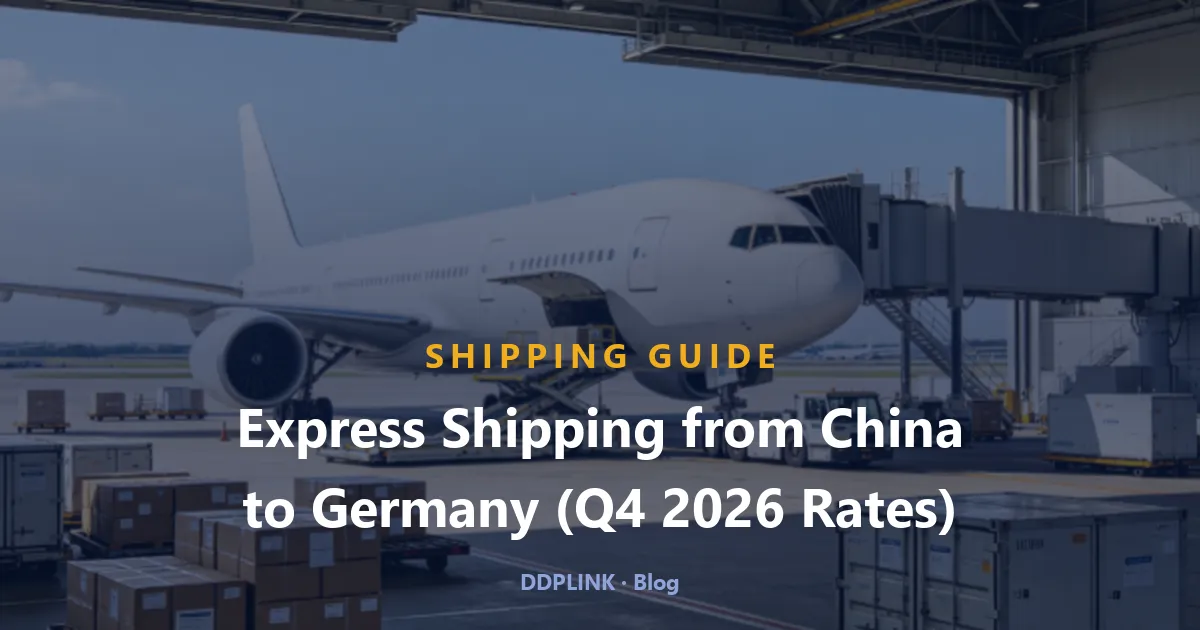

Express shipping from China to Germany: Q4 2026 courier rates by weight band, 2–6 day transit, Zoll clearance and the €3 duty that replaced the €150 relief.
Express shipping from China to Germany is a three-to-six day door-to-door product: one courier collects at your supplier, flies the parcel, clears it with German customs (Zoll) and delivers — at roughly $17 to $42 per chargeable kilo, by weight band and network.
This guide prices that lane for Q4 2026: our contract rates by weight band, the surcharge lines a headline rate hides, how Zoll clearance runs, and the rule that changed on 1 July 2026 — the €3-per-item duty that replaced the €150 relief. Market overview first: Shipping from China to Germany.
Quick Answer: Express Shipping from China to Germany Costs (Q4 2026)
Germany has two express products, quoted differently. An integrator parcel is priced per piece by DHL, FedEx or UPS on chargeable weight and cleared under the carrier’s own customs representation. Consolidated express cargo is priced per kilo by a forwarder that books space and files the entry.
| Service | Practical size | Cost basis (Q4 2026) | Door to door |
|---|---|---|---|
| Express courier (DHL, FedEx, UPS) | 0.5–45 kg chargeable | From about $42 per parcel; $17–$29 per kg from 2 kg up | 2–6 days |
| Consolidated express cargo | 20–300 kg | Per kilo, clearance commonly included | 4–8 days |
| Air freight, for reference | From 100 kg | $10.80–$14.20 per kg at 100 kg, falling to $7.60–$10.10 at 300 kg | 3–7 days |
| DDP air, for reference | From about 21 kg | $5.50–$10.50 per kg all-in, duty and VAT included | 5–8 days |
| Sea LCL, for reference | 1–15 CBM | $140–$230 per CBM | 22–35 days |
The air and sea rows are freight only: no Zoll clearance, duty, 19% import VAT or delivery. DDP is all-in. Express sits between them — the courier clears the parcel, but the duty and VAT bill arrives separately unless you buy DDP.
Express Courier Rates from China to Germany by Weight Band
Couriers sell weight bands, not one flat per-kilo rate: pickup, airway bill and handling do not shrink with the parcel. Our Q4 2026 contract rates, freight only and before fuel:
| Service | 1 kg | 2 kg | 5 kg | 10 kg | 20 kg |
|---|---|---|---|---|---|
| DHL Express Worldwide | $41.60 | $57.20 | $114.80 | $221.40 | $392.60 |
| FedEx International Priority | $52.40 | $77.10 | $108.90 | $209.70 | $371.20 |
| UPS Worldwide Saver | $58.90 | $73.40 | $121.60 | $196.80 | $348.40 |
| UPS Worldwide Expedited | $56.20 | $68.90 | $139.70 | $248.30 | $430.10 |
The effective rate falls from $41.60 a kilo at 1 kg to $22.96 at 5 kg and $19.63 at 20 kg, and the ranking moves with every band: DHL is cheapest at 1 kg and 2 kg, FedEx at 5 kg, UPS Saver at 10 kg and 20 kg. The card on our Express Courier from China page is where these numbers come from, and most of this lane’s volume is collected in Shenzhen before it flies.
Why the Divisor Is 5,000, Not 6,000
Express bills the higher of actual weight and volumetric weight at the courier divisor of 5,000 — length × width × height in centimetres ÷ 5,000 — while an airline air waybill uses 6,000, so the same carton is 20% heavier on a courier bill.
A worked case: a Ningbo supplier packed 12 sample pouches into a 50 × 40 × 40 cm carton weighing 9.4 kg. That is 80,000 ÷ 5,000 = 16 kg volumetric, so the parcel billed at 16 kg — $367 at the 5 kg band on our DHL card. Flat-packing and vacuum-bagging cut it to 50 × 40 × 22 cm, 8.8 kg volumetric, and the same goods billed at 9.5 kg: $218, a 41% cut with no change of service.
One correction to advice that circulates widely: splitting a carton into two does not lower chargeable weight, because volume is conserved — two half-size boxes still total 80,000 cm³. Only removing cubic volume lowers the bill, so run the before-and-after dimensions through the Freight Cost Calculator before you approve a pack.
What a China–Germany Express Quote Leaves Out
The published rate is the freight line. Five other charges appear on this lane’s invoice and can add a third to a small parcel’s freight:
| Charge | Basis and 2026 level | Billed to |
|---|---|---|
| Fuel surcharge | Percentage of freight, indexed weekly; mid-teens to low thirties in 2026 | Shipper or consignee |
| Peak / demand surcharge | Seasonal, late September to mid-January | Duty payer |
| Remote-area delivery | Per shipment, by postcode zone; islands and rural districts | Consignee |
| Advance-payment commission | DHL Express Germany charges 2–3% of duty and tax advanced, floor near €15 | Duty payer |
| Customs-related storage at Zoll | From about day four, around €11 per shipment per day plus €0.50 per kilo per day | Consignee |
The advance-payment commission (Kapitalbereitstellungsprovision) is the line most often mistaken for duty. It is not a tax and it does not go to Zoll: it is what the courier charges for paying your duty and import VAT at the border. A deferment account or SEPA mandate avoids it, and on a €900 duty and VAT bill the 2% to 3% spread is €9. Oversize parcels also leave the courier tariff and reprice as freight.
Our Industry Insight: The parcels that surprise importers are not the expensive ones. They are 6–12 kg sample cartons that clear Zoll, attract 19% import VAT and a small duty line, then meet the advance-payment commission at the door — €38 on a parcel whose freight was €114.80. We quote that commission before booking, because a consignee asked for cash on delivery assumes the forwarder made a mistake.
The €3 Duty That Replaced the €150 Threshold
The EU’s duty relief for consignments of negligible value ended on 30 June 2026: Council Regulation (EU) 2026/382 deleted Articles 23 and 24 of the Duty Relief Regulation and put a temporary flat duty in their place.
| Until 30 June 2026 | From 1 July 2026 | |
|---|---|---|
| Duty up to €150 | Exempt | €3 per item category, per tariff subheading |
| Duty above €150 | Normal tariff rate | Normal tariff rate |
| Import VAT | 19%, no value floor since 2021 | 19%, no value floor |
| Basis of the flat duty | — | Distance sales: IOSS or postal consignments |
| Duration | — | Until 1 July 2028, then tariff rates |
The duty is per tariff subheading, not per unit and not per parcel: five cotton T-shirts under 6109 are one category and cost €3, while three T-shirts plus a watch cost €6. A mixed parcel — garments, a steel bottle, a power bank — carries €9 of duty on a €140 consignment, 6.4% of value. Splitting no longer helps: three parcels of €45 with the same categories pay €9 three times.
VAT Never Had a Threshold
The 19% import VAT (Einfuhrumsatzsteuer) has applied to commercial parcels of every value since 1 July 2021 — 2026 changed duty, not VAT. On B2C sales up to €150 the seller can collect it at checkout through IOSS and declare monthly, which keeps the parcel moving; without IOSS the courier advances the 19% and collects it from the consignee. Above €150 the tax is settled at clearance on the customs value plus duty.
Product Identifiers Became Mandatory on 1 November 2026
Since 1 November 2026 every item in a low-value distance sale must carry product identifiers in the declaration: a merchant identifier (C127, the seller’s or platform’s SKU), a non-standardised manufacturer identifier (C128) and a standardised identifier such as a barcode where one exists (C129, or Y081 declaring none exists). They were voluntary from 1 July; enforcement starts now.
Your supplier’s carton data therefore has to reach the declarant before the parcel is manifested: an invoice reading only “gift samples, 12 pcs” cannot satisfy the requirement, and from this month that is a documentary hold. The EU also intends a Union handling fee on low-value parcels from the same date; the Commission cites €2 per item, final amount set in a delegated act. Sources: the Commission’s guidance on the €3 duty and the EU customs reform overview.
The €3 Flat Is for Distance Sales — B2B Pays the Tariff
A courier parcel from a Chinese factory to a German company is not a distance sale: it pays duty at the TARIC rate on its full value, so a €120 carton of apparel at 12% is €14.40, not €3. Importers who budget €3 for a B2B sample run meet the difference as a courier invoice later.
Zoll Clearance for an Express Parcel: Who Is the Importer
German clearance runs through ATLAS, Zoll’s digital declaration system, and every commercial import needs an EORI number. What decides whether the 19% import VAT is a cost or a recoverable item is who appears on the declaration as importer of record.
| Your situation | Importer of record | Import VAT treatment | Term to book |
|---|---|---|---|
| German company with a USt-IdNr | Your company | Deductible with the Einfuhrabgabenbescheid | DAP, or DDP with your EORI |
| EU company outside Germany | Your company with German VAT registration, or a fiscal rep | Deductible only with a German registration | DAP |
| Non-EU seller shipping to German consumers | Forwarder or platform | Not recoverable — a real cost inside the price | DDP or IOSS |
| Private recipient, samples or gifts | Recipient or courier | Final cost | DDP |
Under DDP the forwarder usually clears in its own name — convenient, but the assessment then names the forwarder, and a German buyer not named on it cannot deduct the VAT (our door-to-door shipping from China to Germany guide works through this). If your accountant intends to reclaim the 19%, book DAP with your own EORI.
Two mechanics matter before the parcel moves: declarations above €1,000 normally need a standard H1 entry rather than the low-value H7 dataset, and Zoll audits up to three years back, so an undervalued sample invoice becomes a Zollprüfung file rather than a saving.
Our Industry Insight: Valuation is where German express shipments actually fail. A supplier who writes $800 on goods worth $3,400 creates a file Zoll can reopen for three years, and the assessment then covers duty, import VAT and a late surcharge. We insist on transaction value, and we say up front when a duty rate makes a product uneconomic at express speed — a 12% apparel line on a 20 kg parcel belongs on the sea lane.
Where Express Stops Paying: 20 kg to 300 kg
Express bundles collection, flight, clearance and delivery into one transaction, which is why it wins at low weights. On the Germany lane the cost crossover arrives earlier than most buyers expect, because DDP air consolidators price this route aggressively.
| Mode | Practical range | Door to door | Priced by | What you give up |
|---|---|---|---|---|
| Express courier | 0.5–45 kg | 2–6 days | Chargeable weight, per parcel | Highest cost per kilo |
| DDP air consolidation | 21–300 kg | 5–8 days | Per kilo, all-in | 2–4 days and a shared uplift |
| Air freight, airport to airport | 100 kg+ | 3–7 days | Per kilo plus destination charges | You arrange clearance and delivery |
| Sea LCL | 1–15 CBM | 22–35 days | Per CBM, 1 CBM minimum | Six weeks; longer cash cycle |
On price alone the crossover is around 20 kg: our DHL card is $392.60 freight-only before surcharge, while a DDP air consolidator quotes $5.50–$10.50 a kilo all-in, or $110–$210 for the same weight. What the courier still sells is certainty — one operator, one tracking number, one claims channel, a commitment that survives a missed connection.
Above 45 kg the gap favours freight for replenishment stock, and by 100 kg airport-to-airport air is the cheapest fast option. We quote Air Freight from China with every express enquiry over 45 kg.
Routing and Transit: Leipzig, Cologne and the CDG Detour
Transit is four clocks, and only the first belongs to the airline. The second depends on the hub — only one integrator’s European air hub is inside Germany.
| Network | European air hub | How Germany is served | Typical door to door |
|---|---|---|---|
| DHL Express | Leipzig/Halle (LEJ) | Direct at LEJ, overnight road line-haul | 2–4 business days |
| UPS | Cologne/Bonn (CGN) | Direct at CGN, road to the Ruhr and south | 3–5 business days |
| FedEx | Paris CDG | Flown to CDG, then 6–10 hours by road | 3–6 business days |
| Consolidated express cargo | Frankfurt (FRA) belly and freighter | Break bulk at FRA, then truck or rail | 5–8 days |
That is not cosmetic: a Shenzhen parcel for Munich on FedEx lands in Paris and is trucked east, roughly a day behind the DHL routing through Leipzig — on a Wednesday cut-off, a Friday instead of a Monday. Direct belly capacity into Frankfurt runs year-round but books as freight, which is why consolidated express sits two to three days behind.
| Stage | Time | Controlled by |
|---|---|---|
| Pickup and export in China | 8–20 hours | Supplier readiness and the courier cut-off |
| Air leg to LEJ, CGN or CDG | 1–2 days, direct or one connection | The network’s own uplift |
| Zoll release under ATLAS | Same day to 2 days, plus 2–4 for a physical exam | Completeness of the entry data |
| Final delivery | 1 business day urban, 2–3 rural | Line-haul, appointment, weather |
Q4 capacity tightens from mid-November, when integrator uplift goes to peak e-commerce and a Friday booking may not fly until Monday: book holiday inventory by the end of October and treat the first three weeks of November as the last reliable window.
Real-Life Scenario — the sample split that saved a launch: A Bavarian wholesaler needed 96 units of a small electronic accessory for a listing on 2026-11-16, and the supplier could ship from Shenzhen on 2026-10-29. The order was 43 kg in five cartons — near $850 on the DHL card before fuel. We split it: 24 units in two cartons, 11.5 kg chargeable, went by DHL express and delivered on day four for $264; the other 72 units went by DDP air consolidation at $6.40 a kilo, $201, landing on day seven with duty and VAT paid. Twelve days of shelf time for 45% less.
Before the Parcel Flies: Compliance Lines That Stop Small Shipments
Zoll checks the declaration, not your product compliance, so a parcel can clear and still be unsellable. What we screen before booking:
| Requirement | Applies to | What it costs you if missed |
|---|---|---|
| LUCID / VerpackG | Anyone placing packaged goods on the German market | Sales ban, fines up to €200,000 |
| WEEE (ElektroG) | Electrical and electronic goods | Marketplace delisting |
| BattG | Products containing batteries | Same as WEEE; often missed on power banks |
| GPSR EU responsible person | Most consumer goods since 13 December 2024 | Product cannot be placed on the market |
| CE marking and EU declaration | Electronics, machinery, toys, PPE | Zoll can refuse release |
| LFGB | Food-contact items | Recall exposure after sale |
| ISPM 15 mark on wood | Pallets and crates | Refused or returned at your cost |
| UN38.3 report and MSDS | Lithium batteries | Airline refusal; booking not refunded |
The packaging obligation follows whoever first places the filled packaging on the German market. If you sell to German consumers that is you, and the registration must exist before the first parcel arrives; if you ship samples to a distributor who resells under its own name it usually sits with them — confirm in writing, because the fine lands on whichever party the authority identifies, often the brand on the label.
FAQ: Express Shipping from China to Germany
How much does express shipping from China to Germany cost?
On our Q4 2026 rates a 1 kg parcel starts at $41.60, a 5 kg parcel runs $108.90–$139.70 and a 20 kg parcel $348.40–$430.10, freight only and before fuel. From 2 kg up the effective rate is $17–$29 per kilo.
How long does express shipping take from China to Germany?
Two to six business days door to door. DHL through Leipzig is fastest at 2–4 days to most German cities; UPS through Cologne and FedEx through Paris CDG run 3–6. A physical inspection adds 2–4 days.
Is DHL cheaper than FedEx and UPS to Germany?
It depends on the band: DHL is cheapest at 1 kg and 2 kg on our card, FedEx at 5 kg, UPS Worldwide Saver at 10 kg and 20 kg. The spread at equal weight reached 28% in Q4 2026, so price all three.
Do I still pay duty on a parcel under €150?
Yes, if it is a distance sale: since 1 July 2026 the €150 exemption is gone and a flat €3 per item category applies. A B2B parcel is not a distance sale and pays the TARIC rate on its full value.
Can I reclaim the 19% import VAT?
Only if your company is named as importer of record and holds a German VAT registration. Under DDP the forwarder usually clears in its own name, and a buyer not named on the assessment cannot deduct the tax — book DAP with your own EORI.
Is express cheaper than air freight from China to Germany?
Not above about 20 kg. A DDP air consolidation from 21 kg quotes $5.50–$10.50 a kilo all-in against $17–$29 on express, but adds two to four days and shares the uplift.
Do I need an EORI or a LUCID registration to send samples?
Samples with commercial value need an EORI for the import declaration; the courier can clear under its own, but then the import VAT is not yours to reclaim. LUCID applies to packaging you place on the market, so a sample to a distributor who resells it usually falls to them — confirm in writing.
Conclusion: Quote the Duty, Not Just the Rate
Express shipping from China to Germany is a predictable service on a lane whose rules changed twice this year. The rate follows billed weight, so the carton’s dimensions decide the price before the courier brand does. Duty starts at €3 per item category on distance sales and at the full TARIC rate on B2B parcels, product identifiers became mandatory on 1 November 2026, and the 19% import VAT is recoverable only if the declaration names your company.
Send the packed dimensions, the product with its HS code and the delivery postcode, and we will quote express, DDP air and sea LCL side by side on one scope. Get a Free Quote
More articles

Air Shipping from China to Brazil: Rates & Transit
Air shipping from China to Brazil in Q4 2026: rates by weight break, routing into GRU and VCP, the DUIMP clearance clock, and air versus express at 30–150 kg.
Read Article →
Air Shipping from China to Kenya: Rates & Transit
Air shipping from China to Kenya in Q4 2026: rates by weight break into Nairobi, the JKIA clearance clock, and the Kenyan taxes outside the per-kilo price.
Read Article →
Air Shipping from China to Kuwait: 2026 Rates, Transit & Clearance
Air shipping from China to Kuwait in Q4 2026: rates by weight break into KWI, transit via Dubai and Doha, KUCAS clearance, and 5% duty with no VAT.
Read Article →