


 USA
 Canada
 Mexico
 Brazil
 UAE
 Saudi Arabia
 Iraq
 Nigeria
 Ghana
 Côte d’Ivoire
 Kenya
 Uganda
 Tanzania
 DR Congo
 Angola
 South Africa
 UK
 Germany
 France
 Netherlands
 Spain
 Australia
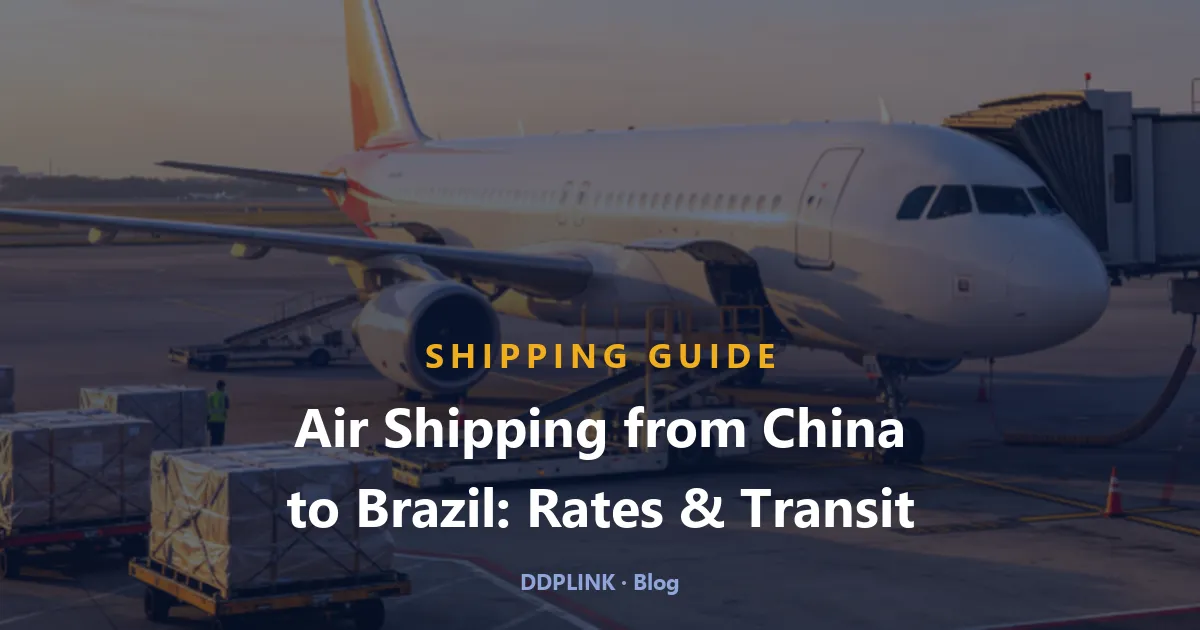

Air shipping from China to Brazil in Q4 2026: rates by weight break, routing into GRU and VCP, the DUIMP clearance clock, and air versus express at 30–150 kg.
Air shipping from China to Brazil buys days, not weeks: 5–10 days airport to airport at $5.50–$10.50 per kg on larger consignments, or 8–12 days door to door under DDP. The flying is the easy part. What decides your invoice and delivery date is an eight-digit NCM code, your buyer’s RADAR habilitação, a DUIMP declaration, and a customs channel that releases cargo in a day or holds it for fifteen.
This guide prices the lane by weight break (Q4 2026), breaks down what actually bills on a China–Brazil air waybill, walks the clearance clock at GRU, VCP and Manaus, and draws the line between air cargo, express and sea at 30–150 kg. Every figure carries its caliber. For the destination picture first, start with shipping from China to Brazil.
Quick Answer: Air Shipping from China to Brazil (Q4 2026)
Read the calibers, not just the numbers: the per-kilogram band is a planning figure, and the tax lines sit outside it.
| Question | Short answer (Q4 2026) | Caliber |
|---|---|---|
| Air freight cost | $5.50–$10.50 per kg on larger consignments | Your weight break decides where in the band you land |
| Booked totals | $1,680–$2,160 at 100 kg, easing to $9,900–$12,800 at 1,000 kg on CAN–GRU | Freight and origin charges |
| Airport transit | 5–8 days CAN–GRU; 6–10 days HKG–GIG | After airline acceptance, general cargo |
| Door to door (DDP air) | 8–12 days | Clearance, taxes and delivery included per agreement |
| Billed on | Chargeable weight, the greater of actual and volumetric weight in cm ÷ 6,000 | One cubic metre is 166.67 kg |
| Before departure | RADAR habilitação confirmed, NCM on the invoice, LI/LPCO where required | Your buyer’s status decides the lane |
| At import | II, IPI, PIS/COFINS and ICMS plus the Siscomex fee | State ICMS varies; air pays no AFRMM |
Air Freight Rates from China to Brazil by Weight Break
Our published lane bands, cut off in September 2026 for general cargo on scheduled capacity. They are planning bands, not a price list: the confirmed rate follows the space booked, the surcharges on the flight date, and the weight measured at origin.
| Route | Transit | 100 kg | 300 kg | 500 kg | 1,000 kg |
|---|---|---|---|---|---|
| Guangzhou (CAN) → São Paulo (GRU) | 5–8 days | $1,680–$2,160 | $3,520–$4,560 | $5,300–$6,850 | $9,900–$12,800 |
| Hong Kong (HKG) → Rio de Janeiro (GIG) | 6–10 days | $1,760–$2,280 | $3,680–$4,780 | $5,520–$7,150 | $10,300–$13,300 |
Read that as a curve. On the Guangzhou–São Paulo pair the same kilogram costs $16.80–$21.60 at a 100 kg booking and $9.90–$12.80 at 1,000 kg. That is not a volume discount: it is the airline’s weight-break structure (45, 100, 300, 500 and 1,000 kg) plus fixed charges that never shrink — screening, AWB documentation, terminal handling, minimum charges. The service sits on the air freight from China page.
Our Industry Insight: Half the rate questions on this lane have an arithmetic answer, not a negotiating one. A 280 kg shipment bills at the 100 kg break, so at $16.80 per kg it prices around $4,700, while the 300 kg band on the same airport pair starts at $3,520. Adding 20 kg of cargo you can actually sell is often cheaper than flying the exact weight. Check the next break before you repack the pallet.
The Five Lines That Build a China–Brazil Air Price
A quote showing only “USD X per kg” is incomplete, and on this lane the missing lines are where budgets fail.
| Line | What it covers | Who bills it | Inside our DDP air quote |
|---|---|---|---|
| Base rate | Airport-to-airport carriage at your weight break | Airline, through us | Yes |
| Fuel and security surcharge | Levied on chargeable weight; tracks fuel and security costs | Airline | Yes, priced at the flight date |
| Origin charges | Pickup, consolidation, export declaration, screening, weighing, AWB | Us, in China | Yes |
| Destination handling | Capatazia and storage at the Brazilian air cargo terminal | Terminal operator | Storage outside the free window is on the consignee |
| Clearance, taxes and delivery | Despachante, DUIMP, II/IPI/ICMS, trucking | Brazilian broker and importer of record | Yes, under DDP by agreement |
The first line is the one importers underrate: air bills the space you occupy, not the mass you ship. Volumetric weight is length × width × height in centimeters ÷ 6,000, and the airline charges the higher of that and the actual weight. Dense cargo pays on the scale; bulky cargo pays for the air it displaces.
Packing is therefore a pricing decision: cartons built close to their contents, soft goods compressed, pallets built to full height. Run the dimensions through the volumetric weight calculator first.
Routing Reality: Why China–Brazil Air Cargo Rarely Flies Direct
Scheduled China–Brazil freighter capacity is thin: most consignments connect through a hub — Doha, Dubai, Abu Dhabi, Addis Ababa, Istanbul, Lisbon, Madrid or Panama City. Two connections are normal, which is why airport transit lands at 5–8 days from Guangzhou rather than thirty-odd hours. Guangzhou (CAN) carries the rate we publish for São Paulo and suits Pearl River Delta electronics and auto parts; Hong Kong (HKG) has the deepest carrier choice and feeds Rio; Shanghai (PVG) fits eastern China suppliers. Our southern China consolidation runs out of Guangzhou.
Plan for three consequences. Transit is only as reliable as the weakest hub, so congestion abroad shows up in your delivery date. A missed acceptance window costs a day for the next connection. And because e-commerce consolidators buy the same capacity, book five to seven days ahead normally, four to six weeks before the November peak.
The arrival airport is a cost decision, not a default.
| Gateway | Terminal reality | Best for | Onward leg |
|---|---|---|---|
| São Paulo–Guarulhos (GRU) | TECA GRU, the largest air cargo complex in Latin America at 97,000 m², about 20 km from São Paulo | Greater São Paulo and the ABC industrial belt | Overnight trucking, same-state delivery |
| Campinas–Viracopos (VCP) | Cargo-focused terminal for the Campinas, Jundiaí and Sorocaba belt | Factories west and north of São Paulo city | Short trucking legs |
| Rio de Janeiro–Galeão (GIG) | Pharma, electronics and consumer goods volumes | Rio de Janeiro and Espírito Santo | Regional trucking |
| Manaus–Eduardo Gomes (MAO) | Gateway to the Manaus Free Trade Zone | Electronics, appliances and motorcycles inside SUFRAMA | Local distribution in the zone |
VCP is not automatically cheaper than GRU: compare the air rate, terminal tariff, storage exposure and inland leg together. A slightly higher airport rate that lands cargo two hours from the factory usually wins.
The Clearance Clock at GRU, VCP and Manaus
Air freight’s advantage is measured in days, so the airport end has to be faster than the flight.
| Step | Who runs it | When | Typical duration |
|---|---|---|---|
| 1. Document pre-alert, then cargo available at the terminal | Shipper, broker, terminal operator | Departure to arrival | Same day |
| 2. Agency checks: LI/LPCO, ANVISA, INMETRO, ANATEL, MAPA | Despachante aduaneiro | At or before arrival | 1–5 days if pre-filed, longer if not |
| 3. DUIMP registered in Portal Único; Siscomex assigns a clearance channel | Despachante, then Siscomex | At arrival | 1 day |
| 4. Channel handling: review, inspection or valuation | Receita Federal | After assignment | 1–15+ days by channel |
| 5. Taxes and ICMS paid, release, collection and trucking | Importer of record, broker, us | After clearance | Same day in-state; 1–3 days regional |
The Receita Federal portal publishes the declaration rules and the phased DI-to-DUIMP schedule; a broker working from the old form loses days on a correction.
What the Four Customs Channels Cost in Days
Siscomex assigns the channel from the importer’s history and risk indicators, not by hand.
| Channel | What happens | Typical air-cargo timeline |
|---|---|---|
| Green | Automatic release after tax payment | Same day to 1 day |
| Yellow | Document review, no physical inspection | 2–5 days |
| Red | Document review plus physical inspection | 5–15 days |
| Grey | Red-channel procedure plus a valuation analysis | 15 days and up |
Storage is what turns a channel into a bill: the GRU terminal tariff counts every calendar day as chargeable, weekends and holidays included, so an inspection that runs over a weekend pays for the weekend.
Real-Life Scenario: A parts importer in Sorocaba booked 140 kg of machine components measuring 1.05 CBM — 175 kg on volume at the ÷ 6,000 divisor, billed at the 100 kg break on the Guangzhou–São Paulo pair. The NCM was confirmed against the invoice before pickup, the despachante registered the DUIMP while the aircraft was in the air, and Siscomex assigned the green channel, so cargo was released the day after arrival — eight days door to door, inside the 8–12 day DDP air window. On the red channel, the same shipment would have added five to fifteen days, with storage billed for every one of them.
Before the Wheels Go Up: Licensing, Labels and SUFRAMA
Brazil’s compliance work happens before departure, or it happens as storage.
| Requirement | Applies to | Has to be in place | Realistic lead time |
|---|---|---|---|
| RADAR habilitação (Siscomex) | Every importer of record, with a CNPJ | Before the first DUIMP is filed | Days to weeks; six-month ceilings set by Receita Federal |
| LI / LPCO (import license) | Products under non-automatic licensing, including much machinery | Approved before the cargo arrives | Days to weeks; must be valid at DUIMP registration |
| ANVISA | Health products, cosmetics, medical devices, food | Before importation | Months for first registrations |
| INMETRO | Regulated industrial and consumer goods, toys, electricals | Certification before release | Weeks to months including testing |
| ANATEL | Telecom and wireless devices | Homologation; number filed in the DUIMP | Weeks |
| MAPA | Agricultural products and food of plant or animal origin | Before shipment | Weeks |
| SUFRAMA | Goods entering the Manaus Free Trade Zone | With the shipment; incentives for electronics | Days if the file is complete |
| Portuguese labeling | Consumer goods offered for sale | At the supplier, before shipment | Before departure |
ANVISA covers health products, INMETRO conformity certification, and SUFRAMA the Manaus regime. None of it can be arranged at the airport while cargo waits; these are origin-side processes with month-scale timelines.
One structural point drives the rest: only an entity with a CNPJ, RADAR habilitação and Siscomex access can be the importer of record and file the DUIMP, so a forwarder without a Brazilian registration cannot declare on your behalf. Where an overseas buyer has no Brazilian entity, the route is a licensed importer of record — which is how our DDP service to Brazil is structured.
Our Industry Insight: The document that stops Brazil air cargo is rarely the invoice — it is the mismatch between documents. The AWB consignee must be the Brazilian entity holding the habilitação, the invoice NCM must match the code the despachante files, and the declared freight feeds the DUIMP customs-value calculation. We reconcile those three before pickup, and check the buyer’s habilitação ceiling at the same time: a capped band can exhaust mid-quarter, and no flight schedule fixes that.
Air, Express or Sea: Drawing the Line at 30–150 kg
The three modes are priced on different bases, so compare them on the same shipment.
| Mode | Best for | Transit | Q4 2026 cost | Priced by |
|---|---|---|---|---|
| Air freight (airport to airport) | Urgent stock, high-value electronics, spare parts | 5–8 days CAN–GRU; 6–10 days HKG–GIG | $5.50–$10.50 per kg (larger consignments) | Chargeable weight, by weight break |
| Express courier | Samples, first units, parcels | 5–10 days | Discounted courier rates | Chargeable weight, parcel bands |
| DDP air (door to door) | Buyers who cannot run DUIMP themselves | 8–12 days | All-in per kg by route and product | Per shipment, taxes per agreement |
| Sea LCL | Planned replenishment from about 1 CBM | 30–50 days | $430–$620 per CBM | CBM plus destination charges |
| Sea FCL | Bulk, machinery, furniture | 30–50 days (Santos 32–42, Itajaí 36–50) | 20ft from about $2,350; 40ft $4,480–$5,860 | Per container |
| DDP sea | Taxes, clearance and delivery handled | 40–55 days | All-in per CBM by route | Per shipment |
Run the crossover first. Sea LCL at $430–$620 per CBM works out to roughly $2.58–$3.72 per kilogram when cargo fills a cubic metre at 166.67 kg, against $5.50–$10.50 by air. Sea wins everything dense, bulky or patient; the honest case for air is cargo under roughly 300 kg, stock whose selling window closes before a vessel arrives, and parts where a stoppage costs more than the premium. See sea freight from China.
The 30–150 kg band is where importers most often pick wrong, because it straddles two legal routes. Brazil’s simplified parcel regime, Remessa Conforme, applies to purchases by individuals on certified platforms: up to $50 there is no federal import tax, and from $50.01 to $3,000 the rate is 60% with a fixed $30 deduction per shipment. Both bands still carry state ICMS, usually 17–20%. None of it is available to a company importing under its own CNPJ — goods that will be resold or invoiced belong on the formal air cargo route with a DUIMP. Express suits samples and first units sent to an individual; for company stock, formal air cargo with DDP handling on the Brazil side usually costs less in total than a clearance file you cannot sign. Parcels sit with express courier from China, commercial cargo with DDP shipping from China.
Landed Cost and the Booking Calendar: What Air Freight Does Not Include
Freight is a fraction of what a Brazilian importer pays. A worked example from our Brazil data:
| Cost component | Amount |
|---|---|
| Product value (FOB Shenzhen) | $12,000 |
| Freight and pickup (1 × 20ft, DDP sea) | $2,850 |
| Import duty II (about 20% average) | $2,970 |
| IPI and ICMS (varies by state and product) | $3,450 |
| Brokerage, DUIMP and delivery to São Paulo | Included |
| Total landed cost (DDP) | $21,270 |
Two mechanics matter for air. Import taxes are calculated on the customs value — merchandise plus international freight and insurance — so a higher freight line lifts II, IPI, ICMS and PIS/COFINS with it, not just the freight invoice. And the code that decides all of it is the NCM, the eight-digit Mercosur code derived from the six-digit HS system; a wrong digit changes the duty rate, the licensing requirement and the agency involved. Check it with the China HS code lookup and let the Brazilian broker confirm it.
This is the calendar we plan around:
| Period | What it does to the air lane | What we do about it |
|---|---|---|
| Jan–Feb (Lunar New Year and Carnaval) | Chinese factories close and Carnaval slows Brazilian airports, banks and trucking | Build in a 2–3 week buffer; book before mid-January |
| Apr–Jun | Post-New-Year rates soften; the calmest booking window of the year | Fix space early and file licensing that needs lead time |
| Oct–Dec (Golden Week, then Black Friday Brazil) | Golden Week closes Chinese handling capacity in early October, and November e-commerce stock must clear customs by early November | Book four to six weeks ahead; air space sells out first |
FAQ: Air Shipping from China to Brazil
How much does air shipping from China to Brazil cost per kg?
$5.50–$10.50 per kg on larger consignments on our published bands. A 100 kg booking prices around $16.80–$21.60 per kg on the Guangzhou–São Paulo pair. Add clearance, II, IPI and ICMS — or book DDP, where those sit inside the per-kilogram price.
How long does air shipping from China to Brazil take?
Five to eight days airport to airport from Guangzhou to São Paulo, six to ten days from Hong Kong to Rio. Door to door under DDP, plan eight to twelve days: the flight is one or two days, and handling, clearance and inland delivery take the rest.
Do I need RADAR to import by air into Brazil?
Yes. Importing is reserved for companies with an active RADAR habilitação in Siscomex, and the modality caps how much a company can import per six-month period. Air cargo is not exempt: if your buyer’s registration is inactive or capped, the cargo stops at the terminal whatever the flight schedule says.
What is DUIMP, and does air cargo use it?
DUIMP is the single import declaration replacing the older DI, filed through Portal Único Siscomex by the importer or its despachante aduaneiro. Air operations are in scope, and the declared freight feeds the customs-value calculation. Registering a DI where DUIMP is already mandatory can lead to that declaration being cancelled.
Is DDP allowed for imports into Brazil?
Only a Brazilian entity with a CNPJ and RADAR can be the importer of record, pay the taxes and file the declaration, so a foreign forwarder cannot execute DDP alone here. Our DDP service to Brazil runs through a licensed importer of record on the Brazilian side, taxes included by agreement and delivery to the final address. Ask how it is set up for your buyer before you book.
Can I ship lithium batteries by air to Brazil?
Yes, on carriers that accept battery cargo, with a UN38.3 test report, an MSDS and the correct packing instruction declared at quoting stage. Some airlines treat battery cargo as a separate service, and approval is part of the booking rather than an afterthought.
Which airport should my cargo land at — GRU, VCP, GIG or MAO?
GRU for Greater São Paulo and the widest carrier choice; VCP when the consignee or factory sits in the Campinas–Sorocaba belt; GIG for Rio de Janeiro and the southeast coast; MAO for cargo entering the Manaus Free Trade Zone. We price the gateway against the delivery address, not the airport rate alone.
Conclusion: Confirm Four Numbers Before You Book Air Space
Air freight to Brazil rewards preparation more than negotiation. Four numbers decide the outcome: the weight break your quote comes from, the volumetric weight of the cargo as it will be tendered, the days to a valid RADAR habilitação or LI on your buyer’s side, and the booking lead time for the week you need. Fix those four and the lane behaves.
Send the cargo dimensions, the product and the delivery city and we will price the route properly. Get a free quote, or start with the freight cost calculator.
More articles
Air Shipping from China to Kuwait: 2026 Rates, Transit & Clearance
Air shipping from China to Kuwait in Q4 2026: rates by weight break into KWI, transit via Dubai and Doha, KUCAS clearance, and 5% duty with no VAT.
Read Article →
Air Shipping from China to Nigeria: 2026 Rates & Transit
Air shipping from China to Nigeria in Q4 2026: rate bands into Lagos, Abuja and Kano, chargeable weight, the Form M and SONCAP clock, and what happens at MMIA.
Read Article →
Air Shipping from China to South Africa: 2026 Rates, Transit Times & Clearance
Air shipping from China to South Africa in 2026: rates by weight break, transit to Johannesburg, Cape Town and Durban, and the SARS duty and 15% VAT stack.
Read Article →