


 USA
USA Canada
 Mexico
 Brazil
 UAE
UAE Saudi Arabia
 Iraq
Iraq Nigeria
 Ghana
Ghana Côte d’Ivoire
 Kenya
Kenya Uganda
 Tanzania
 DR Congo
 Angola
 South Africa
 UK
UK Germany
 France
 Netherlands
 Spain
Spain Australia
Air Shipping from China to Nigeria: 2026 Rates & Transit
September 23, 2026
← All Articles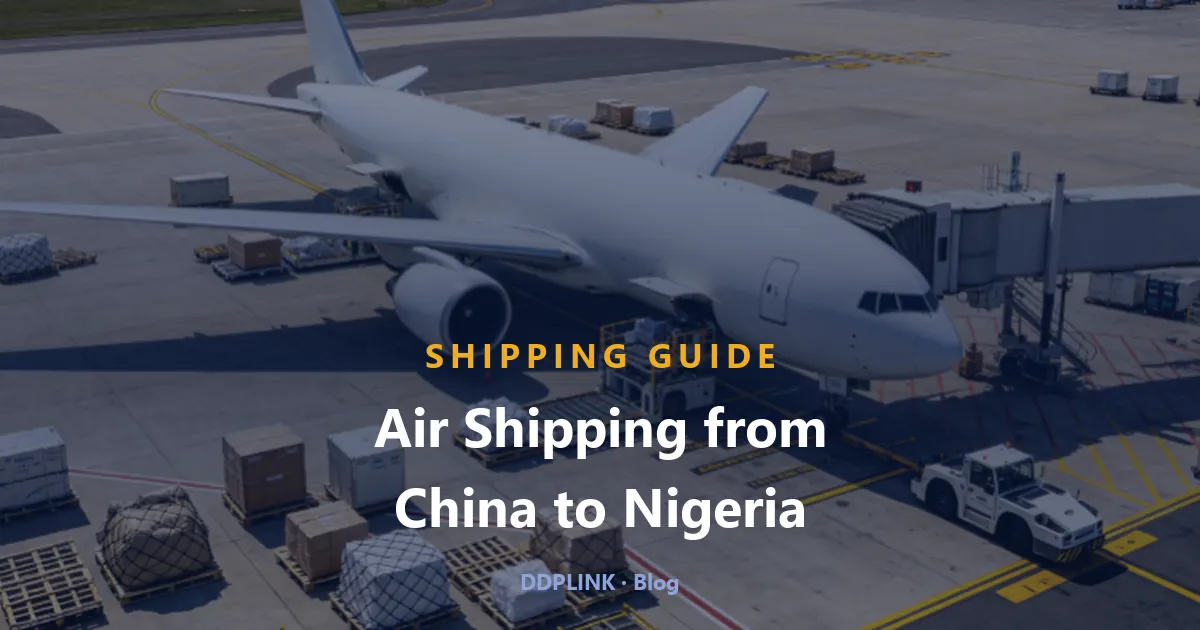

Air shipping from China to Nigeria in Q4 2026: rate bands into Lagos, Abuja and Kano, chargeable weight, the Form M and SONCAP clock, and what happens at MMIA.
Air shipping from China to Nigeria is not slow — it is capacity-tight. A Guangzhou–Lagos flight takes hours, but the lane is served mostly through Middle East and East African hubs, space is sold in weight breaks, and the airport end in Lagos decides when your cargo reaches you. Air cargo runs 4–8 days to Lagos or Abuja and 7–12 days door to door under DDP, and on the Guangzhou–Lagos pair our published bands move from about $17.20 per kg at a 100 kg booking to about $10.10 per kg at 1,000 kg.
This guide covers what decides the invoice: the bands we book, the arithmetic behind billed weight, what Form M, PAAR and SONCAP must have done before the aircraft moves, and the storage clock that starts at Murtala Muhammed Airport. Every price carries its date and caliber. For sea, duty and inland delivery, see shipping from China to Nigeria.
Quick Answer: Air Shipping from China to Nigeria (Q4 2026)
| Question | Short answer (September 2026) |
|---|---|
| Air freight cost | $5.80–$9.50 per kg on larger consignments; a 100 kg booking prices far higher |
| Transit | 4–7 days CAN/SZX → LOS; 5–8 days PVG → ABV; 5–9 days CAN → KAN |
| Door to door (DDP air) | 7–12 days, clearance and delivery included |
| Gateways | Lagos (LOS), Abuja (ABV), Kano (KAN); most cargo transits DOH, DXB, ADD or NBO |
| Billed on | Chargeable weight — higher of actual and volumetric (L × W × H cm ÷ 6,000) |
| Before departure | Form M opened, SONCAP certificate for regulated goods, insurance cover |
| At import | Duty by HS code (commonly 5–35%), 1% CISS, 0.5% ETLS, 7% levy on duty, 7.5% VAT |
| Alternative | Sea freight: 35–50 days to Apapa, Tin Can or Onne, 20ft from about $2,450 |
Read the calibers first. These are freight-only bands for general cargo: Nigerian duty, VAT and levies, clearance and delivery sit outside them. The weight-break table below is airport-to-airport. Air freight from China is the mode; what changes on this lane is the destination side of the invoice.
Air Freight Rates from China to Nigeria by Weight Break
Our published lane bands, cut off in September 2026 for general cargo on scheduled capacity. They are planning bands, not a price list: the confirmed rate follows the space booked, the surcharges in force on the flight date, and the chargeable weight measured at origin.
| Route | Transit | 100 kg | 300 kg | 500 kg | 1,000 kg |
|---|---|---|---|---|---|
| Guangzhou (CAN) → Lagos (LOS) | 4–7 days | $1,760–$2,280 | $3,680–$4,780 | $5,520–$7,150 | $10,300–$13,300 |
| Shenzhen (SZX) → Lagos (LOS) | 4–7 days | $1,720–$2,240 | $3,600–$4,700 | $5,400–$7,000 | $10,100–$13,000 |
| Shanghai (PVG) → Abuja (ABV) | 5–8 days | $1,880–$2,420 | $3,920–$5,080 | $5,880–$7,600 | $10,900–$14,100 |
| Guangzhou (CAN) → Kano (KAN) | 5–9 days | $1,820–$2,360 | $3,800–$4,940 | $5,700–$7,380 | $10,600–$13,700 |
Read that as a curve, not four prices. The kilogram that books at $17.20 on Shenzhen–Lagos at 100 kg is billed at $10.10 at 1,000 kg — not a loyalty discount but the airline’s weight-break structure (45, 100, 300, 500 and 1,000 kg) applied to your consignment. A 260 kg shipment bills at the 100 kg band unless consolidation carries it over the 300 kg line, and splitting a load across two flights to save time costs more on both halves.
Lagos and Abuja carry the capacity, and it is thinner than the Europe or US lanes: book five to seven days ahead in a normal week.
How to Read a Per-Kilo Quote to Nigeria
Several pages rank for this lane and publish incompatible per-kilogram figures. All of the following were live in 2026:
| Source (date) | Published figure | What it covers |
|---|---|---|
| Our Nigeria lane page (Sep 2026) | $1,720–$2,240 per 100 kg, SZX–LOS | Airport-to-airport, freight only |
| Sino-Shipment (Sep 2026) | $6.40–$7.40 per kg | Airport-to-airport, Lagos/Abuja, 1,000 kg+ |
| Langxu Freight (Apr 2026) | $15.00 per kg under 100 kg; $5.50 at 1,000 kg+ | Airport-to-airport bands |
| Foon Chaser (2026) | $12.90–$14.88 per kg at 20 kg+, plus ₦1,500 per kg clearance | DDP within Lagos; clearance billed in naira |
| Presou (Apr 2026) | $7.40–$11.20 per kg, 100–1,000 kg+ | All-in DDP incl. Form M and SONCAP handling |
| FreightQuoteChina (Aug 2026) | from $27.90 per kg | Air channel listed as cleared |
Four variables explain most of that spread: the weight break the figure comes from (a 20 kg rate and a 1,000 kg rate differ two or three times on this lane); what is included (freight, freight plus clearance, or the full DDP chain with duty); which weight is billed (actual, volumetric, or the higher); and what is added at destination — Nigerian quotes often carry a naira-per-kilogram clearance line and MMIA handling on top of the USD rate, so a cheap-looking price can be the freight line alone.
Our Industry Insight: When an importer sends us two quotes for the same cargo, we check the weight break and the inclusion list before we look at the rate. On this lane that question is usually worth more than the gap between the two headline numbers.
What Actually Bills: Chargeable Weight at ÷ 6,000
Airlines bill the greater of actual weight and volumetric weight, and volumetric weight is the space the cargo takes: length × width × height in centimeters ÷ 6,000. One cubic metre is 166.67 kg on that divisor — the “1:167” ratio quoted across the industry, and the same thing written twice. Dense cargo pays on the scale; light, bulky cargo pays for the air it occupies. Our volumetric weight calculator runs the check before booking.
| Cargo | Cartons | Actual weight | Volumetric weight | Billed |
|---|---|---|---|---|
| Phone accessories (dense) | 8 × 50 × 40 × 35 cm | 96 kg | 94 kg | 96 kg |
| Ladies’ bags (bulky) | 6 × 60 × 45 × 45 cm | 36 kg | 122 kg | 122 kg |
| Machine parts on a pallet | 1 × 120 × 100 × 110 cm | 480 kg | 220 kg | 480 kg |
The middle row is where Nigerian importers lose money, because the cargo this lane carries — textiles and bags from Guangzhou, household goods from Yiwu — bills on volume. Packing is a pricing decision. Rebuild those six cartons at 32 cm instead of 45 cm and the volumetric figure falls from 122 kg to 87 kg: about 35 kg of billed weight, roughly $500 at the band we book. Three levers do most of it: compress soft goods in vacuum bags, keep carton sizes close to their contents, and build pallets to full height — a half-built pallet is billed on the same footprint as a full one.
Transit: From Factory Gate to LOS, ABV or KAN
Our door-to-door budget on DDP air, with the sea lane alongside:
| Leg | DDP air | Sea (DDP) |
|---|---|---|
| Pickup and consolidation in China | 1–2 days | 3–7 days to cut-off |
| Export handling, screening, flight | 1–2 days | 30–40 days at sea |
| Hub connection (DOH, DXB, ADD, NBO) | 1–2 days | — |
| Nigerian clearance, valuation, duty | 3–7 days after arrival | 5–10 days after arrival |
| Inland delivery | Lagos same day–1 day; Kano, Kaduna, Onitsha 3–5 days | Same |
| Total | 7–12 days | 45–60 days |
Consolidation happens where the cargo is bought: Guangzhou for electronics, fashion and auto parts, Yiwu for small commodities, with the rest of the network on our China departures overview.
Where the Days Go
- A missed cargo cut-off pushes the shipment to the next flight — usually 24 hours, longer on the Shanghai pair, where frequency is lower.
- Security screening and dangerous goods review are the origin-side holds we see most; an incomplete battery declaration stops cargo at the airport, not in the air.
- SONCAP certificate timing decides whether the aircraft’s speed is spent or wasted — landing without a valid certificate means the cargo waits at the terminal, and valuation queries at NCS add days even when the duty rate and HS code are right.
- Holidays compound: Golden Week closes Chinese handling capacity for a week in early October, and the Lunar New Year fortnight is the tightest booking window of the year.
Nigeria’s own trading calendar runs October to December, when market stock is bought for year-end demand: book four to six weeks ahead. April to June is the calmest period, and the August–September rains add three to five days to upcountry deliveries.
Air, Sea or Express: Choosing by Cargo, Not by Rate
Our Nigeria lane data, September 2026:
| Mode | Best for | Transit | Cost | Priced by |
|---|---|---|---|---|
| Air freight | Urgent restocks, electronics, spare parts | 4–8 days to LOS/ABV | $5.80–$9.50 per kg (larger consignments) | Chargeable kg, by weight break |
| Express courier | Samples, first units, parcels | 5–10 days | Discounted courier rates | Chargeable kg, banded |
| Sea LCL | Planned replenishment from 1 CBM | 35–50 days | $260–$380 per CBM | CBM plus destination charges |
| Sea FCL | Bulk, machinery, building materials | 35–50 days | 20ft from about $2,450 | Per container |
| DDP (air or sea) | Form M, PAAR, duty and delivery handled | 7–12 days air; 45–60 days sea | All-in per kg or per CBM | Per shipment |
Run the crossover first. Sea LCL at $260–$380 per CBM is roughly $1.56–$2.28 per kilogram if the cargo fills a cubic metre at 166.67 kg; air is $5.80–$9.50 per kilogram. On pure cost, sea wins almost everything dense or bulky, and the honest cases for air are narrow: cargo under roughly 300 kg, stock whose selling window closes before the vessel arrives, and parts where a stoppage costs more than the premium. See sea freight from China and express courier from China.
Most first-time Nigerian importers end up on DDP shipping from China for a reason other than price: Form M, PAAR and the bank coordination behind them cannot easily be run from abroad. Under DDP they are handled end to end, with duty paid per agreement and delivery to the final address — the landed number rather than the freight number.
Form M, PAAR and SONCAP: The Compliance Clock
Air freight’s advantage is measured in days, so documents have to be faster than the flight. On this lane they rarely are unless they are started before booking.
| Step | Who runs it | Has to happen | Typical lead time |
|---|---|---|---|
| Form M | Importer’s Nigerian bank, on the trade single window | Before the goods leave China | 2–5 business days |
| SONCAP Product Certificate (PC) | Accredited conformity body, at origin | Before shipment; product-level, usually valid a year | 1–4 weeks incl. testing |
| SONCAP Certificate (SC) | Same body, per shipment | Before or at shipment; NCS will not release without it | 2–5 days once a PC exists |
| PAAR | Nigeria Customs Service, against the Form M and incoming AWB | Before the aircraft lands | 1–3 days |
| NAFDAC registration | NAFDAC — food, drugs, cosmetics, medical devices | Months before the first shipment | 3–6 months |
| Marine insurance certificate | Us, with the underwriter | With the AWB; cover is required on Nigeria imports | Same day |
| Fumigation certificate | Certified provider | Before departure, where packaging includes wood | 1–2 days |
SONCAP Is an Origin-Side Test, Not a Lagos Problem
This is the misunderstanding that costs the most time on the lane. SONCAP is a conformity assessment carried out before shipment, in the country of export, by a body accredited for the programme: the Product Certificate registers the product, and a Soncap Certificate clears each consignment. It cannot be arranged at Lagos airport while your cargo sits in a terminal. The categories most often affected are electronics, electrical goods, toys, textiles and auto parts, and the current lists and route options are published by the Standards Organisation of Nigeria.
Two consequences for planning: start the PC while the order is still with the supplier, not after the flight is booked, and check whether your category needs NAFDAC registration instead of, or as well as, SONCAP — three to six months means that decision belongs at product selection. The same logic runs on neighbouring lanes, which is why importers sourcing for West Africa read our China to Ghana guide alongside this one.
Our Industry Insight: Duty rates rarely stop Nigerian air cargo. Valuation queries do. When customs questions a declared value, the clearance clock does not slow down — it stops, and the terminal bills storage for every day it is stopped. We keep defensible factory documentation on every shipment for that reason.
The Lagos Airport End: Storage Windows, Valuation, Release
When the aircraft lands at Murtala Muhammed Airport, the cargo is handed to a terminal operator under the Federal Airports Authority of Nigeria framework and a different clock starts: a short free-storage window measured in days from arrival, after which storage is billed per kilogram per day by the handler. Any hold — a valuation query, a missing SC, a document mismatch — is a storage bill as well as a delay. The airport operator publishes its own terminal information at FAAN, and the duty and levy framework at the Nigeria Customs Service.
Three things keep that clock short, and all happen before the flight: pre-audit the document set against the Form M so the HS code, value and consignee match; confirm the SONCAP SC exists before tender; and book the onward truck while the cargo is still in the air. After release, Lagos delivery is same-day or next-day, while Kano, Kaduna, Onitsha and Abuja run on bonded trucks and take three to five days — longer in the rains.
Real-Life Scenario: An Onitsha wholesaler shipped six cartons of bags and shoes from Guangzhou: 36 kg on the scale, 122 kg on volume at 60 × 45 × 45 cm. We rebuilt the cartons to 60 × 45 × 32 cm before tendering, which brought the billed weight to 87 kg — about 35 kg of freight that no longer had to be paid for. The Soncap Certificate, ordered when the order was confirmed rather than when the flight was booked, was in place before departure, so the cargo was released three days after landing instead of accruing storage. Bonded trucking to Onitsha took four days. Door to door: eleven days.
What Should Not Fly to Nigeria
Nigeria restricts more categories than most destinations on our network, and both ends enforce it — Chinese export customs and NCS. This is what we screen for at booking:
| Category | Position |
|---|---|
| Used clothing and textiles, used tires | Prohibited or heavily restricted |
| Food, beverages, drugs, cosmetics, medical devices | NAFDAC registration before importation; 3–6 months |
| Electronics, toys, auto parts, textiles | SONCAP certificate required; check the current regulated list |
| Lithium batteries and battery-powered goods | Approved airlines only, with UN38.3 test report, MSDS and the correct packing instruction (PI 965–967) |
| Standalone power banks and loose cells | Cargo only, never in mail, and some airlines decline them |
| Liquids, aerosols, perfumes, powders, magnets | MSDS or magnetic field test before the airline accepts |
| Branded goods | Written authorization from the brand owner; counterfeits are confiscated |
| High-value electronics | Fly well — insure them; cover is required on Nigeria imports |
Battery cargo moves slower than general cargo here: airline approval is part of the booking, and several carriers treat battery consignments as a separate service. For a regulated lane outside West Africa, our guide to air shipping from China to South Africa walks the same paperwork chain end to end.
FAQ: Air Shipping from China to Nigeria
How much does air shipping from China to Nigeria cost per kg?
On larger consignments, $5.80–$9.50 per kg on our published bands. A 100 kg booking prices around $17–$22 per kg to Lagos or Abuja, because the 100 kg weight break applies. Add clearance, duty and VAT — or book DDP, where those sit inside the per-kilogram price.
How long does air shipping from China to Nigeria take?
Four to seven days airport-to-airport from Guangzhou or Shenzhen to Lagos, five to eight days from Shanghai to Abuja, five to nine days to Kano. Door to door under DDP, plan seven to twelve days: the flight is one day, the rest is handling, clearance and delivery.
Do I need Form M for an air shipment?
For commercial imports cleared through NCS, yes, and it must be opened through a Nigerian bank before the goods leave China. Air is not exempt. Under DDP we coordinate it with your bank or through our licensed partners.
What is SONCAP, and do I need it for air cargo?
SONCAP is Nigeria’s pre-shipment conformity assessment for regulated products: the Product Certificate registers the product and a Soncap Certificate is issued per consignment. Air cargo goes through the same process as sea cargo, and without the certificate NCS will not release the goods.
Can I ship lithium batteries by air to Lagos?
Yes, on airlines that accept battery cargo, with a UN38.3 test report, an MSDS and the correct packing instruction. Declare it at the quote stage: airline approval is part of the booking.
Which airport should my cargo fly into — Lagos, Abuja or Kano?
Lagos (LOS) has the capacity and the widest carrier choice, so it is the default for south-western addresses. Abuja (ABV) removes an inland leg for central and northern buyers, and Kano (KAN) suits northern markets when space allows. We price the gateway against the delivery address.
How is chargeable weight calculated for Nigeria-bound air cargo?
Length × width × height in centimeters ÷ 6,000 gives volumetric weight, and the airline bills the higher of that and the actual weight. Soft goods, bags and household plastics usually bill on volume, so packing dimensions change the invoice.
Conclusion: Three Numbers to Confirm Before You Book
Air shipping to Nigeria rewards planning more than negotiation. Confirm three numbers before you commit: the weight break your quote is drawn from, the volumetric weight of the cargo as it will actually be tendered, and the days between Form M being opened and your SONCAP certificate being valid. Those three decide the invoice and the delivery date.
Send the cargo dimensions, the product and the delivery city, and we will price the lane properly. Get a Free Quote, or run an estimate first with the freight cost calculator.
More articles
Air Shipping from China to Kuwait: 2026 Rates, Transit & Clearance
Air shipping from China to Kuwait in Q4 2026: rates by weight break into KWI, transit via Dubai and Doha, KUCAS clearance, and 5% duty with no VAT.
Read Article →
Air Shipping from China to South Africa: 2026 Rates, Transit Times & Clearance
Air shipping from China to South Africa in 2026: rates by weight break, transit to Johannesburg, Cape Town and Durban, and the SARS duty and 15% VAT stack.
Read Article →
Buying on Alibaba vs 1688: What Changes for Shipping (2026)
Alibaba vs 1688, compared on the shipping side: what changes in export documents, consolidation, rates and landed cost when you buy from either platform.
Read Article →