


 USA
 Canada
 Mexico
 Brazil
 UAE
 Saudi Arabia
 Iraq
 Nigeria
 Ghana
 Côte d’Ivoire
 Kenya
 Uganda
 Tanzania
 DR Congo
 Angola
 South Africa
 UK
 Germany
 France
 Netherlands
 Spain
 Australia
How Long Does Shipping Take from China to the UK? (2026 Transit Times)
October 16, 2026
← All Articles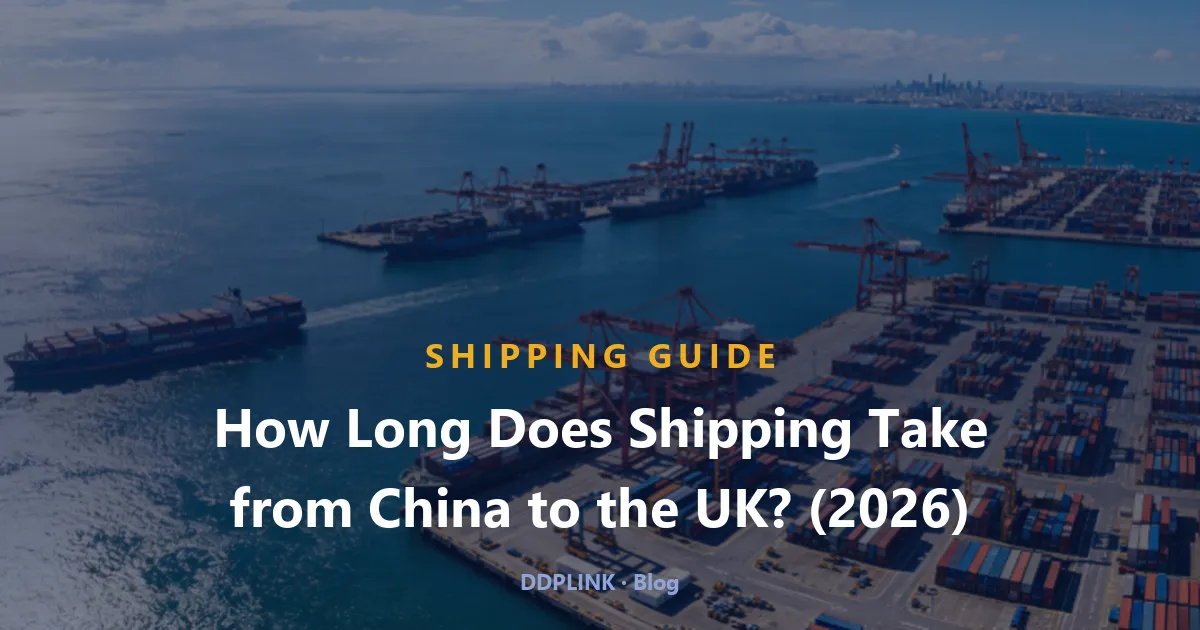

Shipping time from China to the UK in Q4 2026: sea, air, rail and express bands for Felixstowe, a door-to-door day budget and the buffers that matter.
Shipping time from China to the UK is two numbers, not one: the sailing band printed on a carrier schedule, and the date a container is actually collectable at Felixstowe or your warehouse in the Midlands. On the same Q4 2026 booking those two sit six to twelve days apart, and the ocean leg is rarely the reason.
Three stages create that gap. A published figure usually starts when the vessel sails, not when your supplier finishes production. Port-to-port and door-to-door bands get quoted as if they measured the same thing. And after arrival the UK release runs on its own clock. This guide uses the Q4 2026 data behind our shipping from China to the UK guide and budgets each mode day by day.
Quick Answer: Transit Times from China to the UK at a Glance
These are door-to-door planning bands for general cargo, dated October 2026.
| Method | Door-to-door transit (Q4 2026) | What the clock includes | Best for |
|---|---|---|---|
| Express courier | 3–7 days | Pickup, flight, UK clearance, VAT, delivery, one tracking number | Samples, parcels and spare parts up to about 45 kg |
| Air freight (DDP) | 6–9 days | Pickup, air freight, CDS clearance, 20% VAT, nationwide delivery | Seasonal stock, electronics, Amazon UK replenishment |
| Air freight (airport-to-airport) | 3–7 days | Flight and terminal handling only — no clearance or delivery | Buyers clearing UK customs on their own GB EORI |
| Rail freight | 18–26 days | Rail to a European hub, then road, ferry or Channel Tunnel into the UK | Mid-volume cargo that cannot wait for a vessel |
| Sea freight (FCL, DDP) | 32–42 days | Supplier pickup, vessel, CDS clearance, 20% VAT, delivery | Containers, furniture, machinery, bulk cargo |
| Sea freight (LCL, DDP) | 34–45 days | The same sailing band plus consolidation and UK deconsolidation | Part loads from about 1 CBM |
Two caveats. Sea and air bands are pure freight timing: duty, 20% import VAT and delivery are separate lines unless you book DDP. Every band is also a planning range, not a commitment.
Sea Freight Transit Time from China to the UK
Sea freight is the baseline for most China–UK cargo, and the port-to-port bands are tight: Felixstowe and Southampton are early calls on the Asia–North Europe strings.
| Route (port to port) | Transit | 20ft | 40ft | LCL |
|---|---|---|---|---|
| Shanghai → Felixstowe | 25–32 days | $1,250–$1,950 | $2,380–$3,280 | $150–$210/CBM |
| Ningbo → Southampton | 26–35 days | $1,320–$2,050 | $2,480–$3,420 | $160–$220/CBM |
| Shenzhen → Felixstowe | 27–38 days | $1,380–$2,180 | $2,580–$3,580 | $170–$250/CBM |
Those rates are freight only, October 2026, and exclude UK duty, import VAT and destination charges. Equipment and cut-offs are on our sea freight from China service page.
Origin matters more than sailing tables admit. Third-party lane guidance splits this lane into three regional bands: Southern China gateways such as Yantian at roughly 35–41 days port to port under current Cape routing, Central and East China ports such as Shanghai and Ningbo at 43–49 days, and Northern China ports such as Qingdao at 45–51 days.
Why LCL Adds Two to Four Days
LCL cargo waits for a container to fill before it sails and is unpicked after arrival, so it carries two extra handling windows: consolidation in China and deconsolidation at the UK depot. That is why we publish LCL door-to-door at 34–45 days, two to four days behind FCL. The LCL–FCL break-even sits around 13–15 CBM.
Choosing the UK Gateway: Felixstowe, Southampton, London Gateway or Liverpool
The discharge port is a delivery decision, not just a sailing decision.
| Port | Transit from China | Why it matters | Best for |
|---|---|---|---|
| Felixstowe | 25–32 days | The UK’s largest container port and the main China gateway | General cargo, eCommerce and FBA stock |
| Southampton | 26–35 days | Deep-water berths, fewer peak-week queues | Large containers, retail and bulk cargo |
| London Gateway | 26–35 days | Thames-side, closest to London distribution centres | London and South East distribution |
| Liverpool | 27–38 days | Cuts the inland leg for the north and Scotland | Northern England and Scotland deliveries |
For a consignee in Glasgow or Manchester, a Liverpool or Felixstowe discharge plus a short northbound haul usually beats a Southampton discharge plus a long one. Shipments leaving from Zhejiang and Jiangsu fit the Felixstowe strings, and our Shanghai departure guide covers the cut-off pattern behind them.
Air Freight and Express Transit Time from China to the UK
Air freight is the practical answer when a delay costs more than the freight. Heathrow is the main gateway, with Manchester taking a growing share of northern cargo.
| Route | Airport-to-airport | Weight-break rates (100 / 300 / 500 / 1,000 kg) |
|---|---|---|
| Shenzhen (SZX) → London (LHR) | 3–6 days | $1,120–$1,460 / $2,360–$3,120 / $3,550–$4,680 / $6,600–$8,800 |
| Shanghai (PVG) → London (LHR) | 4–7 days | $1,180–$1,540 / $2,480–$3,280 / $3,720–$4,900 / $6,900–$9,200 |
| Guangzhou (CAN) → Manchester (MAN) | 4–7 days | $1,140–$1,500 / $2,400–$3,200 / $3,600–$4,780 / $6,700–$8,950 |
The airport-to-airport column is flight and terminal handling only. Door-to-door under DDP adds pickup, export clearance, UK clearance, import VAT and delivery, which is where the 6–9 day band comes from. Airlines bill the higher of gross and volumetric weight, so cargo that looks like 300 kg but bills at 700 kg lands on a different weight break and a different date.
Express Courier: the Fastest Door into the UK
Express courier runs 3–7 days door to door and is economical up to about 45 kg per consignment. Above that, air freight is usually cheaper, because the per-kilo rate falls as the weight break improves. The two overlap between roughly 20 kg and 100 kg.
Rail and Road: The Overland Options Into the UK
Two lighter modes cover the gap between a parcel and a container, and both pay a UK-specific penalty that continental price lists hide.
China–Europe rail reaches European hubs such as Duisburg or Małaszewicze in about 16–20 days railhead to railhead. The UK leg changes the maths: the container still has to cross the Channel by unaccompanied trailer, ferry or short sea service, typically adding three to six days. Rail quoted at “15–20 days” almost always means rail to the continent, not rail to Birmingham; plan 18–26 days door to door.
Road freight follows the same logic. Cross-border trucking reaches Europe in 12–25 days, but a UK delivery needs the second, shorter movement across the Channel, giving 18–28 days door to door. Where road wins is flexibility: a truck can be loaded when your cargo is ready, which matters when you have missed this week’s cut-off.
The Door-to-Door Ledger: Where 32–42 Days Actually Go
This is the section published transit tables skip. A port-to-port band ends at the quay; the number your planning calendar needs ends at your warehouse door.
| Stage | Typical days | What decides it |
|---|---|---|
| Production ready to supplier pickup | 0–2 | Supplier readiness and pickup city |
| Export declaration, trucking, container loading | 1–2 | Distance to port, and whether you make the cut-off |
| Waiting for vessel departure | 0–4 typical, up to 7 | Weekly sailing frequency — the hidden stage |
| Ocean transit, Shanghai → Felixstowe | 25–32 | Direct service versus transhipment; Cape of Good Hope routing |
| UK customs release under CDS | 0–2 | EORI, commodity codes and invoice consistency; an inspection adds 2–4 days |
| Delivery order, slot booking and terminal release | 1–3 | Whether the delivery order is settled and a terminal slot is free |
| Inland delivery to the consignee | 1–4 | Felixstowe to the Midlands, the North or Scotland |
| Total door to door | 32–42 typical; 48+ at the tail |
The waiting stage is the one nobody quotes. A vessel loading on Tuesday cannot accept cargo after its documentation cut-off, so a shipment finished on Wednesday waits for the next weekly call — up to seven days that never appear in any transit figure. That row, plus the release and inland stages, is the difference between a 25-day sailing and a 40-day delivery.
The Stage You Actually Control: the Cut-Off
Direct China–North Europe services load on fixed weekdays, each with a documentation cut-off one to three days before departure. In Q4 2026 the sailings into Felixstowe, Southampton and London Gateway ran on roughly this cadence.
| String | Documentation cut-off | Departure (ETD) | Port-to-port transit |
|---|---|---|---|
| Shanghai → Felixstowe (alliance service A) | Thursday | Tuesday | 29–33 days |
| Shanghai → Felixstowe (alliance service B) | Saturday | Wednesday | 30 days |
| Ningbo → Southampton (direct) | Friday or Monday | Thursday or Sunday | 28 days |
| Shenzhen → Felixstowe (direct) | Wednesday | Saturday | 27–30 days |
Read that table against your production date, not the rate. A shipment that misses Monday’s cut-off by a day does not travel a day later — it travels on the following week’s call. Booking the right sailing is the only delay in the chain fully under your control.
Real-Life Scenario — the Friday finish, the Thursday cut-off: A Guangdong supplier finished a 20ft load of homeware on a Friday and confirmed it as “ready”. The documentation cut-off for that week’s direct Felixstowe call had closed on Thursday, so the container rolled to the next sailing. The ocean transit matched the quote exactly; the delivery date moved a week later. Nothing went wrong operationally — the cargo-ready date was simply never compared with the cut-off before the booking was confirmed.
Why UK Transit Times Slip: the Arrival-Side Clock
For a UK importer the working date is the first collectable day, not the vessel’s arrival. A box can be alongside at Felixstowe while it is still waiting for discharge, a customs release, a settled delivery order, a terminal slot or a suitable vehicle.
Carrier guidance for this lane puts China–UK ocean transit at roughly 35–45 days port to port, wider than the 25–38 day band our sailing data shows, and aggregators that track full door-to-door journeys publish averages in the high forties to high fifties for China–North Europe. Two structural factors sit behind that tail: carriers routing around the Cape of Good Hope instead of the Suez Canal add roughly seven to fifteen days to the sailing, and every blank sailing removes a weekly slot from a lane where space is committed weeks ahead.
Our Industry Insight: When a China–UK shipment runs late, the ocean leg is almost never what our team is chasing. It is cargo-ready dates slipping, cut-off misses, a delivery order that was never paid, or a haulier who was never told the box had landed. Ask your forwarder which stage the cargo is sitting in and when the next cut-off falls, rather than for a new ETA. An ETA is a forecast; a cut-off is a decision with a deadline.
For a neighbouring lane with the same arrival-side mechanics, our transit-time study for Germany budgets the stages the same way.
Vessel Arrived Is Not the Same as Collectable
A container is only collectable when the release chain is complete: the entry is cleared under CDS, the delivery order has been issued and settled, the terminal has released the unit, and the haulier holds a slot. Under DDP we run that chain before the vessel berths on our own GB EORI, so cargo moves from quay to truck on the release day. An unpaid delivery order is what turns a two-hour clearance into a two-week one.
UK Clearance, VAT and the Paperwork That Moves the Clock
UK customs after Brexit is digital and, on clean documents, fast: a compliant CDS entry clears in hours to 48 hours. Paperwork errors, not customs queues, cause most of the delay.
| Stage | Typical time | What can extend it |
|---|---|---|
| ENS / Safety and Security filing | Before arrival | Late or incomplete advance data can hold cargo before it loads |
| CDS import declaration | Same day if pre-filed | Wrong commodity code; invoice value that does not reconcile |
| Duty and VAT settlement | Same day | No deferment account, or VAT not postponed |
| Physical inspection | Adds 2–4 days | Unclear commodity description, or a flag on the trader |
| Release and delivery order | 1–3 days | Delivery order not settled; terminal slot unavailable |
Two mechanisms matter for cash flow as much as for timing. Postponed VAT Accounting (PVA) lets a VAT-registered importer declare the 20% import VAT on the same return that reclaims it, so nothing leaves the business at the border. It is not automatic: the election must be marked on each CDS declaration, and the figures come from the monthly postponed import VAT statement, which HMRC keeps available for six months. On an import with a $45,000 VAT value, that is $9,000 of cash that stays in the company. Our DDP shipping from China page covers how duty and VAT sit inside an all-in price.
The second mechanism is registration. A GB EORI number is mandatory for commercial imports into Great Britain, and it has to link to the correct legal entity on the entry. Two points catch importers out: goods destined for Northern Ireland follow the Windsor Framework arrangements rather than the Great Britain regime, so the EORI and movement rules differ; and Amazon UK sellers must supply an Import Entry Number (IEN) for stock sent to UK fulfilment centres, which only exists if the entry was declared under the seller’s own details. Under DDP we clear on our EORI, which is why FBA sellers often need a separate conversation about their own VAT and IEN position.
Product marking is the third. UKCA is the Great Britain mark, but since 2024 the UK has continued to recognise CE marking indefinitely for most product regulations, so for most categories either mark can be used in Great Britain.
Official references: HMRC guidance on the Customs Declaration Service for the declaration route; check when you can account for import VAT on your VAT return for PVA eligibility and statements; placing UKCA or CE marked products on the market in Great Britain for marking rules; and the UK Integrated Online Tariff for commodity codes and duty rates.
Our Industry Insight: Nine times out of ten a “customs delay” on this lane is a data problem, not a customs problem — an EORI that was never linked to the importing entity, a commodity code that does not match the invoice description, or a delivery order nobody paid for. We check all three before a DDP booking is confirmed, because fixing them after arrival costs days.
Peak Season, Compliance and the Buffers That Actually Matter
Seasonality is predictable, and it belongs in the same plan as the transit band.
| Period | Effect on transit | Buffer to build in |
|---|---|---|
| January–February (Chinese New Year) | Factories close one to three weeks; the first sailings afterwards book out | Book before late January, or plan March departures |
| March–May | Rates soften after CNY; a good window for new supplier setups | No extra buffer needed |
| August–September (Q4 build-up) | Ocean rates firm up from September; peak season surcharges tighten space | Place Q4 and Black Friday stock by late August |
| October–November (Black Friday and Christmas) | Air and express capacity sells out from mid-November | Ship holiday inventory by mid-October |
| December–January (January sales restock) | Rates soften and space opens | A good window for sea bookings |
Compliance sits in the same list, because it can slow a shipment before it even loads. Sea cargo needs advance Safety and Security data, wooden packaging must be ISPM 15 treated, and regulated categories need their conformity assessment in place before departure. The cheapest place to lose a day is at origin.
FAQ: Shipping Time from China to the UK
How long does shipping from China to the UK take by sea?
Sea freight takes 25–32 days port to port from Shanghai to Felixstowe, 26–35 from Ningbo to Southampton and 27–38 from Shenzhen. Under DDP, add five to eleven days for pickup, UK clearance, 20% VAT and inland delivery, giving 32–42 days end to end for FCL and 34–45 for LCL.
How long does air freight from China to the UK take?
Air freight takes 3–6 days airport to airport from Shenzhen to Heathrow and 4–7 days from Shanghai Pudong or Guangzhou, rising to 6–9 days door to door under DDP. The variables are your cargo-ready date, the weight break you qualify for and space from mid-November.
How long does shipping from China to Felixstowe take?
Felixstowe is the discharge port for most China–UK container cargo, so the sea band is the same: 25–32 days port to port from Shanghai, 27–38 from Shenzhen. What differs is what follows — Felixstowe is the busiest gateway in the country, so its vehicle booking slots shape the collection date more than the sailing does.
How long does UK customs clearance take for imports from China?
A clean CDS entry releases in hours to 48 hours, and pre-filed entries are often cleared before the vessel berths. Physical inspections add two to four days. The common causes of a longer hold are a mismatched commodity code and an EORI that is not linked to the importing entity.
Why is my shipment from China to the UK delayed?
The usual causes in our experience are a missed documentation cut-off at origin, an unpaid delivery order, a customs query, an inspection, and space shortages before Chinese New Year or in November. Ask which stage the cargo is in: the fix is different for each.
How much does it cost to ship from China to the UK?
Freight only, October 2026: a 20ft container to Felixstowe runs $1,250–$1,950, a 40ft $2,380–$3,280 and LCL $150–$250/CBM, while air runs $1,120–$1,540 per 100 kg to London. UK duty, 20% import VAT, destination charges and delivery sit on top unless you book DDP.
Conclusion: Planning Your UK Timeline
Choose a mode and the transit question mostly answers itself: express at 3–7 days for parcels, DDP air at 6–9 days for pallets, rail at 18–26 days for mid-volume cargo, and sea at 32–42 days door to door for containers. Then add the two stages nobody quotes — the wait after the cut-off, and the UK release-and-delivery chain.
Model both options side by side on the freight cost calculator so freight, duty and VAT stay visible instead of bundled. Send us the dimensions, weight, commodity, commodity code if you have one and the delivery postcode, and we will return an itemized quote with every transit stage dated, as soon as possible. Get a Free Quote and we will map the timeline against your deadline.
More articles

Air Shipping from China to Brazil: Rates & Transit
Air shipping from China to Brazil in Q4 2026: rates by weight break, routing into GRU and VCP, the DUIMP clearance clock, and air versus express at 30–150 kg.
Read Article →
Air Shipping from China to Kenya: Rates & Transit
Air shipping from China to Kenya in Q4 2026: rates by weight break into Nairobi, the JKIA clearance clock, and the Kenyan taxes outside the per-kilo price.
Read Article →
Air Shipping from China to Kuwait: 2026 Rates, Transit & Clearance
Air shipping from China to Kuwait in Q4 2026: rates by weight break into KWI, transit via Dubai and Doha, KUCAS clearance, and 5% duty with no VAT.
Read Article →