


 USA
 Canada
 Mexico
 Brazil
 UAE
 Saudi Arabia
 Iraq
 Nigeria
 Ghana
 Côte d’Ivoire
 Kenya
 Uganda
 Tanzania
 DR Congo
 Angola
 South Africa
 UK
 Germany
 France
 Netherlands
 Spain
 Australia
Door-to-Door Shipping from China to South Africa: Costs, Stages & Transit (Q4 2026)
October 23, 2026
← All Articles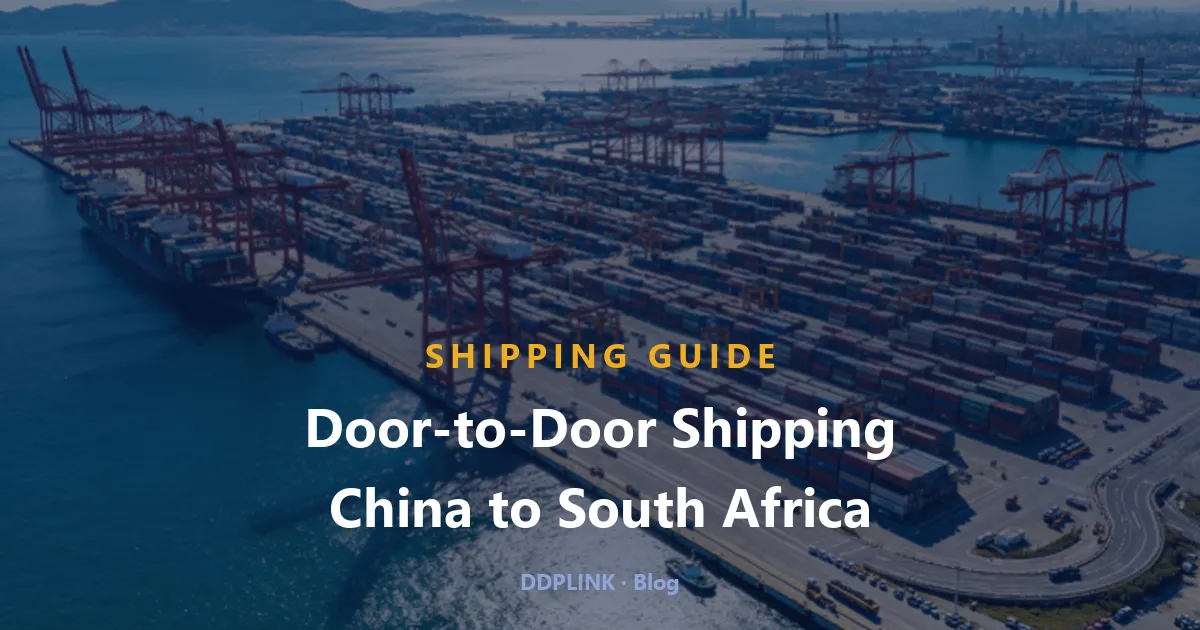

Door-to-door shipping from China to South Africa in Q4 2026: DDP air and sea costs, the SARS 10% uplift, NRCS letters of authority and Durban waits.
Door-to-door shipping from China to South Africa is one invoice covering eight stages, from a supplier’s loading bay in Guangdong to a warehouse in Gauteng. In Q4 2026 the working bands are $4.80–$8.20/kg all-in by DDP air in 6–9 days, and $1,650–$2,380 for a 20ft to Durban plus the SARS bill, 30–45 days under DDP sea. On most shipments freight is the smaller half of that number.
What separates a quote that holds from one that does not is rarely the freight rate. It is who holds the importer code, how the 10% upliftment moves the VAT base, whether the product needs an NRCS letter of authority, and how long a Durban berth is taking this quarter. Bands below come from our Shipping from China to South Africa guide.
Quick Answer: Door-to-Door Shipping from China to South Africa (Q4 2026)
Q4 2026 bands for general commercial cargo. Rows one to five are door-to-door with duty and VAT handled; the last row is not, and it is the row most rate tables publish.
| Service | Door-to-door (Q4 2026) | What the price contains | Best for |
|---|---|---|---|
| Express courier | 4–7 days | Pickup, flight, SARS clearance, duty, VAT, delivery | Samples to about 30 kg |
| DDP air | 6–9 days, $4.80–$8.20/kg all-in | Pickup, export, air freight, SARS entry, duty, VAT, delivery | 100–500 kg of launch stock |
| Air freight, airport-to-door | 4–7 days, $8.75–$19.20/kg by break | Freight, origin charges, delivery | Buyers filing their own entry |
| DDP sea, LCL | 32–45 days | Consolidation, ocean freight, SARS entry, duty, VAT, delivery | 1–12 CBM of mixed cargo |
| DDP sea, FCL | 30–45 days | The same scope, full container | Machinery, solar panels, furniture |
| Sea FCL, port-to-port | 25–35 days to Durban, from $1,650 per 20ft | Ocean freight and origin charges only | Importers with their own broker and code |
The last row stops at the terminal gate, and airport-to-door leaves the SARS assessment to you.
What Door-to-Door Covers on a South African Shipment, Stage by Stage
Eight stages, each with an owner, a document and a characteristic failure. A quote is only as complete as the stage it quietly hands back.
| Stage | Owner | Document | Where it fails |
|---|---|---|---|
| 1. Supplier pickup, consolidation | Forwarder | Warehouse receipt, packing list | Supplier misses the cargo-ready date |
| 2. China export declaration | Forwarder | Export customs release | Missing MSDS for batteries, licence for controlled goods |
| 3. Main carriage | Carrier, booked by forwarder | Bill of lading or air waybill | Rolled booking, blank sailing, berth queue |
| 4. Pre-arrival SARS preparation | Broker | Tariff determination, entry draft | Wrong heading, no letter of authority or permit |
| 5. SARS release, duty and VAT | Broker or importer of record | CUSRES release, entry summary | Examination, valuation query |
| 6. Terminal release | Terminal and haulier | Delivery order | Storage clock, no truck booking slot |
| 7. Inland leg | Trucker or rail | Proof of delivery | Corridor congestion, rail allocation |
| 8. Final delivery | Trucker or courier | Signed proof of delivery | No dock, no appointment, remote address |
Ask for the entry summary as well as the goods: it shows what duty and VAT were paid on your behalf, and whether the declared value matches the invoice you paid.
Our Industry Insight: the stage that generates most of our South African claims is stage six, not stage three. Importers watch the vessel and stop watching the terminal. A container can berth on schedule, be released on schedule, and still incur four days of storage because nobody secured a truck booking slot while the vessel was waiting.
Door-to-Door Costs from China to South Africa by Mode
Air is priced on chargeable weight, sea on the container or the CBM, and DDP on either once the HS code is known. Comparisons go wrong when those three share a column.
Air freight and DDP air weight breaks
Air bills on the greater of actual and volumetric weight, and the effective per-kg rate falls steeply as the break rises. These are booked freight-and-origin figures from Guangzhou to Johannesburg, before duty, VAT and delivery.
| Chargeable weight | Freight total | Effective per kg | Transit |
|---|---|---|---|
| 100 kg | $1,480–$1,920 | $14.80–$19.20/kg | 4–6 days |
| 300 kg | $3,120–$4,050 | $10.40–$13.50/kg | 4–6 days |
| 500 kg | $4,680–$6,080 | $9.36–$12.16/kg | 4–6 days |
| 1,000 kg | $8,750–$11,350 | $8.75–$11.35/kg | 4–6 days |
The all-in DDP band of $4.80–$8.20/kg is a different product: consolidated weekly space from roughly 300 kg upward, with the SARS assessment and delivery inside the price. Neither figure is wrong, but mixing them starts an argument over a quote that was never comparable.
Sea freight and DDP sea
Port-to-port references for buyers clearing on their own code. They exclude duty, VAT, brokerage and inland delivery.
| Route | Transit | 20ft | 40ft | LCL |
|---|---|---|---|---|
| Shanghai → Durban | 25–35 days | $1,650–$2,380 | $3,180–$4,320 | $180–$220/CBM |
| Ningbo → Cape Town | 30–40 days | $1,850–$2,650 | $3,480–$4,720 | $210–$260/CBM |
Staging cargo at our Shanghai consolidation warehouse can combine several suppliers into one booking, often the difference between three LCL minimums and one part-container. Sailing detail sits on Shipping from Shanghai, and the service scope on Sea Freight from China.
What all-in adds up to on a 20ft to Johannesburg
Assume FOB Shanghai of $18,000, a machinery tariff line at 0% duty, and delivery to a Gauteng industrial address.
| Line | Basis | Amount |
|---|---|---|
| Goods value (FOB Shanghai) | Supplier invoice | $18,000 |
| Ocean freight, 1×20ft to Durban | Q4 2026 band | $1,650–$2,380 |
| Customs duty | 0% assumed; machinery lines vary | $0 |
| Added Tax Value | $18,000 × 1.10, plus duty | $19,800 |
| Import VAT at 15% | 15% of the ATV | $2,970 |
| Handling, clearance, inland, delivery | Our Q4 2026 planning band | $850–$1,450 |
| Delivered total | $23,470–$24,800 |
Raise the duty line to 20% and the VAT rises with it, because duty enters the VAT base before the 15% is applied. The next section works that through.
Where the Door-to-Door Clock Goes: Durban in Q4 2026
The ocean leg is no longer the predictable part of this lane. The main container terminal has been working through a backlog since its new operating system went live in mid-August 2026, and the queue reaches your delivery date before it reaches your freight rate.
| Stage | What we are seeing in October 2026 | Days added |
|---|---|---|
| Vessel waiting for a berth | Seven-day average 7.33 days in the week of 14–20 October; one terminal at 6–11 days, the main container terminal at 10–16, some vessels at 25 | 6–16 |
| Truck booking and release | Bookings took one to two days to secure in September; waits of four to 22 hours with one | 1–4 |
| SARS clearance | One to three days clean; three to seven if examined | 1–7 |
| Inland to Gauteng | 570 km, one to two days by road; rail to City Deep or Kaserne | 1–2 |
Add those and a “25–35 day” Durban sailing becomes a 35–50 day Johannesburg delivery this quarter: plan on two dates, a working date and a planning date, and price the difference.
The money runs on the same clock. Terminal storage after free time has been charged at up to about $140 per container per day, with carrier demurrage and detention at $80–$100 on top. Storage was reinstated on 1 October 2026 with a five-day free window, and at least one major carrier has announced a Durban congestion surcharge of $450 per 20ft and $900 per 40ft from 1 November 2026. Free time is not a buffer you can spend twice.
Real-life scenario: a Gauteng importer’s 20ft of solar mounting hardware berthed at Durban on day 29 of a 30-day quote. Berth to gate took nine days: the vessel waited, the stack was congested, and the truck slot came through after two days of trying. Storage started on day five and ran for four, and because the detention clock starts when the box leaves the terminal, the return leg to Gauteng had to be booked before the truck left Durban. The quote was accurate and the delivery was eleven days late, which is why we now publish a planning date beside the working date.
Q4 compresses both ends: festive retail peaks from October and Chinese factories close for Spring Festival in late January. Book three weeks earlier than in a normal quarter, and treat any quote that ignores the terminal queue as a port-to-port number wearing a door-to-door label. Timings by mode are set out in How Long Does Shipping Take from China to South Africa?.
Duty, VAT and the 10% Uplift: What “Duties Included” Really Means
South Africa values imports on an FOB basis, not CIF. That is unusual, and it breaks landed-cost spreadsheets built for Europe or the United States.
Because the FOB value leaves out freight and insurance, SARS adds a statutory 10% upliftment before calculating VAT. The base is the Added Tax Value: ATV = (customs value × 1.10) + non-rebated duty, and import VAT = ATV × 15%. The uplift falls away only for goods originating in SACU member states. Chinese-origin goods always carry it.
| Step | Calculation | Amount |
|---|---|---|
| FOB customs value | Invoice, converted at the SARS rate on the entry date | $18,000 |
| 10% upliftment | $18,000 × 0.10 | $1,800 |
| Customs duty at 20% | $18,000 × 0.20 | $3,600 |
| ATV | $18,000 + $1,800 + $3,600 | $23,400 |
| Import VAT | $23,400 × 0.15 | $3,510 |
| Total payable to SARS | Duty plus VAT | $7,110 |
A quote that computes VAT as “15% of the goods value” produces $2,700 on this shipment. The real figure is $3,510, an $810 gap that widens as the duty rate rises. When a door-to-door price looks unusually low, this is usually where the difference sits.
Duty runs from 0% to 45% by tariff heading, and the heading matters more than the product description. SARS publishes the tariff book and the registration rules, and the importer path is documented on the SARS importers page.
Our Industry Insight: we show the duty line separately inside a DDP price even though the client pays one number. The client can sanity-check our classification before the cargo sails, and when SARS queries a valuation the paper trail already exists. Quotes that hide the duty line are the ones that produce a second invoice three weeks after delivery.
Importer of Record: DDP Under Our Code, or DAP Under Yours
This decision shapes everything downstream, and most door-to-door pages skip it. Door-to-door describes how far the service reaches. DDP describes who pays duty and who appears as importer on the entry.
SARS requires any importer to register, and a foreign entity must nominate a South African registered agent who assumes full liability for the principal’s customs acts. In practice a DDP shipment clears under a South African entity’s code — ours or our partner’s — and you take delivery as consignee.
| DDP (we clear as importer) | DAP (you clear as importer) | |
|---|---|---|
| SARS importer code | Ours or our partner’s | Yours |
| Duty and VAT paid by | Us, inside the quoted price | You, on assessment |
| VAT input claim | Not available to you | Available on your VAT return |
| NRCS letter of authority | Must be held by the importing entity | Held by you, in your name |
| ITAC import permit | Issued to the registered importer | Issued to you |
| Valuation risk | Ours | Yours |
| Paper trail in your name | Delivery note and invoice | Full entry and release |
For a small importer without a customs code or VAT registration, DDP is simpler and often cheaper once broker fees and a first registration are counted. For a VAT-registered business, the 15% import VAT is recoverable under DAP and not under our code, so a DDP price must sit roughly 15% below the equivalent DAP structure or the buyer funds tax they could have claimed. Most importers never run that comparison.
Our standard answer is a split: DDP for samples and buyers without a code; DAP under your own code once volume is predictable. The service scope is identical either way, as set out on DDP Shipping from China.
Before the Cargo Sails: NRCS Letters of Authority and ITAC Permits
Two regulators can stop a door-to-door shipment before it reaches a terminal, and neither works to a shipping schedule.
| Gate | Which goods | Who applies | Lead time | What it blocks |
|---|---|---|---|---|
| NRCS letter of authority | Goods under compulsory specifications: electrical and electronic equipment, automotive components, tyres, certain food-contact and health products | Importer or manufacturer, on a South African entity | Up to 120 calendar days | Market entry; under the NRCS–SARS memorandum goods in scope need an original valid LOA |
| ITAC import permit | 276 of roughly 6,650 tariff lines, plus all used and second-hand goods, waste and scrap, tyres, listed chemicals, arms | Registered importer | Three to five working days once lodged; R339 per application per tariff subheading | Clearance; SARS will not release without it |
| SARS importer registration | Every commercial import | The importer, through eFiling | Days to weeks | Lodging the entry at all |
The NRCS clock is the one that breaks promises. An application can take up to 120 calendar days and needs test reports from an accredited facility, so compliance starts before production finishes, not after the container is booked. Requirements are in the NRCS letter of authority instructions. When a first-time importer asks for a price on electrical goods with no LOA in hand, the honest answer is that transit time is not yet the constraint.
The ITAC list is narrower than most importers fear. New general merchandise is largely outside import control; used equipment, waste and scrap are inside it almost without exception, and the list is published on the ITAC import control page. If an order mixes second-hand machinery with new stock, treat the whole consignment as permit-bearing.
Choosing the Gateway: Durban, Cape Town or Gqeberha
The port on your bill of lading sets your inland cost, and on Gauteng cargo it also sets your exposure to the terminal queue.
| Gateway | Transit | Inland to Gauteng | Q4 2026 note |
|---|---|---|---|
| Durban | 25–35 days | 570 km, one to two days by road; rail to City Deep or Kaserne | Deepest congestion; the queue is the planning constraint |
| Cape Town | 30–40 days | About 1,400 km, two to four days | Absorbs some Durban diversion; berth windows compete with the fruit season |
| Gqeberha (Port Elizabeth) | 30–40 days | About 1,050 km | Niche, low volume; worth checking for auto parts |
The arithmetic that matters is delivered cost, not port rate. A Cape Town sailing quoting $200 less per 20ft than Durban adds two days of road and a second handling set to reach Johannesburg, roughly $500–$900 of trucking, so the cheaper port is the more expensive delivery. For a Western Cape consignee the logic reverses, and Durban is the wrong gateway by 1,400 km.
Last mile is where a door-to-door price meets reality. A business address with a dock is a same-day drop; a residential address or a site without a loading bay needs a smaller vehicle and often a liftgate, priced separately. Deliveries outside the metros — Bloemfontein, Nelspruit, Polokwane and the smaller mining towns — usually carry a remote-area surcharge and an extra day. Give your forwarder the access conditions at quoting stage, not after release.
FAQ: Door-to-Door Shipping from China to South Africa
What does door-to-door shipping from China to South Africa include?
Pickup at the supplier, export declaration in China, the main air or sea leg, SARS entry and release, duty and VAT settlement, terminal handling and delivery to your address. Under DDP all of that sits in one price; under DAP the SARS assessment is yours.
How much does door-to-door shipping cost from China to South Africa in Q4 2026?
DDP air runs $4.80–$8.20/kg all-in for typical general cargo. DDP sea is quoted per shipment: a 20ft to Johannesburg carrying $18,000 of zero-duty machinery lands at roughly $23,470–$24,800 including freight, VAT and delivery. The LCL ocean leg alone starts at $180–$220/CBM from Shanghai.
How long does door-to-door shipping take to Johannesburg, Durban and Cape Town?
Six to nine days by DDP air to all three. By DDP sea, 30–45 days to Johannesburg via Durban and 32–45 to Cape Town. In Q4 2026 add the Durban queue: a 7.33-day average vessel wait in the week of 14–20 October, and 10–16 days at the main container terminal.
Is door-to-door the same as DDP?
No. Door-to-door is a service scope; DDP is an Incoterm that puts duty and import clearance on the seller’s side. You can buy door-to-door delivery on DAP terms and still receive a duty invoice on arrival.
Do I need a South African importer code for door-to-door delivery?
Not under DDP, where cargo clears under the forwarder’s or a partner entity’s code. You do need one under DAP, and in your own name to claim the 15% import VAT back or to hold an NRCS letter of authority or ITAC permit.
Can you deliver to a residential address or a 3PL warehouse?
Yes to both, and to a bonded warehouse with notice. Deliveries without a loading dock need a smaller vehicle and often a liftgate, priced separately.
What is not included in a door-to-door quote?
Typical exclusions are demurrage and detention after free time, terminal storage once the free window closes, examination fees, cargo insurance, duties reassessed after a valuation query, and compliance testing for an NRCS application. Ask for those lines explicitly before comparing two quotes.
Conclusion: One Invoice, Eight Stages, Three Decisions
Door-to-door shipping from China to South Africa is not difficult because of distance. It is difficult because three decisions sit behind one number: which Incoterm carries the duty, whether the product can enter without an NRCS letter of authority, and which port your delivery address belongs to. Get those wrong and a competitive rate turns into an expensive quarter.
Our Q4 2026 bands are 6–9 days by DDP air and 30–45 days by DDP sea, with the SARS assessment shown as a separate line so you can check it against the tariff book. Run a first estimate on the Freight Cost Calculator, or send the cargo details, HS code and delivery postcode for an itemised quote. Get a Free Quote
More articles

Air Shipping from China to Brazil: Rates & Transit
Air shipping from China to Brazil in Q4 2026: rates by weight break, routing into GRU and VCP, the DUIMP clearance clock, and air versus express at 30–150 kg.
Read Article →
Air Shipping from China to Kenya: Rates & Transit
Air shipping from China to Kenya in Q4 2026: rates by weight break into Nairobi, the JKIA clearance clock, and the Kenyan taxes outside the per-kilo price.
Read Article →
Air Shipping from China to Kuwait: 2026 Rates, Transit & Clearance
Air shipping from China to Kuwait in Q4 2026: rates by weight break into KWI, transit via Dubai and Doha, KUCAS clearance, and 5% duty with no VAT.
Read Article →