


 USA
 Canada
 Mexico
 Brazil
 UAE
 Saudi Arabia
 Iraq
 Nigeria
 Ghana
 Côte d’Ivoire
 Kenya
 Uganda
 Tanzania
 DR Congo
 Angola
 South Africa
 UK
 Germany
 France
 Netherlands
 Spain
 Australia
How Long Does Shipping Take from China to South Africa? (2026 Transit Times)
October 7, 2026
← All Articles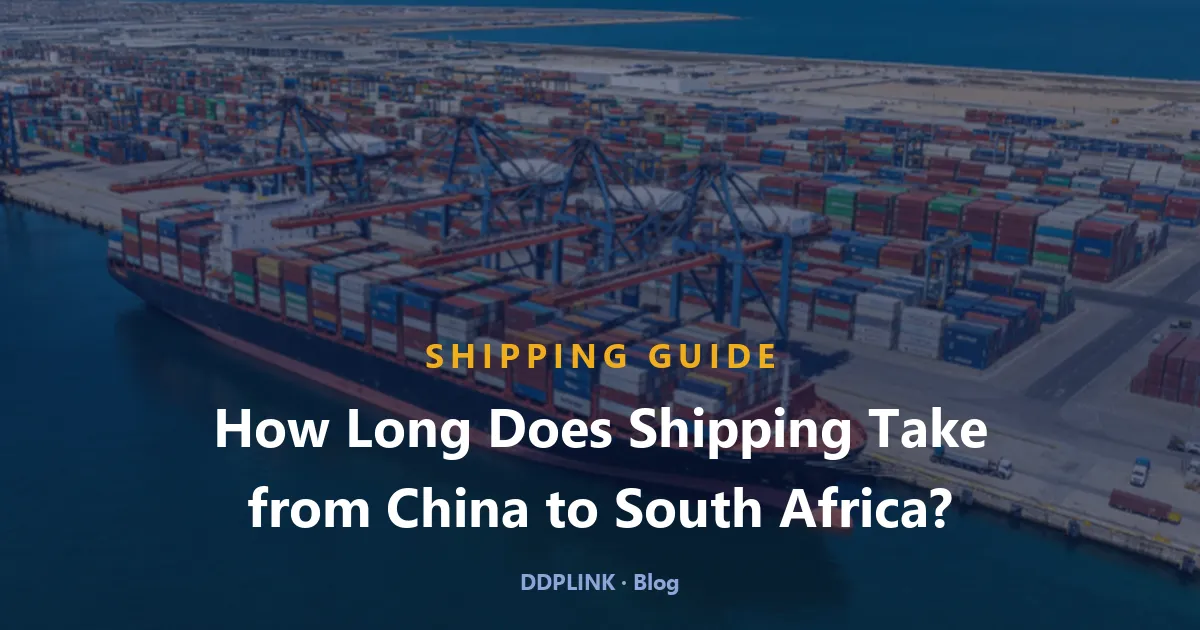

Shipping time from China to South Africa in Q4 2026: door-to-door sea, air and DDP bands for Durban, Johannesburg and Cape Town, plus SARS and PVoC buffers.
Shipping time from China to South Africa comes in two versions: the number on a sailing schedule and the number your warehouse calendar keeps. On a Durban container in Q4 2026 those two sit five to ten days apart, and the ocean leg is rarely the reason.
Production timing, a missed cut-off, terminal release and the inland run to Gauteng live inside the door-to-door figure and outside most published transit tables. This guide uses the Q4 2026 figures behind our shipping from China to South Africa guide, labels every band by where its clock starts and stops, and covers the compliance clock that changed for Chinese-origin goods in September 2026.
Quick Answer: How Long Shipping from China to South Africa Takes (Q4 2026)
These are door-to-door planning bands for general cargo in the Q4 2026 market, from the same data set behind our destination pages. The middle column is where most misquotes begin.
| Method | Door-to-door transit (Q4 2026) | What the clock includes | Best for |
|---|---|---|---|
| Express courier | 4–7 days | Pickup, flight, SARS clearance and delivery under one tracking number | Parcels and samples up to about 30 kg |
| Air freight (airport-to-airport) | 4–6 days to Johannesburg | Flight and terminal handling only | Buyers filing their own SARS entry |
| Air freight under DDP | 6–9 days | Pickup, flight, SARS clearance, 15% VAT, delivery | Seasonal stock, electronics, solar parts |
| Sea FCL (port-to-port, Durban) | 25–35 days | Ocean transit and discharge only | Containers with a Durban broker appointed |
| Sea FCL under DDP | 30–45 days | Pickup, vessel, SARS clearance, VAT, delivery | Machinery, bulk cargo, solar panels |
| Sea LCL under DDP | 32–45 days | Same sailing plus consolidation and deconsolidation | Part loads from roughly 1 CBM |
Two caveats. Duty and the 15% VAT are separate lines unless you book DDP, where they sit inside the price. And every band is a planning range for a normal week, not a commitment. Parcels and samples travel by express courier; anything heavier is a freight decision on routing and weight break.
Sea Freight Transit Time to Durban, Cape Town and Gqeberha
Sea freight moves most China–South Africa cargo, and published numbers spread widest here: 22–35 days port-to-port on direct sailings, 35–45 days through a hub. Our Q4 2026 windows are 25–35 days into Durban and 30–40 days into Cape Town; rates below are freight only.
| Route (port to port) | Ocean transit | 20ft FCL | 40ft FCL | LCL |
|---|---|---|---|---|
| Shanghai → Durban | 25–35 days | $1,650–$2,380 | $3,180–$4,320 | $180–$220/CBM |
| Ningbo → Cape Town | 30–40 days | $1,850–$2,650 | $3,480–$4,720 | $210–$260/CBM |
Durban handles roughly 60% of South Africa’s container traffic and is the default gateway for Gauteng; Cape Town suits Western Cape and temperature-controlled cargo; Gqeberha serves the Eastern Cape automotive corridor. Full detail is on the sea freight from China service page, and Ningbo loadings ride a different weekly service from the southern China ports.
FCL vs LCL: Where the Extra Two to Five Days Come From
FCL keeps your cargo in a box nobody else touches, so the clock is the sailing plus terminal handling at each end. LCL adds two windows: consolidation in China, where pallets wait for the container to fill, and deconsolidation at Durban, where the box is stripped before release. Each runs one to three days in a normal week, and a co-loaded consignment held for inspection delays the whole box.
Direct Sailings vs Transshipment: The Biggest Spread on the Lane
Two quotes for one port pair can differ by ten days with neither being wrong: one is a direct call, the other relays through a hub. Ask which routing a quote is built on before comparing — a cheap relay that adds a week costs more than the direct sailing it undercut.
Air Freight Transit Time from China to Johannesburg and Cape Town
Air freight answers the question sea cannot: how do I get goods onto a shelf this week? Our band for the lane is 4–7 days door-to-door, with 4–6 days on the Guangzhou to Johannesburg service. O.R. Tambo is the cargo gateway; Cape Town and Durban add about a day of domestic transit.
| Chargeable weight (CAN → JNB) | Freight total | Effective per kg | Airport-to-airport transit |
|---|---|---|---|
| 100 kg | $1,480–$1,920 | $14.80–$19.20/kg | 4–6 days |
| 300 kg | $3,120–$4,050 | $10.40–$13.50/kg | 4–6 days |
| 500 kg | $4,680–$6,080 | $9.36–$12.16/kg | 4–6 days |
| 1,000 kg | $8,750–$11,350 | $8.75–$11.35/kg | 4–6 days |
Those rates are freight and origin charges; SARS duty, VAT and delivery sit outside them unless you book DDP air, which we publish at 6–9 days door-to-door. Service detail is on the air freight from China service page.
Chargeable Weight Changes Your Date, Not Just Your Invoice
Airlines bill the greater of actual and volumetric weight — length × width × height in centimeters divided by 6,000. Bulky cargo consumes more than its share of a fixed-capacity flight and is rolled first when space tightens. Run your dimensions through the volumetric weight calculator before requesting space: a shipment that looks like 300 kg but bills at 700 kg can land on a later departure.
The Door-to-Door Ledger: Where 30–45 Days Actually Go
Below is a clean 20ft shipment from a Jiangsu supplier to a Johannesburg warehouse, built from our Q4 2026 working figures. The clock column shows what starts each stage, because that determines whether a delay is yours to control.
| Stage | Typical days | Clock starts when | Controlled by |
|---|---|---|---|
| Supplier pickup, export declaration, loading | 1–2 | Cargo-ready date | Us, with your supplier |
| Cut-off to vessel departure | 0–3 | Booking cut-off | Carrier schedule |
| Ocean transit to Durban | 25–35 | Sailing date | Carrier and routing |
| Discharge and container availability | 2–4 | Vessel arrival | Terminal operations |
| SARS clearance under DDP | 1–3 | Discharge or pre-arrival filing | Us |
| Inland move to Gauteng | 1–2 | Container release | Us, by road or rail |
| Delivery appointment and unloading | 0–1 | Arrival at your address | You |
The typical values land inside our published 30–45 day DDP band. Adding the worst case of every row instead gives a number no shipment experiences, because a late cut-off usually means a quieter terminal and a faster release at the far end. What DDP shipping from China buys is not a faster vessel; it is that clearance and delivery stop waiting on another desk.
Our Industry Insight: When an importer calls about a late container, the ocean leg is almost never where the days went. In our files the losses sit at the cargo-ready date, the cut-off and the terminal release — so ask which stage the container is in, not for a new ETA.
Planning works better backwards. Here is the same lane from a fixed shelf date: stock required in Johannesburg on Friday 4 December 2026, during the festive peak.
| Step (counting backwards) | Date window | Why it sits there |
|---|---|---|
| Arrival and discharge at Durban | 22–27 November 2026 | 25–35 day ocean leg from a late-October sailing |
| Container available and SARS clearance | 24–29 November 2026 | Terminal release plus one to three clearance days |
| Inland move and delivery in Johannesburg | 30 November – 4 December 2026 | One to two days on the road, plus an appointment |
| Sailing from Shanghai | 22–30 October 2026 | Counting back the ocean leg |
| Documentation cut-off | 19–27 October 2026 | Two to three days before loading |
| Cargo ready at the factory | 14–22 October 2026 | Production must finish here |
| CoC or Letter of Authority in hand | Mid-September 2026 | Compliance testing runs four to six weeks |
Real-Life Scenario — the container that arrived on time and delivered four days late: A Gauteng importer booked a 20ft solar-equipment load in September 2026 on a quoted 30-day transit. The vessel berthed at Durban on day 27, exactly as scheduled. The container was released on day 31 and the truck reached the importer on day 34, two days before a stock-out. The quote ended at the quay; the importer’s problem ended at the warehouse door.
Why Johannesburg Takes Two to Four Days Longer Than Durban
A “25–35 day” Durban transit answers a port-to-port question. Deliver that container to a Johannesburg or Pretoria address and you need another two to four days, because two steps separate the port date from the warehouse date: getting the box out of the terminal, and moving it 570 km inland.
| Inland leg | Mode we use | Typical days | What decides it |
|---|---|---|---|
| Durban → Johannesburg, Pretoria | Direct trucking | 1–2 | Truck availability, N3 corridor, city congestion |
| Durban → Gauteng depots | Rail to City Deep or Kaserne plus local trucking | Comparable days, lower cost per container | Rail allocation and depot handling |
| Durban → Cape Town or Eastern Cape | Coastal feeder or long-haul road | 2–3 | Coastal schedule frequency |
| Cape Town → Gauteng | Road, about 1,400 km | 2 | Distance, not congestion |
Two consequences follow. Cape Town metro delivery is a same-day to next-day move, but the western gateway is not faster for Johannesburg. When a quote says “Johannesburg” while the transit figure came from a Durban sailing, ask what the inland leg costs and who books the truck. And choosing a gateway on rate alone is a trap for Gauteng cargo: the cheapest Cape Town rate usually adds two days of road and a second set of handling charges, though the logic reverses for a Western Cape consignee.
What Delays a China–South Africa Shipment: SARS, Durban Terminals and the Compliance Clock
Delays cluster in four places: origin documentation, the terminal at Durban, SARS assessment, and paperwork that must exist before cargo can be cleared at all.
| Cause | Typical added days | Where it shows up | How to avoid it |
|---|---|---|---|
| Missing Certificate of Conformity or NRCS Letter of Authority | Blocks release; 3–10 days or longer | SARS or BMA check | Start compliance before production finishes |
| Customs code or valuation query | 1–3 | SARS assessment | Register the importer code; match invoice to payment |
| Physical inspection | 2–4 | Durban or OR Tambo, plus storage | Accurate descriptions, consistent documents |
| Terminal delay at Durban (berthing queue or late release) | 1–5 | Before and after discharge | Accept it as a range; pre-file clearance |
| Missed documentation cut-off | Up to 7 | Origin, before loading | Compare cargo-ready date with the cut-off |
| Festive or post-holiday space crunch | 5–14 | Booking and departure | Book stock early (see the season table) |
SARS Clearance: Digital, Fast and Strict About Data
SARS processes declarations electronically, and a clean entry usually releases within one to three days of discharge. The delays come from data: an inactive importer code, an invoice value that does not reconcile with the payment, a tariff line that does not match the description, or a missing letter of authority. Checking documents before the vessel sails costs nothing. The steps are on the SARS importers page.
Durban Terminal Release, Not Vessel Arrival, Is the Date That Matters
Durban handles about 60% of the country’s container traffic on a terminal footprint built for a different era, so berthing queues and yard congestion appear in most months. That is why we quote container availability two to four days after arrival rather than same-day release. Operating detail is published by Transnet Port Terminals.
The 2026 Compliance Clock Starts at the Factory
Under a directive gazetted in March 2026, South Africa introduced a Pre-Export Verification of Conformity (PVoC) programme for certain previously unregulated categories imported from China, mandatory from 20 September 2026. In scope: cosmetics and toiletries, cookware, furniture, bicycles and sports gear, plastic toys, generators, gas stoves, plumbing supplies and construction materials. Those consignments need a Certificate of Conformity (CoC) issued before loading, which SARS and the Border Management Authority may verify at the port.
The effect on shipping time is at the origin, not at sea. Testing takes weeks, and cargo without a CoC is not slow to clear — it cannot be cleared. We request the certificate at purchase-order stage. Regulated products such as electronics and auto parts separately need an NRCS Letter of Authority. References: the directive in Government Gazette 54374 and the NRCS on compulsory specifications. Air cargo follows the same rules; our air shipping guide for this lane covers the airport side.
Our Industry Insight: The 2026 compliance shift moved the critical path for regulated cargo from Durban to the factory floor in China. We check certificate status before booking space and have held shipments rather than load them: a container waiting for a CoC in China costs storage, while the same container waiting at Durban costs storage, demurrage and a missed shelf date.
Peak Season and Holiday Effects on Transit Time
Seasonality works in two directions: Chinese factory and space cycles at the origin, South African retail and weather cycles at the destination. The buffers below come from the calendar behind our South Africa destination data.
| Period | Effect on shipping time | Buffer to build in |
|---|---|---|
| January–February (Chinese New Year) | Factories close one to three weeks; the first sailings back are the tightest of the year | Order before late January |
| June–August (Southern Hemisphere winter) | Winter weather can slow the Durban–Gauteng corridor | Add one to three days on inland legs |
| September–December (festive build-up and peak) | Festive demand lifts volumes and rates from September; depot working days shrink in December | Place Q4 orders by September; ship November cargo in October |
The origin calendar matters more than most importers expect. A container that misses the last sailing before the Chinese New Year shutdown does not wait a day — it waits three weeks while factories and consolidators close, then competes for space with everyone else’s backlog. Treat late January as a hard booking deadline for anything selling in the first quarter.
How to Shorten the Journey: What Buys Days and What Only Feels Fast
Most of these cost little. The ranking is by days saved per unit of effort, from our own shipment history.
| Action | Days saved | Cost | When it works |
|---|---|---|---|
| Book the cut-off, not the cheapest sailing | Up to 7 | Free | Cargo-ready dates close to a weekly cut-off |
| Start PVoC or NRCS compliance at purchase order | 3–10 | Certification fees | Any in-scope or regulated category |
| Pre-file the customs entry before arrival | 1–3 | Free under DDP | Every sea and air shipment |
| Ship FCL instead of LCL | 2–5 | Higher freight | From about 15 CBM |
| Clear at Durban and move inland rather than wait for a through bill | 1–3 | Same or less | Gauteng addresses |
| Split the order by urgency | Protects the date rather than shortening transit | Air premium on part of the load | Fixed launch or shelf dates |
| Book DDP so nobody waits on the consignee’s broker | 1–4 | Included in the rate | Importers without a customs team |
Things that feel faster but rarely are: paying a premium for an “express” sailing that is the same service with a faster name, re-routing to Cape Town to reach Johannesburg, switching forwarders mid-shipment, and flying cargo that is not needed early. Model each option on the freight cost calculator before committing.
FAQ: Shipping Time from China to South Africa
How long does shipping from China to South Africa take by sea?
Sea freight runs 25–35 days port-to-port into Durban and 30–40 days into Cape Town on our Q4 2026 bands. Door-to-door under DDP, plan 30–45 days for FCL and 32–45 days for LCL.
How long does shipping from China to Durban take?
A Shanghai or Ningbo sailing reaches Durban in 25–35 days, and the container is usually available two to four days after berthing. Add one to three days for SARS clearance if you clear it yourself.
How long does shipping from China to Johannesburg take?
Add two to four days to the Durban figure: one to two days of terminal release, then one to two days of trucking. Door-to-door FCL lands at 30–45 days, and DDP air at 6–9 days when the deadline is tight.
How long does air freight from China to South Africa take?
Air freight runs 4–6 days airport-to-airport from Guangzhou to Johannesburg and 4–7 days door-to-door. Cape Town and Durban add about a day of domestic transit, and chargeable weight sets both your price and the space you can secure.
How long does DDP shipping from China to South Africa take?
Our published DDP bands are 6–9 days by air and 30–45 days by sea. DDP does not shorten the sailing or the flight; it removes the queue after arrival, because clearance, the 15% VAT and delivery run on one invoice instead of three.
Why is my shipment from China to South Africa delayed?
In our records the usual causes are a missing certificate, a valuation or documentation query at SARS, a physical inspection adding two to four days, a berthing queue at Durban, and space shortages before the festive peak or Chinese New Year.
Do the new PVoC rules add time to shipping from China to South Africa?
They can add days at the origin, not at sea. In-scope categories need a Certificate of Conformity before loading, and testing takes weeks. Handled at purchase-order stage it changes nothing in your transit band; discovered at the port it can hold cargo for a week or longer.
Conclusion: Planning Your South Africa Timeline
Choose the mode and the question mostly answers itself: express at 4–7 days for parcels, DDP air at 6–9 days for pallets and urgent stock, sea at 25–35 days to Durban or 30–45 days door-to-door to Gauteng. Then add the stages nobody quotes — origin handling and the cut-off, terminal release, clearance and the inland leg. That is where the gap between a sailing table and your shelf date lives. If your goods fall into a PVoC category, fix the certificate before you fix the vessel.
Send us your dimensions, weight, commodity, HS code if you have one and the delivery address, and we will return an itemized quote with freight, duty and VAT as separate lines and each transit stage dated, as soon as possible. Request a free quote and we will map the timeline against your deadline.
More articles

Air Shipping from China to Brazil: Rates & Transit
Air shipping from China to Brazil in Q4 2026: rates by weight break, routing into GRU and VCP, the DUIMP clearance clock, and air versus express at 30–150 kg.
Read Article →
Air Shipping from China to Kenya: Rates & Transit
Air shipping from China to Kenya in Q4 2026: rates by weight break into Nairobi, the JKIA clearance clock, and the Kenyan taxes outside the per-kilo price.
Read Article →
Air Shipping from China to Kuwait: 2026 Rates, Transit & Clearance
Air shipping from China to Kuwait in Q4 2026: rates by weight break into KWI, transit via Dubai and Doha, KUCAS clearance, and 5% duty with no VAT.
Read Article →