


 USA
USA Canada
 Mexico
 Brazil
 UAE
UAE Saudi Arabia
 Iraq
Iraq Nigeria
 Ghana
Ghana Côte d’Ivoire
 Kenya
Kenya Uganda
 Tanzania
 DR Congo
 Angola
 South Africa
 UK
UK Germany
 France
 Netherlands
 Spain
Spain Australia
Sea Shipping from China to Nigeria: FCL/LCL Rates (Q4 2026)
September 30, 2026
← All Articles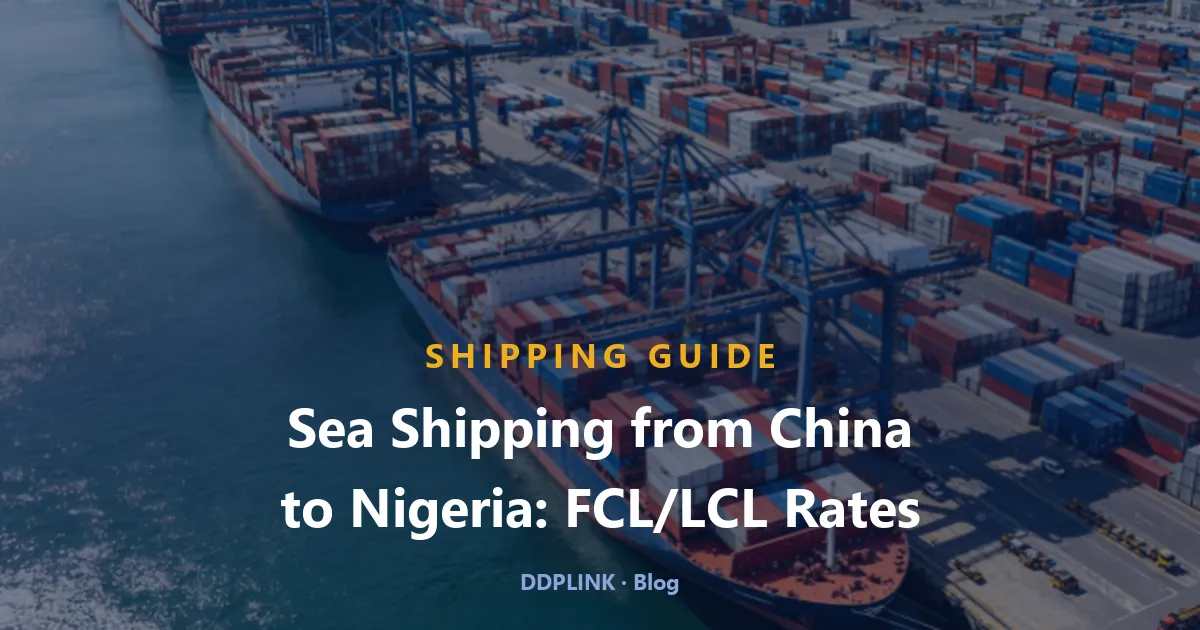

Sea shipping from China to Nigeria in Q4 2026: FCL and LCL rates to Apapa, Tin Can and Onne, transit times, the Form M and PAAR clock, and duty plus 7.5% VAT.
Sea shipping from China to Nigeria is the cheapest way to move volume, and the easiest lane to misread. A 20ft container to Apapa can be quoted at about $2,450 port to port or at four times that all-in with Nigerian clearance, duty and delivery inside — and both numbers are honest.
This guide gives both calibers, dated to Q4 2026 (October to December) and split by loading port and destination port. The lane is consistent: 35–50 days port to port into Apapa, Tin Can Island or Onne, LCL from $260 per CBM, and a compliance gate — Form M, PAAR and SONCAP — opened while your container is still in China. Duty, inland legs and the landed-cost picture are on our Shipping from China to Nigeria guide.
Quick Answer: Sea Shipping from China to Nigeria at a Glance
Q4 2026 working bands for general cargo. The freight rows are port to port and exclude Nigerian clearance, duty and delivery; the DDP rows put those inside one price.
| Product | Example Route | Transit | Q4 2026 Band |
|---|---|---|---|
| Sea FCL 20ft | Ningbo → Apapa (Lagos) | 35–45 days | $2,450–$3,380 |
| Sea FCL 40ft | Ningbo → Apapa (Lagos) | 35–45 days | $4,680–$6,150 |
| Sea FCL 20ft | Guangzhou → Onne (Port Harcourt) | 36–48 days | $2,550–$3,520 |
| Sea LCL | Ningbo → Apapa (Lagos) | 35–45 days | $260–$320 per CBM |
| Sea LCL | Shanghai → Tin Can Island | 38–50 days | $300–$380 per CBM |
| Air freight | Shenzhen → Lagos | 4–7 days | $1,720–$2,240 per 100 kg |
| DDP sea, all-in | Factory → Lagos | 45–60 days | Quoted per shipment, duty and delivery inside |
Four numbers decide most Nigeria sea quotes: the loading port, the Nigerian gateway, whether the figure is ocean freight or all-in, and the free time your container gets at the terminal.
FCL Rates from China to Nigeria: 20ft and 40ft Bands
FCL (Full Container Load) means you book the whole container: sealed at the Chinese port, opened at your warehouse, no consolidation between. It is the lowest cost per unit once volume is high enough, and the lowest risk in handling terms.
The bands below are ocean freight only, port to port. Chinese export handling, Nigerian clearance, duty, VAT, destination port charges and inland delivery sit outside them.
| Route | Transit | 20ft FCL | 40ft FCL |
|---|---|---|---|
| Ningbo → Apapa (Lagos) | 35–45 days | $2,450–$3,380 | $4,680–$6,150 |
| Shanghai → Tin Can Island | 38–50 days | $2,650–$3,650 | $4,980–$6,500 |
| Guangzhou → Onne (Port Harcourt) | 36–48 days | $2,550–$3,520 | $4,820–$6,300 |
| Qingdao → Lagos | 38–52 days | $2,720–$3,780 | $5,100–$6,700 |
West Africa strings are thinner than the Europe or US lanes, so a sailing can be rolled to the following vessel, and booking two weeks earlier usually keeps the lower end of the band.
Loading port is also a cost question: cargo bought in Yiwu, Foshan or Dongguan is trucked to whichever port gives the better sailing, and that leg is priced into the quote. If your suppliers sit in Zhejiang or Jiangsu, Shipping from Ningbo explains the cut-off and consolidation behind those sailings; the wider product is on the Sea Freight from China service page.
20ft, 40ft or 40ft High Cube
Container choice moves the price as much as the route. A 20ft takes about 28–30 CBM usable, a 40ft about 55–58 CBM and a 40ft high cube about 65–68 CBM on similar payload. A 40ft costs roughly 1.8 times the 20ft rate rather than double, so light bulky cargo — furniture, plastics, packed textiles — ships better in a 40HQ, while dense cargo hits the weight limit first and a 20ft wins.
LCL Rates from China to Nigeria: What a CBM Really Costs
LCL (Less than Container Load) puts your cargo in a shared container and bills it per CBM (cubic metre), normally against a one-cubic-metre minimum. It is how most first orders and market stock enter Nigeria: you pay for the space your cartons occupy rather than the air around a half-filled container.
| Route | Transit | LCL per CBM | Minimum |
|---|---|---|---|
| Ningbo → Apapa (Lagos) | 35–45 days | $260–$320 | 1 CBM |
| Shanghai → Tin Can Island | 38–50 days | $300–$380 | 1 CBM |
| Guangzhou → Onne (Port Harcourt) | 36–48 days | $280–$350 | 1 CBM |
| Qingdao → Lagos | 38–52 days | $310–$395 | 1 CBM |
LCL is not billed on volume alone. Carriers rate it on the greater of the cubic metres and the weight in tonnes — the W/M rule, where one cubic metre counts as one revenue tonne — so a dense consignment of tiles or machine parts can be charged on weight. Send both figures at quote stage, and the basis is explicit rather than arriving as a correction on the invoice.
The 13–15 CBM Break-Even
On this lane the crossover sits around 13–15 CBM: below it LCL usually wins in total, above it a 20ft does, because you stop paying per cubic metre and start paying per box. Between 12 and 18 CBM ask for both, since density and gateway change the answer.
LCL also carries destination charges that do not scale with volume — deconsolidation, terminal handling, documentation and a delivery order fee — which is why a 2 CBM quote often lands close to a 4 CBM one.
Transit Time from China to Nigeria by Sea
Port-to-port transit is the number carriers publish, and the destination port matters as much as the loading port: Lagos sailings are the most frequent; Onne is served by fewer strings.
| Loading Port | → Apapa (Lagos) | → Tin Can Island (Lagos) | → Onne (Port Harcourt) |
|---|---|---|---|
| Ningbo | 35–45 days | 35–45 days | 38–48 days |
| Shanghai | 38–50 days | 38–50 days | 40–50 days |
| Guangzhou (Nansha) | 36–48 days | 36–48 days | 36–48 days |
| Qingdao | 38–52 days | 38–52 days | 40–52 days |
Transshipment is the usual reason a shipment runs longer than the published band: a relay over Singapore, Port Klang, Colombo or Tanger Med adds three to ten days and often costs less. LCL runs three to seven days behind FCL on the same lane, because consolidation waits for a full container at origin and deconsolidation takes time after berthing.
Door to Door Is Longer Than the Sailing
What your buyer experiences is the whole chain, and most of the slack sits before the vessel sails or after it berths.
| Stage | Sea DDP to Lagos | Sea DDP to Kano or Onitsha |
|---|---|---|
| Supplier pickup and consolidation in China | 3–7 days to cut-off | 3–7 days to cut-off |
| Export handling and loading | 1–2 days | 1–2 days |
| Ocean transit | 35–45 days | 36–48 days |
| Nigerian clearance, valuation, duty | 5–10 days after arrival | 5–10 days after arrival |
| Inland delivery | Same day to 2 days | 3–5 days by bonded truck |
| Realistic door to door | 45–60 days | 50–65 days |
Clearance is the largest single variable. With the Form M opened before the vessel sailed, the PAAR generated before arrival and the invoice matching the packing list, sea cargo clears in days, where without them a container sits while paperwork is corrected and storage accrues. When the selling window is shorter than the sailing, the case for flying is about the window rather than the rate — see our Air Shipping from China to Nigeria: 2026 Rates & Transit guide.
Apapa, Tin Can, Onne or Lekki: Choosing the Nigerian Gateway
Nigeria has four practical container gateways, and only one is right for a given delivery address — freight differences are modest next to the inland cost of choosing wrongly.
| Your Delivery Address | Recommended Gateway | Transit | Why |
|---|---|---|---|
| Lagos mainland and island, Ogun, Ibadan | Tin Can Island | 35–45 days | Same port complex as Apapa, usually clearing faster in the current week |
| Lagos cargo with flexible timing | Apapa | 35–45 days | The classic gateway; congestion is the trade-off |
| Port Harcourt, Aba, Owerri, Uyo, Onitsha | Onne | 38–48 days | Removes a long westward truck leg through Lagos traffic |
| Large containers, heavy or project cargo | Lekki Deep Sea Port | 35–45 days | Deep-water berths and a growing share of China services |
| Kano, Kaduna, Abuja | Lagos gateway plus bonded truck | 35–45 days + 3–5 days | The inland leg is the constraint, not the port |
Our Industry Insight: Port choice on this lane is a weekly decision, not a permanent one. Apapa, Tin Can, Onne and now Lekki move at different speeds depending on berth availability, yard density and how fast the terminal releases containers. We route each booking through whichever gateway is clearing fastest that week.
Form M, PAAR and SONCAP: The Gate Before Your Container Loads
Nigeria’s import process is the most documentation-heavy on our African network, and the sequence catches first-time importers: two of the three steps happen before the vessel sails.
| When | Who Acts | What Has To Happen | If It Is Missed |
|---|---|---|---|
| Before the vessel sails | Importer, through a Nigerian bank | Form M opened on the trade single window | Cargo cannot be cleared; the sailing date is lost |
| Before shipment | Accredited conformity body, at origin | SONCAP Product Certificate plus a Soncap Certificate for regulated goods | NCS will not release the container |
| Before the vessel arrives | Nigeria Customs Service | PAAR (Pre-Arrival Assessment Report) generated against the Form M and B/L | No assessment, no duty payment, no release |
| Before clearance | Importer or broker | IDF, levy and VAT funded; marine insurance certificate in place | The demurrage clock keeps running |
| At release | Terminal and clearing agent | Duty settled, container gate-out arranged | Storage and demurrage accrue per day |
SONCAP is an origin-side test, not a Lagos problem: a conformity assessment carried out in the country of export by an accredited body, where the Product Certificate registers the product and a Soncap Certificate clears each consignment. The categories most often affected are electronics, electrical goods, toys, textiles and auto parts, and the current lists are published by the Standards Organisation of Nigeria. Food, drugs and cosmetics instead need NAFDAC registration, which runs three to six months. The duty framework sits with the Nigeria Customs Service.
| Document | Issued By | What To Watch |
|---|---|---|
| Commercial invoice | Chinese supplier | Description and value matching the Form M |
| Packing list | Chinese supplier | Carton count, weights and dimensions matching the load |
| Bill of lading | Carrier or forwarder | Consignee matching the importer named on the Form M |
| SONCAP certificate | Accredited body at origin | Required before shipment for regulated categories |
| Insurance certificate | Insurer | Marine cover is mandatory on Nigeria imports |
| Fumigation certificate | Certified provider | Required where packaging includes wood (ISPM 15) |
Real-Life Scenario: A Lagos trader consolidated 6.4 CBM of kitchenware and household plastics from three Yiwu suppliers into one LCL shipment to Tin Can Island. Two suppliers delivered after the original cut-off, so the cargo rolled to the next weekly consolidation — four days lost at origin rather than at sea. The Form M had been opened before that cut-off, and the consignment cleared four days after berthing, which kept a delay at origin from becoming a demurrage bill. Door to door, including bonded trucking across Lagos: 52 days.
What the Nigerian Port Bills You: Duty, Levies and 7.5% VAT
Value-based charges are usually larger than the freight on a container that clears normally, and they are the lines most often missing from a quote comparison. Nigeria applies them in a fixed order on CIF value (goods plus freight plus insurance):
- Customs duty at the rate for your HS code, commonly 5–35%, with machinery and some electronics at the lower end.
- IDF (Import Duty Form) at 1% of CIF, paid at a designated bank before clearance.
- CISS and ETLS at 1% of FOB and 0.5% of CIF respectively.
- Levy at 7% of the duty amount, on top of duty.
- VAT at 7.5% on the duty-inclusive value, which means duty increases the VAT line too.
Here is the arithmetic on a representative sea shipment, using our own Nigeria lane data. The duty rate is illustrative; yours follows your HS code.
| Line | Amount |
|---|---|
| Product value (FOB Guangzhou) | $8,000 |
| Freight plus pickup (LCL about 3 CBM, DDP sea) | $1,050 |
| IDF (1%) plus levy plus VAT (7.5%) | $780 |
| Duty (illustrative 10%, HS-dependent) | $800 |
| SONCAP, Form M, PAAR and brokerage | Included |
| Trucking and delivery to a Lagos warehouse | Included |
| Total landed cost (DDP) | $10,630 |
That gap is why an LCL quote at $260 per CBM and an all-in DDP quote can differ several times over on the same cargo. Under DDP shipping from China the clearance, duty and delivery sit inside one figure.
Demurrage, Detention and Free Time
Lagos free time is tight. Demurrage applies while the container sits inside the terminal after the free storage window; detention applies once the box has left the port and is not returned empty in time. Demurrage here runs about $200–$400 per container per day, so a week of congestion can consume the entire freight saving on a 20ft. Three habits keep that clock short, all before the vessel berths: pre-audit the documents against the Form M so HS code, value and consignee agree; hold the PAAR and any SONCAP certificate rather than chase them; and book the bonded truck for the week the vessel is due. Terminal information comes from the Nigerian Ports Authority.
Our Industry Insight: Valuation review, not the duty rate, is what stops Nigerian sea cargo. When customs questions a declared value, the clearance clock does not slow down — it stops, and the terminal bills storage for every day it is stopped. We keep defensible factory documentation and matched invoice sets for that reason: a container held for valuation costs more than the duty difference it was questioned over.
Surcharges, Seasonality and When to Book
Freight rates are only part of what moves between quote and sailing: peak-season surcharges and bunker adjustments are quoted separately, and blank sailings remove capacity when carriers decide a string is not paying.
| Window | When | What It Does to Your Booking |
|---|---|---|
| Lunar New Year | January to February | Two to three weeks of factory shutdown; the busiest booking fortnight is immediately before it |
| Post-holiday window | April to June | Calmest period on this lane; space is available and rates are usually at their softest |
| Rainy season | August to September | Heavy rains slow inland trucking to Kano, Kaduna and Onitsha; add three to five days upcountry |
| Year-end trade peak | October to December | Market stock is bought for festive demand; book four to six weeks ahead and expect PSS |
| Golden Week | Early October | Chinese handling slows for a week; pre-holiday cut-offs land in late September |
The rule we give importers is to book four to six weeks ahead of any holiday window and keep one alternative gateway in mind: space and equipment, not the headline rate, fail first in a peak.
FAQ: Sea Shipping from China to Nigeria
How much does sea shipping from China to Nigeria cost?
Port to port, a 20ft container runs about $2,450–$3,380 to Apapa and a 40ft about $4,680–$6,150 on our Q4 2026 bands, with LCL at $260–$395 per CBM. Those are ocean freight only: add clearance, duty, VAT and delivery, or book DDP where they sit inside one figure.
How long does sea shipping from China to Nigeria take?
35–50 days port to port depending on the loading port and the Nigerian gateway, and 45–60 days door to door under sea DDP including clearance and inland delivery. Onne runs a few days longer than Lagos because fewer strings call there.
Is FCL or LCL cheaper for my shipment?
Below roughly 13–15 CBM, LCL usually costs less in total because you pay only for the space you use; above that a 20ft wins. Density matters too: LCL is rated on the greater of volume and weight, so 10 CBM of tiles can price like a heavier shipment.
What is a CBM, and how is it calculated?
A CBM is one cubic metre: length × width × height in metres. A carton of 60 × 40 × 50 cm is 0.12 CBM, so ten are 1.2 CBM. Sea LCL bills per CBM against a one-cubic-metre minimum, or on the equivalent weight in tonnes where the cargo is dense.
Do I need Form M for a sea shipment?
Yes, for commercial imports cleared through Nigeria Customs Service, and it has to be opened through a Nigerian bank before the goods leave China. Sea is not exempt and neither is air. Under DDP we coordinate it with your bank or through our licensed partners.
What happens if my container is delayed at the port?
Demurrage runs at about $200–$400 per container per day after the free storage window, charged to the party named on the booking. The most common causes are a valuation query on the declared value and a document set that does not match the Form M — both avoidable before the vessel berths.
When is the cheapest time to ship to Nigeria by sea?
April to June is usually the calmest window on this lane, after the Lunar New Year backlog clears and before the year-end build. October to December is the tightest: market stock is bought for festive demand and peak-season surcharges apply, so book four to six weeks ahead.
Conclusion: Four Numbers to Confirm Before You Book
Sea shipping from China to Nigeria rewards planning more than negotiation. Confirm the loading port and the gateway against your delivery address, check whether the quote is ocean freight or an all-in landed figure, and ask what free time the terminal allows — the days after berthing, not the days at sea, are where the money moves.
Send the cargo details — CBM or container size, weight, loading city, delivery city and HS code — and we will come back with a port-to-port rate and an all-in door-to-door figure side by side, with the Form M and SONCAP steps mapped to your supplier. Get a Free Quote, or run a first estimate with the Freight Cost Calculator.
More articles
Air Shipping from China to Kuwait: 2026 Rates, Transit & Clearance
Air shipping from China to Kuwait in Q4 2026: rates by weight break into KWI, transit via Dubai and Doha, KUCAS clearance, and 5% duty with no VAT.
Read Article →
Air Shipping from China to Nigeria: 2026 Rates & Transit
Air shipping from China to Nigeria in Q4 2026: rate bands into Lagos, Abuja and Kano, chargeable weight, the Form M and SONCAP clock, and what happens at MMIA.
Read Article →
Air Shipping from China to South Africa: 2026 Rates, Transit Times & Clearance
Air shipping from China to South Africa in 2026: rates by weight break, transit to Johannesburg, Cape Town and Durban, and the SARS duty and 15% VAT stack.
Read Article →