


 USA
 Canada
 Mexico
 Brazil
 UAE
 Saudi Arabia
 Iraq
 Nigeria
 Ghana
 Côte d’Ivoire
 Kenya
 Uganda
 Tanzania
 DR Congo
 Angola
 South Africa
 UK
 Germany
 France
 Netherlands
 Spain
 Australia
How Much Does It Cost to Ship from China to Canada? (2026)
October 22, 2026
← All Articles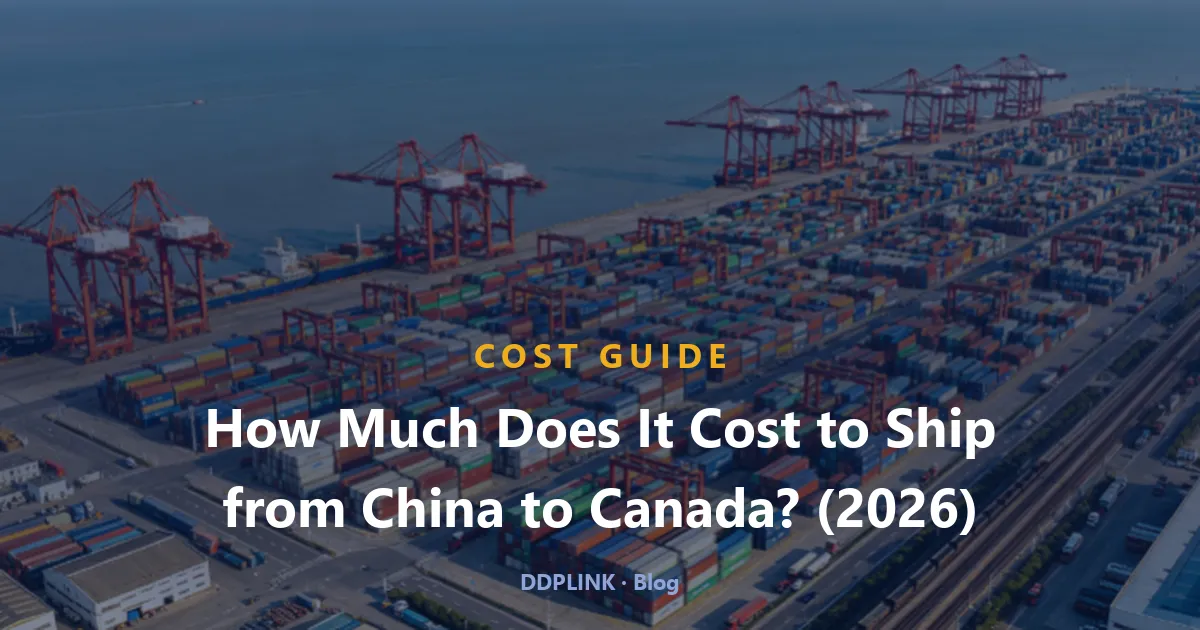

Shipping cost from China to Canada in 2026: FCL and LCL rates to Vancouver and Toronto, air freight bands, plus duty, GST/HST and the CAD 20 de minimis.
Shipping cost from China to Canada is two numbers on the same booking: what the carrier charges to move the box, and what the border adds before it leaves the terminal. A 20ft from Shanghai to Vancouver prices at $1,120–$1,680 port to port in Q4 2026; the same box delivered to Mississauga with duty and tax settled lands near $12,800.
Canada differs from the markets buyers compare it with: duty is assessed on the FOB value, not freight plus insurance, so the ocean rate does not inflate the duty bill, and sales tax is provincial as well as federal. The low-value line for goods from China is CAD 20, not the CAD 150 that applies to US and Mexican goods. Bands below match our Shipping from China to Canada guide.
Quick Answer: What It Costs to Ship from China to Canada in 2026
Q4 2026 bands for general commercial cargo. Sea and air rows are freight only; Canadian clearance, duty, GST/HST and delivery sit outside them unless the row says otherwise.
| Method | Example lane | Transit | Q4 2026 cost | What the figure contains |
|---|---|---|---|---|
| Sea FCL 20ft | Shanghai → Vancouver | 20–28 days | $1,120–$1,680 | Ocean freight, port to port |
| Sea FCL 40ft | Shanghai → Vancouver | 20–28 days | $2,480–$3,240 | Ocean freight, port to port |
| Sea FCL 40ft to Ontario | Ningbo → Toronto via rail | 30–38 days | $3,380–$4,400 | Ocean plus rail, ramp to ramp |
| Sea LCL | Shanghai → Vancouver | 24–32 days | $350–$430 per CBM | CFS to CFS, one-CBM minimum |
| Air freight | Shenzhen (SZX) → Vancouver (YVR) | 3–6 days | $1,180–$1,520 at 100 kg; $6,950–$9,100 at 1,000 kg | Airport to airport |
| Express courier | Shenzhen → Toronto | 3–6 days | From about CAD $40 per parcel; CAD $17–$26 per kg mid-band | Door to door, carrier clears |
| DDP sea, all-in | Factory → Ontario | 35–45 days | Per shipment, duty and tax inside | Door to door |
| DDP air, all-in | Factory → Ontario | 6–9 days | Per chargeable kg, duty and tax inside | Door to door |
Our Industry Insight: The comparison that goes wrong most often is a port-to-port ocean rate set beside a delivered DDP price. On a 20ft to Ontario the ocean leg is about 12% of the landed total and duty and tax another 14%. Ask what each quote contains.
Cost to Ship a 20ft or 40ft Container from China to Canada
Container pricing here is a west-coast price with an inland leg bolted on. Vancouver and Prince Rupert are the direct Pacific calls; Toronto is an inland ramp fed by rail.
| Lane | Transit | 20ft FCL | 40ft FCL | LCL per CBM |
|---|---|---|---|---|
| Shanghai → Vancouver | 20–28 days | $1,120–$1,680 | $2,480–$3,240 | $350–$430 |
| Shenzhen → Vancouver | 20–30 days | $1,240–$1,820 | $2,600–$3,380 | $370–$450 |
| Ningbo → Prince Rupert | 22–30 days | $1,180–$1,720 | $2,520–$3,300 | $360–$440 |
| Ningbo → Montreal | 30–40 days | $1,650–$2,480 | $3,280–$4,260 | $430–$460 |
| Shanghai → Toronto (via Vancouver rail) | 30–38 days | $1,720–$2,560 | $3,380–$4,400 | $440–$470 |
Destination handling, drayage, brokerage, duty and tax sit outside these rates, and on the Ontario lanes the rail leg is the largest line after the ocean freight. Service detail is on the Sea Freight from China page; much of this volume is collected in Zhejiang, and the Shipping from Shanghai page covers pickup there.
20ft, 40ft or 40ft High Cube
Usable volume runs about 28–30 CBM in a 20ft, 55–58 in a 40ft and 65–68 in a 40ft high cube. The 40ft costs 1.5–1.6 times the 20ft rate rather than double, so light bulky cargo ships better in a 40HQ at close to the standard 40ft rate. Dense cargo — tiles, machinery, hardware — hits the road weight limit before it fills the volume.
LCL Cost per CBM and Where It Stops Beating FCL
LCL shares a container and bills by cubic metre against a one-CBM minimum, so the calculation turns on the per-CBM rate and on whether destination CFS charges are inside it.
| Cargo size | LCL at $350–$430 per CBM | 20ft FCL to Vancouver | Lower total |
|---|---|---|---|
| 2 CBM | $700–$860 | $1,120–$1,680 | LCL |
| 5 CBM | $1,750–$2,150 | $1,120–$1,680 | FCL, once destination lines are counted |
| 8 CBM | $2,800–$3,440 | $1,120–$1,680 | FCL |
| 12 CBM | $4,200–$5,160 | $1,120–$1,680 | FCL |
The 12–15 CBM crossover repeated in most guides is built on $70–$150 per CBM LCL rates. At the band above — which includes origin consolidation and documentation — it arrives at roughly 5–7 CBM once the container’s fixed destination charges join the comparison. LCL bills the greater of volume and weight under the W/M rule, so a dense four-CBM stack of hardware can be charged as tonnes, and the flat lines (CFS unstuffing, documentation, terminal minimum, delivery) add 30–50% to a two-CBM consignment.
Air Freight and Express Cost from China to Canada
Air cargo reaches Vancouver, Toronto and Montreal in 3–8 days and suits goods worth more than the freight. Billing uses chargeable weight, and the effective rate falls with size.
| Chargeable weight | Shenzhen → Vancouver | Effective per kg | Shanghai → Toronto | Effective per kg |
|---|---|---|---|---|
| 100 kg | $1,180–$1,520 | $11.80–$15.20 | $1,320–$1,720 | $13.20–$17.20 |
| 300 kg | $2,480–$3,260 | $8.27–$10.87 | $2,760–$3,620 | $9.20–$12.07 |
| 500 kg | $3,720–$4,880 | $7.44–$9.76 | $4,150–$5,420 | $8.30–$10.84 |
| 1,000 kg | $6,950–$9,100 | $6.95–$9.10 | $7,680–$10,050 | $7.68–$10.05 |
The step between brackets matters more than the airport pair: moving a 290 kg consignment to the 300 kg break can produce a lower total, because the lower rate applies to the whole shipment. Service detail is on the Air Freight from China page.
Chargeable Weight and the 6,000 Divisor
Airlines bill the greater of actual and volumetric weight, with volumetric weight calculated as length × width × height in centimetres divided by 6,000. A carton measuring 80 × 60 × 60 cm and weighing 9 kg bills at 48 kg.
Express covers the parcel end: 3–6 days door to door, priced by weight band, and usually cheaper below about 45 kg because collection, clearance and delivery are bundled. Above 100 kg consolidated air freight wins on like-for-like scope.
Canada Duty, GST/HST and the CAD 20 Line
Canadian import charges cascade, each calculated on a base that includes the previous one — and the base is the part most Chinese suppliers get wrong.
| Charge | Base | Rate (2026) | When it is paid |
|---|---|---|---|
| Customs duty | Value for duty — price paid for the goods, freight to Canada excluded | MFN rates by tariff item, commonly 0–18% | At release |
| GST | Value for duty plus duty | 5% | At release |
| Provincial part of HST | Value for duty plus duty | 8% Ontario, 9% Nova Scotia, 10% New Brunswick, Newfoundland and Prince Edward Island | Self-assessed on the GST/HST return |
| QST (Quebec) | Value for duty plus duty | Quebec rate | Self-assessed through Revenu Québec |
| PST (BC, Manitoba, Saskatchewan) | Duty-paid value | 7%, 7%, 6% | Self-assessed provincially |
| Surtax on listed goods | Value for duty | 25% on covered steel and aluminium goods | At release |
Canada values imports on an FOB basis: duty is charged on the price paid for the goods without adding freight and insurance — the opposite of the EU and UK, which compute duty and VAT on CIF. On a 20ft carrying $1,780 of freight that removes about $142 of duty at 8% and $96 of GST, provided the invoice separates goods value from freight.
Is the GST and HST Recoverable?
For a GST-registered business that is the importer of record, the 5% GST and the provincial HST return as input tax credits — cash flow, not cost. Duty is not recoverable. Under all-in DDP the forwarder may declare in its own name, leaving the buyer unable to claim the credit.
Surtax and Anti-Dumping: the Lines a Freight Quote Never Shows
Trade remedies sit on top of duty and follow the product and origin, not the way the goods travel.
| Measure | In force since | Applies to | Rate |
|---|---|---|---|
| China Surtax Order (2024) | 22 October 2024 | Steel and aluminium goods originating in China | 25% of value for duty |
| Steel Goods and Aluminum Goods Surtax Order | 31 July 2025 | Steel melted and poured, or aluminium smelted and cast, in China, whatever the export country except the US | 25% of value for duty |
| Steel Derivative Goods Surtax Order | 26 December 2025 | Specified steel derivative goods, all countries | 25% of value for duty |
| Upholstered domestic seating (SIMA) | CITT finding 2 September 2021, under expiry review initiated 31 August 2026 | Sofas, chairs and similar seating from China and Vietnam | 188% of export price without normal values |
Goods declared at a cumulative value for duty of CAD $5,000 or less are outside the steel and aluminium surtax, and casual goods are excluded. Anti-dumping duty has no such floor, and the seating measure stays in force during the expiry review, with a determination due by 28 January 2027. Check CBSA’s measures in force against your tariff item before booking.
CARM, Release Security and the CAD 20 Threshold
Since CARM became the system of record on 21 October 2024, a commercial importer needs a CRA Business Number with an RM program account, a CARM Client Portal registration, and its own release prior to payment security — a surety bond at 50% of the highest monthly duty and tax with a CAD $25,000 minimum, or a cash deposit at 100%. The broker’s bond no longer covers you.
On the parcel side, the threshold for goods from China is CAD $20 per shipment under the Courier Imports Remission Order; the CAD $150 figure applies to US and Mexican goods under CUSMA. Splitting an order across parcels does not help, because CBSA assesses the transaction rather than the number of boxes. Detail is in CBSA’s courier low value shipment program and CRA’s GST/HST on imports guidance.
Landed Cost Example: One 20ft Container to BC and to Ontario
Same container, same goods, two delivery provinces. Product value is $8,000 FOB Ningbo, duty is 8% on a furniture tariff item, and one broker clears both boxes.
| Line | Richmond, BC (20ft) | Mississauga, ON (20ft) |
|---|---|---|
| Product value, FOB Ningbo | $8,000 | $8,000 |
| Freight — ocean, plus rail to Ontario | $1,400 | $2,140 |
| Duty at 8% on the FOB value | $640 | $640 |
| GST at 5%, collected at release | $432 | $432 |
| Provincial tax, self-assessed | $605 (7% BC PST) | $691 (8% Ontario HST part) |
| Brokerage and entry | $250 | $250 |
| Delivery from terminal or rail ramp | $450 | $620 |
| Total cash outlay | $11,777 | $12,773 |
Freight is 12% of the BC number and 17% of the Ontario one; duty and tax together are about 14% in both cases. The gap is almost entirely the inland leg — the part suppliers quote least accurately, which is why a “door to Canada” price built on a Vancouver rate is short by roughly $1,000 here. For a GST/HST-registered importer the $432 and the provincial line return as input tax credits, so the economic cost is nearer $10,740 in BC and $11,650 in Ontario. Duty stays.
Five levers move the number: a 40HQ for light cargo, crossing the LCL line above 5 CBM, landing on the west coast and railing east instead of all-water to Montreal, classifying before booking, and sailing around the Q4 peak.
Our Industry Insight: We price Canada shipments off the tariff item, not the product name. A “furniture” order that includes metal frames can straddle a duty-free line and a surtaxed steel line in one container, and the split changes the bill by four figures. Ask for the material breakdown before production — after loading, the only lever left is a reclassification request that costs more time than it saves.
West Coast or East Coast: the Inland Leg Decides the Number
Gateway choice here is an inland-distance decision more than an ocean-rate one: the spread between Pacific gateways is a few percent, while landing in Vancouver and landing in Montreal differ by hundreds of dollars per container.
| Gateway | Transit from China | Inland leg | Best for |
|---|---|---|---|
| Vancouver | 20–28 days | Rail to Toronto 4–6 days; local drayage in the Lower Mainland | BC, western Canada, rail-forwarded Ontario |
| Prince Rupert | 22–30 days | CN rail to the Prairies and Toronto, 5–7 days | Prairie distribution; thinner schedule |
| Montreal | 30–40 days | Truck to Quebec and eastern Ontario, 1–2 days | Quebec, Montreal, eastern Ontario |
| Halifax | 32–40 days | Truck to Atlantic Canada | Atlantic Canada and reefer cargo |
| Toronto (inland ramp) | 30–38 days via Vancouver | Final delivery from the ramp | GTA warehousing and FBA inbound |
Vancouver is fastest and busiest. Prince Rupert adds a day or two at sea but often clears faster on lower volume; Montreal’s all-water option avoids a rail transfer but sails less often.
Seasonality and the Winter Rail Problem
| Window | What it does to cost and schedule | Planning |
|---|---|---|
| January–February (Chinese New Year) | Factories close two to four weeks; rates spike before the holiday, soften after | Book before mid-January, or plan a March arrival |
| April–May | Softest rates of the year on this lane | Good window for large FCL bookings |
| August–October | Q4 retail peak, peak season surcharges, tight space | Book three to four weeks ahead |
| November–December | Prairie cold snaps and rail congestion add three to five days | Pad the in-store date rather than pay for air |
Real-Life Scenario: A Toronto buyer booked 9 CBM of shelving on an LCL rate of $420 per CBM and budgeted $3,780 for freight. Destination CFS handling, a terminal minimum, brokerage and delivery to Mississauga added $1,150; duty at 6.5% on $14,000 of goods added $910, and 13% HST added $1,938. The shipment closed at $19,778 against a plan of about $18,200 — 41% over the FOB value, with freight only 19% of the total. Nothing on that invoice was invented and the per-CBM rate was competitive; the quote stopped at the port. We now send a destination-charge worksheet with every Canada LCL rate.
Where a Canada Quote Stops: Destination Charges and Demurrage
Freight quotes end at the terminal gate. The lines below arrive on the second invoice and explain why two forwarders quoting the same ocean rate differ by 20% on the delivered total.
| Charge | Typical amount (CAD) | Trigger |
|---|---|---|
| Destination terminal handling | $400–$800 per container | Every FCL |
| Drayage or rail ramp delivery | $350–$900 per container | Every FCL |
| Brokerage and entry | $150–$350 per entry | Every commercial shipment |
| Demurrage | $150–$300 per container per day | After three to five free days at the port |
| Detention | $150–$250 per container per day | After the free time on the box |
| CBSA examination | $250–$600 plus two to four days | Risk score, missing documents, valuation query |
| ISPM 15 treatment | $30–$80 per pallet | Unstamped wood packaging |
Two habits keep these lines small. Book the drayage and chassis with the sailing, because a box waiting for a truck at Vancouver accrues demurrage from day four. And check the wood packaging before loading: ISPM 15 treatment with the stamp on every pallet is a two-day fix in China and a two-week problem in Canada.
FAQ: China to Canada Shipping Costs
How much does it cost to ship from China to Canada?
Q4 2026: $1,120–$1,680 for a 20ft and $2,480–$3,240 for a 40ft to Vancouver, port to port; $350–$460 per CBM for LCL; $11.80–$17.20 per kg by air at a 100 kg booking, falling to $6.95–$10.05 at 1,000 kg. Add clearance, duty, GST/HST and delivery.
How much does it cost to ship a 20ft or 40ft container from China to Canada?
A 20ft runs $1,120–$2,560 depending on whether it lands in Vancouver or is railed to Toronto, a 40ft $2,480–$4,400 on the same lanes. Expect $1,000–$2,000 of destination charges, duty and tax on top.
Do I pay duty and GST when importing from China to Canada?
Yes. Duty follows the tariff item at MFN rates, commonly 0–18%, and 5% GST applies to the value for duty plus duty, with the provincial HST or PST self-assessed. There is no duty-free allowance for commercial goods, and no Canada–China trade agreement lowers the rate.
Is there a de minimis threshold for imports from China to Canada?
Only for courier shipments: CAD $20 per shipment under the Courier Imports Remission Order. The CAD $150 threshold covers US and Mexican goods, and splitting an order into parcels does not reset it.
What is the cheapest way to ship from China to Canada?
Sea FCL to Vancouver above 8 CBM, sea LCL below that, and consolidated air only when the goods are worth more than the freight. The cheapest total usually belongs to the option with the fewest handling steps.
Can a forwarder handle Canadian customs and tax under DDP?
Yes, and the practical difference is who is the importer of record. Under DDP the forwarder clears in its own name and the price includes duty and tax; under DAP or CIF you clear and pay, which keeps the input tax credit but puts CARM registration on your side. Our DDP Shipping from China service follows the same structure for Canada.
Conclusion: Budget on the Landed Number, Not the Ocean Rate
Shipping cost from China to Canada is a freight band plus a border stack. The band moves with the gateway and mode: $1,120–$1,680 for a 20ft to Vancouver, $600–$900 more by rail to Ontario, $350–$460 per CBM for LCL. The border stack moves with the tariff item and province: duty from zero to 18%, 5% GST, a provincial tax on top, and on a short list of goods a 25% surtax or an anti-dumping rate that outweighs the freight.
Put a date on every rate, classify the product before booking, and ask for an FOB invoice so the duty base excludes freight. Send us the goods description, tariff code, volume or weight and the delivery city, and we will return a line-by-line landed figure — or run a first estimate on the Freight Cost Calculator.
More articles

Air Shipping from China to Brazil: Rates & Transit
Air shipping from China to Brazil in Q4 2026: rates by weight break, routing into GRU and VCP, the DUIMP clearance clock, and air versus express at 30–150 kg.
Read Article →
Air Shipping from China to Kenya: Rates & Transit
Air shipping from China to Kenya in Q4 2026: rates by weight break into Nairobi, the JKIA clearance clock, and the Kenyan taxes outside the per-kilo price.
Read Article →
Air Shipping from China to Kuwait: 2026 Rates, Transit & Clearance
Air shipping from China to Kuwait in Q4 2026: rates by weight break into KWI, transit via Dubai and Doha, KUCAS clearance, and 5% duty with no VAT.
Read Article →