


 USA
 Canada
 Mexico
 Brazil
 UAE
 Saudi Arabia
 Iraq
 Nigeria
 Ghana
 Côte d’Ivoire
 Kenya
 Uganda
 Tanzania
 DR Congo
 Angola
 South Africa
 UK
 Germany
 France
 Netherlands
 Spain
 Australia
How Much Does It Cost to Ship from China to the Netherlands? (2026)
October 30, 2026
← All Articles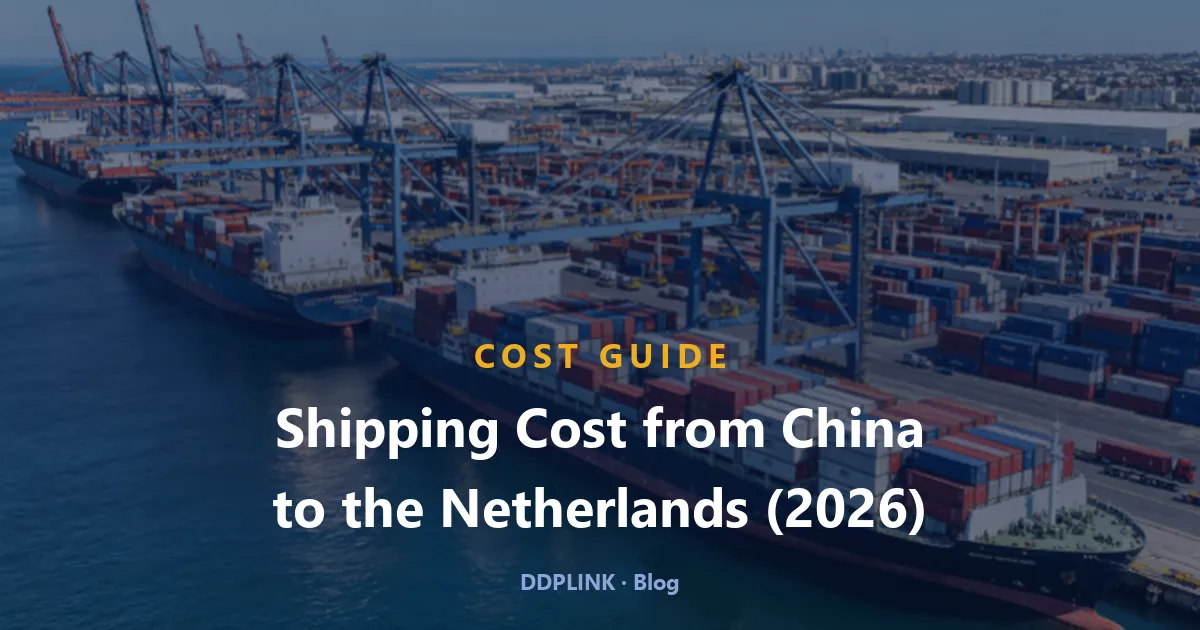

Shipping cost from China to the Netherlands in 2026: Rotterdam container and LCL rates, air freight to Amsterdam, 21% BTW, duty and the real landed cost.
Shipping cost from China to the Netherlands is three bills stacked on one booking: what the carrier charges to Rotterdam, what Dutch Customs adds on the CIF value, and what the last leg to your warehouse costs. On our Q4 2026 bands a 20ft container from Shanghai runs $1,050–$1,750 port to port, LCL runs $130–$220 per CBM, and air freight lands at $6.30–$8.40 per kg once you reach a tonne.
The Netherlands is an EU entry point before it is a destination, which changes the arithmetic: duty on the CIF value, 21% BTW on top of that, and an EORI number before the first declaration. The bands below use the same data as our Shipping from China to the Netherlands guide, dated Q4 2026.
Quick Answer: What It Costs to Ship from China to the Netherlands in 2026
Q4 2026 working bands for general commercial cargo. Sea and air rows are freight only; Dutch clearance, duty, 21% BTW and delivery sit outside them unless the row says otherwise.
| Method | Example lane | Transit | Q4 2026 cost | What the figure contains |
|---|---|---|---|---|
| Sea FCL 20ft | Shanghai → Rotterdam | 22–30 days | $1,050–$1,750 | Ocean freight, port to port |
| Sea FCL 40ft | Shanghai → Rotterdam | 22–30 days | $2,100–$2,980 | Ocean freight, port to port |
| Sea FCL 40HQ | Ningbo → Rotterdam | 23–31 days | $2,250–$3,150 | Ocean freight, port to port |
| Sea LCL | Shanghai → Rotterdam | 24–32 days | $130–$220 per CBM | CFS to CFS, one-CBM minimum |
| Air freight | Shanghai (PVG) → Amsterdam (AMS) | 3–5 days | $1,060–$1,400 at 100 kg; $6,300–$8,400 at 1,000 kg | Airport to airport |
| Air freight | Shenzhen (SZX) → Amsterdam (AMS) | 3–6 days | $1,080–$1,430 at 100 kg; $6,400–$8,550 at 1,000 kg | Airport to airport |
| Express courier | Shenzhen → Amsterdam | 3–6 days | $11–$17 per kg at 5–15 kg | Door to door, carrier clears |
| China–Europe rail | Xi’an → Duisburg, truck to NL | 18–24 days | Per container or per CBM, quoted per booking | Rail plus final truck leg |
| DDP sea, all-in | Factory → Utrecht | 26–36 days | Per shipment, duty and BTW inside | Door to door |
| DDP air, all-in | Factory → Amsterdam | 5–8 days | Per chargeable kg, duty and BTW inside | Door to door |
Our Industry Insight: The comparison that misleads most often is a port-to-port ocean rate placed beside a delivered DDP price. On a 20ft to Utrecht the ocean leg is roughly 12–14% of what the importer finally pays, while duty and 21% BTW together are three to four times the freight line. Ask what each quote contains before ranking them.
Container Cost to Rotterdam: 20ft, 40ft and 40HQ
Container pricing here is set by capacity, not distance: Rotterdam is the first call on most Asia–North Europe strings, so transit is short and sailings dense; the season and booking lead time move the number.
| Lane | Transit | 20ft FCL | 40ft FCL | LCL per CBM |
|---|---|---|---|---|
| Shanghai → Rotterdam | 22–30 days | $1,050–$1,750 | $2,100–$2,980 | $130–$190 |
| Ningbo → Rotterdam | 23–31 days | $1,100–$1,820 | $2,180–$3,080 | $140–$200 |
| Shenzhen → Rotterdam | 24–33 days | $1,180–$1,950 | $2,320–$3,280 | $150–$220 |
Destination handling, duty, BTW and inland delivery sit outside every figure above. Service detail is on the Sea Freight from China page, and Zhejiang-loaded cargo — the largest share of our Dutch bookings — is collected through the Shipping from Ningbo desk.
20ft, 40ft or a 40HQ
Usable volume runs about 28–30 CBM in a 20ft, 55–58 CBM in a 40ft and 65–68 CBM in a 40HQ. The 40ft costs roughly 1.9–2.0 times the 20ft rate on this lane, so cargo that fills a 40HQ at the 40ft price is the cheapest space you can buy. The exception is dense cargo: a 20ft carries about 21–22 tonnes of payload against 26–27 tonnes in a 40ft, so tiles, machinery and hardware hit the weight ceiling before the volume ceiling and pay for space they cannot use.
Port choice moves the rate by $50–$200 on a 20ft: Shanghai and Ningbo carry the deepest North Europe services, Shenzhen and Yantian price higher but collect from Guangdong factories without an inland leg.
LCL Cost per CBM and Where FCL Wins
LCL shares a container and bills by cubic metre, so the rate is half the story — destination CFS handling and the one-CBM minimum decide the rest.
| Cargo size | LCL at $150 per CBM | 20ft FCL to Rotterdam | Lower total |
|---|---|---|---|
| 2 CBM | $300 plus destination CFS | $1,050–$1,750 | LCL |
| 5 CBM | $750 plus destination CFS | $1,050–$1,750 | LCL |
| 8 CBM | $1,200 plus destination CFS | $1,050–$1,750 | Close — depends on CFS charges |
| 12 CBM | $1,800 plus destination CFS | $1,050–$1,750 | FCL |
| 18 CBM | $2,700 plus destination CFS | $1,050–$1,750 | FCL |
The crossover sits at roughly 8–9 CBM on this lane once destination charges are counted — earlier than most importers expect. Below that, LCL is the cheaper way to test a market; above it, you are paying for space you could have filled.
The volumetric trap
LCL is charged on W/M — whichever is greater, weight in tonnes or volume in cubic metres. Light bulky cargo is billed on volume, and a carton that weighs 8 kg can occupy 0.12 CBM and be charged as 120 kg. Repacking to reduce empty space is often the largest single saving on an LCL shipment.
Air Freight to Amsterdam: Cost per Kg and the Break-Even
Amsterdam is a top-three European air cargo hub, and air freight into AMS is priced on chargeable weight — the higher of actual weight and volumetric weight at a 6,000 divisor, which is 1 CBM = 166.67 kg.
| Chargeable weight | PVG → AMS total | Effective per kg | SZX → AMS total | Transit |
|---|---|---|---|---|
| 100 kg | $1,060–$1,400 | $10.60–$14.00 | $1,080–$1,430 | 3–5 days |
| 300 kg | $2,240–$2,980 | $7.47–$9.93 | $2,280–$3,040 | 3–6 days |
| 500 kg | $3,360–$4,460 | $6.72–$8.92 | $3,420–$4,550 | 3–6 days |
| 1,000 kg | $6,300–$8,400 | $6.30–$8.40 | $6,400–$8,550 | 3–6 days |
The economics improve quickly with weight: the per-kg rate at a tonne is roughly 40% below the rate at 100 kg. The figures exclude Dutch clearance, duty, BTW and delivery; on our Air Freight from China service those are added at quote stage or folded into a DDP rate.
When air is worth the difference
Air costs roughly five to nine times sea per cubic metre, so the decision is a holding-cost question, not a freight-rate one. If a container will sit unsold for four extra weeks at a 35% gross margin, the capital tied up plus the risk of arriving after a season change usually outweighs the air premium on the first 150–300 kg of a launch order.
Real-Life Scenario: A Dutch home-goods importer booked 4 CBM of spring stock by LCL in February. The container was rolled a week at Ningbo and landed three days before a retail listing. This year the same order was split at SKU level — 380 kg by air to AMS, 2 CBM by sea — and the blended cost per unit rose 6% against a 40% cut in stock-out days. Splitting one order across two modes is routine on this lane and rarely quoted unless the importer asks.
Express Courier and China–Europe Rail: the Two Middle Options
Express covers parcels and small consolidated cargo; rail covers the 15–25 day gap that sea cannot and air should not.
| Option | Typical cargo | Q4 2026 cost | Door to door |
|---|---|---|---|
| Express courier (DHL, UPS, FedEx) | 1–30 kg per parcel | $11–$17 per kg at 5–15 kg; $22–$30 per kg on 1–3 kg parcels | 3–6 working days |
| Consolidated express cargo | 20–300 kg | $6–$11 per kg, clearance commonly included | 5–9 days |
| Rail FCL | 20ft or 40ft | Roughly 1.7–2.5 times the ocean rate for the same box | 18–24 days |
| Rail LCL | 1–10 CBM | Quoted per CBM, above sea LCL and below air | 20–26 days |
Rail is the option most importers underuse on this lane. It runs from Xi’an, Chengdu, Chongqing and Yiwu across Kazakhstan to Duisburg, Tilburg and Małaszewicze, then by truck into the Netherlands; our rail service publishes 16–20 days door to door, and 18–24 days is the planning figure we give Dutch addresses once terminal handling is counted.
Our Industry Insight: Rail space is allocated in weekly blocks, not daily, so a booking made on a Thursday for a Friday departure usually waits a week. On this lane rail is 8–12 days faster than sea at roughly double the freight cost on a 20ft, and about two weeks slower than air at a third of the price. It wins where a two-week delay costs more than the rail premium but less than the air bill.
Duty, 21% BTW and the Landed Cost of One Container
Dutch Customs charges duty on the CIF value — goods, insurance and freight to the EU border — and then charges 21% BTW on the CIF value plus duty. Getting the sequence right is the difference between a landed cost you can price against and a surprise on the declaration.
Duty is per HS line, not per shipment
The rate comes from the TARIC classification of each product, and one container can carry six different rates. Under the EU’s most-favoured-nation tariff, typical Chinese-origin lines run around 0–2.7% for furniture, 2–4.7% for machinery and parts, 12% for textiles and apparel, and 8–17% for footwear. On top of MFN rates the EU applies anti-dumping duties to specific lines from China — bicycles, e-bikes, ceramic tableware, some steel fasteners — and those add far more than the tariff itself. A wrong HS code triggers reassessment, penalties and, on repeat errors, an audit.
Article 23 keeps 21% BTW off your cash flow
Article 23 of the Dutch VAT Act lets an importer report import VAT on its periodic return instead of paying it at the border. For a VAT-registered business the tax is neutral either way; the difference is cash. On a container carrying $3,000 of import VAT, the licence is the difference between funding that for a month and not. The condition is a Dutch establishment or a fiscal representative — a non-EU seller cannot apply directly, which is why DDP bookings run through our Dutch clearance partner. The mechanism is documented on the Belastingdienst Article 23 page; the clearance structure sits inside DDP Shipping from China.
One 40ft, landed in Utrecht
A furniture importer, FOB Shanghai $12,000, 40ft to Rotterdam, duty 2.7%, delivery to a Utrecht warehouse. The freight figure includes pickup and export clearance; the shipment clears under DDP so brokerage sits inside the rate.
| Line | Amount | Note |
|---|---|---|
| Goods, FOB Shanghai | $12,000 | Commercial invoice value |
| Pickup, export clearance, ocean 40ft | $2,400 | Origin to Rotterdam |
| EU duty at 2.7% | $389 | Charged on CIF, not on FOB alone |
| Import BTW at 21% | $3,106 | 21% of CIF plus duty |
| Brokerage and delivery to Utrecht | Included | Inside the DDP rate |
| Cash out at import | $17,895 | What leaves the bank account |
| Net cost after BTW recovery | $14,789 | For a Dutch VAT-registered importer |
A VAT-registered business recovers the $3,106 in its next return, so the real cost of moving that container is $14,789 — 23% above the goods value, not 49%. A non-EU seller without a Dutch registration cannot recover it, which is why DDP pricing for such sellers differs from DDP pricing for a Dutch BV.
Cost Levers and the Destination Charges That Eat Them
Most of the money is decided before the container is booked; the rest at the terminal, by the day.
Six levers that move the number without moving the calendar
Consolidate at one origin — collecting from three provinces into one container adds $250–$600 of trucking but can save a second LCL booking. Fill the box to the weight limit before the volume limit on dense cargo. Move from LCL to FCL at 8–9 CBM. Book four to six weeks ahead in the August–October build-up. Cut CBM by repacking rather than by under-declaring value. Use Article 23 if you are VAT-registered in the Netherlands: a cash lever rather than a cost lever, but it changes what a quarter of imports feels like.
Destination charges, demurrage and detention
Port-to-port rates stop at the terminal gate. The lines below are what Dutch terminal and carrier invoices typically add on our Q4 2026 bookings; they vary by terminal and contract, so treat them as a checklist rather than a quote.
| Charge | Typical Q4 2026 range | Applies to |
|---|---|---|
| Terminal handling (THC) | €140–€210 per 20ft, €190–€270 per 40ft | Every container |
| Documentation and release | €35–€65 per shipment | Every shipment |
| ISPS security fee | €15–€30 per container | Every container |
| CFS handling for LCL | €10–€18 per CBM | LCL only |
| Barge or feeder surcharge | €90–€220 per container | Inland waterway routing |
| Demurrage (container at terminal) | €60–€140 per container per day after free time | Late pick-up |
| Detention (container off-terminal) | €45–€110 per container per day after free time | Late return |
Free time is commonly five to seven days after discharge for demurrage and five to ten days for detention, and it is the first thing to confirm on a booking — a shipment released on day nine instead of day five costs more than the gap between two carriers’ ocean rates.
What Changed in 2026: Parcels, Carbon and Pre-Arrival Data
Three rule changes moved real money on this lane in 2026.
The €3 parcel duty replaced the €150 relief
The EU abolished the customs duty relief for consignments valued up to €150. From 1 July 2026 an interim flat duty of €3 per item category applies to low-value consignments, running until 1 July 2028 or until the EU Customs Data Hub is operational. Categories are counted by tariff subheading, so a parcel holding silk blouses and wool blouses carries €6 of duty. Product identifiers become mandatory from 1 November 2026. Split shipments no longer save duty and now attract scrutiny; the legal basis sits under the EU customs reform programme.
CBAM now carries a price for steel and aluminium
The Carbon Border Adjustment Mechanism moved to its definitive regime on 1 January 2026. Importers above 50 tonnes a year of covered goods — iron and steel, aluminium, cement, fertilisers, plus electricity and hydrogen, which have no threshold — need authorised CBAM declarant status before import, must report embedded emissions and surrender certificates. Certificate sales open on 1 February 2027; the first declaration covers 2026 imports, due 30 September 2027. Certificates are priced quarterly off EU ETS averages — €82.32 per tonne of CO2 in the third quarter of 2026. For a hardware importer moving steel components this is now a landed-cost line, not a compliance footnote. Details are on the European Commission CBAM page.
EORI, ICS2 and the documents that stop a container
An EORI number is required for every EU import, and it must belong to the party declaring — ours under DDP, yours under FOB or DAP. Since 2025, house-level entry summary declarations are filed in ICS2, and a deep-sea container needs a complete ENS at least 24 hours before loading; missing data means the box does not load. Add ISPM 15 treatment for wooden pallets and crates, CE marking for regulated products, and Dutch packaging EPR registration for consumer goods placed on the market. Each is cheap when prepared and expensive when discovered at the terminal.
FAQ: Shipping Costs from China to the Netherlands
How much does it cost to ship from China to the Netherlands?
On Q4 2026 bands, a 20ft container from Shanghai to Rotterdam runs $1,050–$1,750 port to port, a 40ft $2,100–$2,980, LCL $130–$220 per CBM, and air freight $6.30–$8.40 per kg at a tonne. Duty at 0–12% and 21% BTW sit on top, plus destination charges and delivery.
How much does a 20ft or 40ft container cost to Rotterdam?
$1,050–$1,750 for a 20ft and $2,100–$2,980 for a 40ft from Shanghai, with Ningbo $50–$70 higher and Shenzhen $130–$200 higher. These are port-to-port figures; add €350–€600 of Dutch terminal and documentation charges plus duty and BTW.
Is LCL or FCL cheaper to the Netherlands?
LCL is cheaper below about 8–9 CBM once destination CFS handling is counted. Above that, a 20ft container costs less than the equivalent LCL volume and arrives with fewer handling steps.
How much is air freight from China to Amsterdam per kg?
$10.60–$14.00 per kg at 100 kg chargeable weight, falling to $7.47–$9.93 at 300 kg and $6.30–$8.40 at a tonne. Chargeable weight is the higher of actual and volumetric weight at a 6,000 divisor.
Do I pay duty and VAT when importing from China to the Netherlands?
Yes. Duty is charged on the CIF value at the TARIC rate for each HS line, and 21% BTW is charged on the CIF value plus duty. VAT-registered importers recover the BTW; duty is permanent, since China-origin goods do not qualify for EU preferential rates.
What is the cheapest way to ship from China to the Netherlands?
Sea LCL for cargo under 8–9 CBM, sea FCL above it, and rail when a 20–25 day door-to-door window matters. Air and express are cost-effective only for high-value, margin-carrying cargo or a launch deadline.
Can you ship DDP to the Netherlands with VAT included?
Yes. A DDP rate covers pickup, freight, Dutch clearance, duty, 21% BTW and delivery to the named address, with the BTW itemized on the invoice so a VAT-registered importer can reclaim it.
Do the new EU parcel rules apply to my shipment?
The €3 per item category duty applies to consignments up to €150 in distance sales from 1 July 2026. Commercial container and pallet imports are declared normally and pay full tariff rates plus 21% BTW — the parcel rule is not a cheaper route for commercial cargo.
Conclusion: Budget the Landed Number, Not the Ocean Rate
The ocean rate is the smallest moving part of a Netherlands import: a 40ft at $2,400 of freight against $3,500 of duty and BTW plus €500 of terminal charges is a normal shape on this lane. Budget the landed account, not the freight line. Run a first estimate with our Freight Cost Calculator and we will confirm it against your HS codes and delivery address.
More articles
Air Shipping from China to Brazil: Rates & Transit
Air shipping from China to Brazil in Q4 2026: rates by weight break, routing into GRU and VCP, the DUIMP clearance clock, and air versus express at 30–150 kg.
Read Article →
Air Shipping from China to Kuwait: 2026 Rates, Transit & Clearance
Air shipping from China to Kuwait in Q4 2026: rates by weight break into KWI, transit via Dubai and Doha, KUCAS clearance, and 5% duty with no VAT.
Read Article →
Air Shipping from China to Nigeria: 2026 Rates & Transit
Air shipping from China to Nigeria in Q4 2026: rate bands into Lagos, Abuja and Kano, chargeable weight, the Form M and SONCAP clock, and what happens at MMIA.
Read Article →