


 USA
USA Canada
 Mexico
 Brazil
 UAE
UAE Saudi Arabia
 Iraq
Iraq Nigeria
 Ghana
Ghana Côte d’Ivoire
 Kenya
Kenya Uganda
 Tanzania
 DR Congo
 Angola
 South Africa
 UK
UK Germany
 France
 Netherlands
 Spain
Spain Australia
Sea Shipping from China to Egypt: FCL/LCL Rates (Q4 2026)
October 1, 2026
← All Articles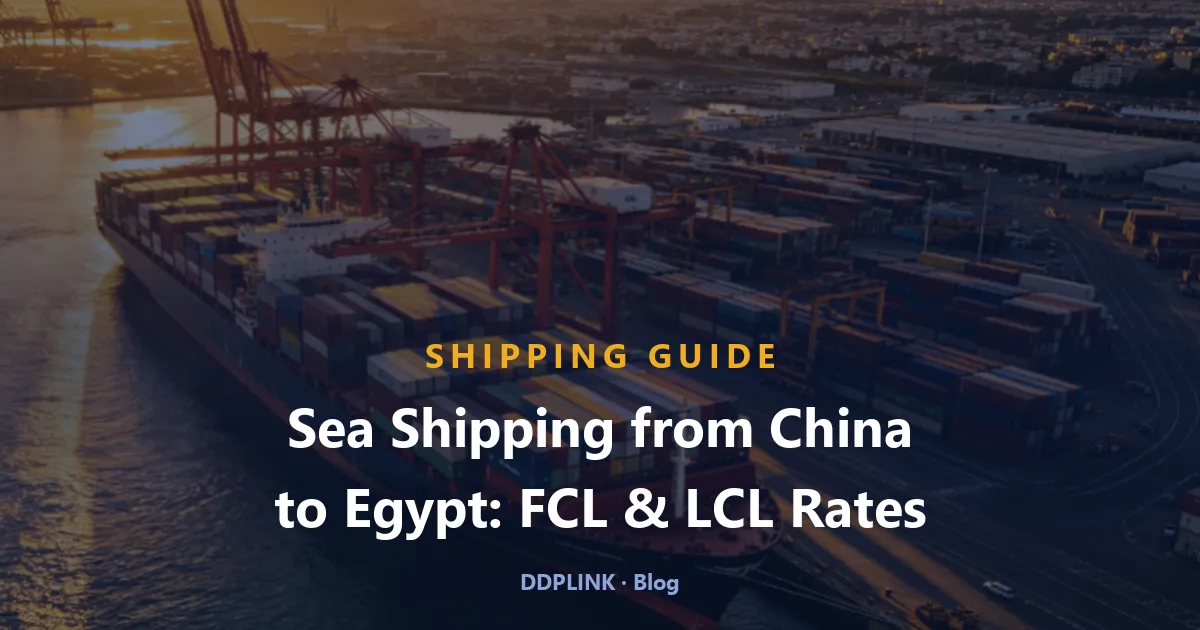

Sea shipping from China to Egypt in Q4 2026: FCL and LCL rates to Sokhna and Alexandria, sea transit times, the ACID and CargoX rules, and duty plus 14% VAT.
Sea shipping from China to Egypt is quoted two different ways, and which one you are holding decides whether the number in front of you is roughly $1,300 or roughly $4,000 for the same container. One is ocean freight, port to port; the other is an all-in door-to-door figure with Egyptian clearance, duty and 14% VAT inside it. This guide gives both, dated to Q4 2026 and split by loading port and destination port.
Egypt sits on two water systems at once. Cargo can enter the Mediterranean at Alexandria, Damietta or Port Said, or the Red Sea at Sokhna — and that choice changes the transit time, the inland truck leg and, on some routings, the freight. Layered on top is a compliance gate that has to be opened before your container is loaded in China, not after it arrives: get the sequence wrong and the rate stops mattering, because the cargo never sails.
Quick Answer: Sea Shipping from China to Egypt at a Glance
Q4 2026 (October–December) working bands for general cargo, freight only unless the row says otherwise. For the all-in figure, read the bottom two rows and then the section on DDP shipping from China.
| Product | Example Route | Transit | Q4 2026 Band |
|---|---|---|---|
| Sea FCL 20ft | Shenzhen → Sokhna | 20–28 days | $1,250–$1,850 |
| Sea FCL 40ft | Shenzhen → Sokhna | 22–30 days | $2,300–$3,300 |
| Sea FCL 20ft | Ningbo → Alexandria | 25–35 days | $1,450–$2,150 |
| Sea LCL | Shekou → Sokhna | 26–34 days | $85–$125 per CBM |
| Air freight | Guangzhou → Cairo | 3–7 days | $4.50–$8.00 per kg |
| DDP sea, all-in | Factory → Cairo | 30–45 days | Quoted per shipment, duty and VAT inside |
| DDP air, all-in | Factory → Cairo | 7–12 days | Quoted per kg or per shipment |
Three numbers decide most Egypt quotes, and none is the headline rate: the loading port, the Egyptian gateway, and whether the figure includes the charges at the destination end.
Our Industry Insight: The most common problem with China–Egypt quotes is a comparison between two different products — one forwarder’s all-in rate set beside another’s ocean freight. The ocean leg is often less than half of what you finally pay; clearance, duty, VAT and delivery are the rest.
FCL Rates from China to Egypt: 20ft and 40ft Bands
FCL (Full Container Load) means you book the whole container: sealed at the loading port, opened at your warehouse, no consolidation in between. That makes it cheapest per unit once volume is high enough, and lowest-risk in handling terms.
Rates below are ocean freight only, port to port; export handling in China, Egyptian clearance, duty, VAT, destination port charges and inland delivery sit outside the band.
| Route | Transit | 20ft FCL | 40ft FCL |
|---|---|---|---|
| Shenzhen (Yantian / Shekou) → Sokhna | 20–28 days | $1,250–$1,850 | $2,300–$3,300 |
| Guangzhou (Nansha) → Sokhna | 21–29 days | $1,280–$1,900 | $2,350–$3,400 |
| Ningbo → Alexandria | 25–35 days | $1,450–$2,150 | $2,650–$3,900 |
| Shanghai → Port Said | 24–34 days | $1,420–$2,100 | $2,600–$3,800 |
| Qingdao → Alexandria | 28–38 days | $1,600–$2,350 | $2,900–$4,200 |
20ft, 40ft or 40ft High Cube
Container choice moves the price as much as the route. A 20ft takes about 28–30 CBM usable; a 40ft about 55–58 CBM; a 40ft high cube about 65–68 CBM on similar payload. A 40ft costs about 1.8 times the 20ft rate rather than double, so light bulky cargo — furniture, plastics, packed textiles — ships better in a 40ft. Dense cargo such as ceramics or machinery hits the road weight limit first, where a 20ft wins.
Two surcharges sit on top: a peak season surcharge (PSS), applied from September into January on Asia–Mediterranean and Asia–Red Sea strings, and a war-risk surcharge where the routing touches the Red Sea. Both pass through at cost, so ask for current levels before you fix a selling price. Loading-port detail for South China is in our shipping from Shenzhen guide; the wider product is on the sea freight from China service page.
LCL Rates from China to Egypt: What a CBM Really Costs
LCL (Less than Container Load) puts your cargo in a shared container and bills it per CBM against a minimum of one. It is how you start with 1–5 CBM without paying for the space around your pallets.
| Route | Transit | LCL per CBM | Minimum |
|---|---|---|---|
| Shekou (Shenzhen) → Sokhna | 26–34 days | $85–$125/CBM | 1 CBM |
| Nansha (Guangzhou) → Sokhna | 27–35 days | $90–$130/CBM | 1 CBM |
| Ningbo → Alexandria | 30–40 days | $105–$145/CBM | 1 CBM |
| Shanghai → Alexandria | 29–39 days | $100–$140/CBM | 1 CBM |
LCL bills the greater of volume and weight — the W/M rule — so a dense shipment of tiles or hardware can be charged on tonnes instead. Send both figures at quote stage; the volumetric weight calculator settles the question in seconds.
The 13–15 CBM Break-Even
The crossover sits around 13–15 CBM on this lane. Below it LCL usually wins in total; above it a 20ft does, because you stop paying per CBM. Between roughly 12 and 18 CBM ask for both prices — density changes the answer, and so does the gateway.
Why 2 CBM Is Not Half of 4 CBM
LCL carries flat destination charges that do not scale with volume — deconsolidation, handling, documentation and a delivery order fee on the Egyptian side. On a 2 CBM shipment those lines can dominate, so small LCL quotes land closer together than the CBM rate suggests. For small, urgent cargo, price it against air on the same freight cost calculator first.
Transit Time from China to Egypt by Sea: Sailing, Clearance, Inland
Port-to-port transit is the number carriers publish, and the Red Sea side is shorter: Sokhna is served by strings that stay in the Red Sea, while Alexandria and Port Said require the vessel to complete the Suez Canal.
| Loading Port | → Sokhna (Red Sea) | → Alexandria (Mediterranean) | → Port Said |
|---|---|---|---|
| Shenzhen (Yantian / Shekou) | 20–28 days | 26–34 days | 26–34 days |
| Guangzhou (Nansha) | 21–29 days | 27–35 days | 27–35 days |
| Ningbo | 23–32 days | 25–34 days | 25–33 days |
| Shanghai | 22–31 days | 24–33 days | 24–32 days |
| Qingdao | 26–35 days | 27–36 days | 27–37 days |
A relay over Jebel Ali, Singapore, Jeddah or Malta adds 3–10 days and often costs less — worth asking whether the extra week matters to you.
Door-to-Door Is Longer Than the Sailing
What your customer experiences is the whole chain, and most slack sits before the vessel sails or after it berths.
| Stage | Sea DDP to Cairo |
|---|---|
| Supplier pickup and export handling in China | 2–4 days |
| Consolidation, documentation and cut-off | 2–5 days |
| Ocean transit | 20–30 days |
| Egypt customs clearance | 2–5 days |
| Inland delivery (Sokhna or Alexandria → Cairo) | 1–3 days |
| Realistic door-to-door | 30–45 days |
Clearance is the largest single variable. With the ACID in place and documents matching the cargo, sea freight clears in a few days; without them a container can sit for a week or more while paperwork is corrected, with storage and possibly demurrage on your account.
Sokhna, Alexandria or Damietta? Matching the Port to Your Address
Egypt has four container gateways, and only one is right for a given address. Freight differences between them are real but small next to the inland cost of choosing wrongly.
| Your Delivery Address | Recommended Gateway | Why | Inland Leg |
|---|---|---|---|
| Cairo, 6th of October City, New Capital | Sokhna (Red Sea) | About 120–140 km to Cairo on the desert highway; no canal transit for the vessel | 3–6 hours |
| Alexandria, North Coast, Beheira, Tanta | Alexandria (incl. El Dekheila) | Shortest inland leg; largest share of Egypt’s trade | Same day |
| Damietta and the Delta industrial zone | Damietta | Dedicated berths, modernizing container terminal; fewer strings call here | 3–6 hours |
| SCZone factories, re-export, relay cargo | Port Said (East) | Transshipment hub; inland clearance less common than at the other two | Depends on zone |
| Upper Egypt (Assiut, Minya, Sohag) | Usually Sokhna | Shorter run south on the Red Sea road than from the Delta | 6–9 hours |
The mechanism is simple. A vessel calling Sokhna enters the Red Sea and stops; a vessel calling Alexandria completes the canal transit, and convoys queue. That is why Sokhna transit runs shorter on South China strings — but it does not make Sokhna cheaper: Alexandria often prices better, and the difference is usually decided by inland trucking.
Our Industry Insight: We have seen importers pay an extra inland leg worth several hundred dollars by routing a Delta-bound container through Sokhna because it looked faster on paper. Work backwards from the delivery address, and decide before booking — switching later means re-issuing documents that already carry the ACID.
Two neighbouring lanes are useful context: Saudi Arabia shares the Red Sea corridor through Jeddah, and Kenya shows one port serving a whole inland region.
ACID, NAFEZA and CargoX: The Compliance Gate Before Loading
Egypt requires advance cargo information on ocean imports, and it sits before the vessel loads in China, not at the Egyptian port. Three systems do the work: NAFEZA, the single window where the importer files shipment data; the ACID, the 19-digit number NAFEZA issues against it; and CargoX, where the Chinese exporter lodges original documents with Egyptian customs. Together they form the ACI regime in force since October 2021.
| When | Who Acts | What Has To Happen | If It Is Missed |
|---|---|---|---|
| Before booking is confirmed | Egyptian importer | File shipment data on NAFEZA, obtain the ACID | No ACID, no loading |
| Before the container loads | Chinese supplier | Register on CargoX, upload invoice, packing list, B/L draft | Cargo held or returned at your cost |
| At least 48 hours before arrival | Carrier and importer | ACI data set matched to the ACID | Vessel may refuse to discharge |
| Before release | Clearing agent | Duty, VAT and advance payment settled | Demurrage clock keeps running |
The main failure point is not Egyptian customs — it is a Chinese supplier who has never heard of CargoX, finding out in the week the container is due to load. We confirm supplier-side registration and invoice data at booking stage, because the ACID has to match the invoice character for character.
Documents That Have To Agree With Each Other
| Document | Issued By | What To Watch |
|---|---|---|
| Commercial invoice | Chinese supplier | ACID number, HS codes and importer’s tax registration number on the face; description matching the packing list |
| Packing list | Chinese supplier | Carton count, weights and dimensions matching the load |
| Bill of lading | Carrier or forwarder | ACID on the B/L; consignee matching the importer registered on NAFEZA |
| Certificate of origin | CCPIT or chamber, plus Egyptian attestation where required | Form depends on the goods; some importers are asked for attestation before sailing |
| Insurance certificate | Insurer | Written against the CIF value |
| Conformity documents | Testing body or factory | Regulated goods need the plant registered with GOEIC — textiles, footwear, appliances and lighting catch importers out |
Check the rules against your own shipment: NAFEZA single window, Egyptian Customs Authority, GOEIC, CargoX.
Real-Life Scenario — varnish from Shekou, cleared at Sokhna: A Cairo-area importer of printing consumables ordered screen printing varnish from Guangdong. The volume did not justify a container, so it moved as an LCL consolidation from Shekou to Sokhna. Varnish sits close to the line between general cargo and dangerous goods, decided by the formulation rather than the product name — we reviewed the MSDS and transport classification before booking. Documents matched the cargo description exactly and the consignment cleared at Sokhna with no hold. The full case study is on our site.
Duty, 14% VAT and What the Port Bills You at the Other End
Two value-based charges fall on an Egyptian import, in a fixed order, with a small third line after them:
- Customs duty = CIF value × the rate for your HS code. Raw materials often land in the low single digits; finished goods run far higher.
- VAT = (CIF value + duty) × 14% — on the value including duty, not the goods value alone.
- Advance payment = 1% under the deduction-and-collection system for registered importers.
Here is the arithmetic on a representative 20ft of general cargo. The duty rate is illustrative; yours follows your HS code, and the Egyptian Customs Authority publishes the tariff.
| Line | Amount |
|---|---|
| Goods value (FOB Shenzhen) | $18,000 |
| Ocean freight (1 × 20ft to Sokhna) | $1,550 |
| Insurance | $70 |
| CIF value | $19,620 |
| Customs duty (illustrative 10%) | $1,962 |
| VAT (14% on CIF + duty) | $3,021 |
| Advance payment (1%) | $196 |
| Subtotal at the port | $24,799 |
| Destination charges (THC, delivery order, handling) | $200–$500 |
| Inland delivery, Sokhna → Cairo | $250–$450 |
The value-based lines are larger than the freight on a full container, which is why a “$1,550 container” is never a $1,550 landed cost. VAT is also a cash-flow line: even if you recover it, it has to be funded until the return clears.
Our Industry Insight: The 14% import VAT is the largest line most Egyptian importers pay on a container that is not otherwise heavily dutied, and the line most often missing from a quote comparison. Folding VAT into a per-CBM rate does not hide it — it makes it invisible until the invoice lands.
Demurrage, Detention and Free Time
Egyptian terminals are strict on time. Demurrage applies while the container is still in the terminal, after the free storage window — typically 5–7 days — and detention once it has left the port and is not returned empty within the agreed period. Negotiate 14–21 days of combined free time at destination before booking, and line up the customs entry and delivery appointment in the week the vessel is due: a container that clears on day two but is collected on day nine still pays for days three to nine.
Red Sea Routing, Surcharges and When to Book
Egypt sits at the end of one of the world’s busiest maritime corridors. The Suez Canal is why a Shanghai–Alexandria sailing is measured in weeks rather than months, and also why this lane is exposed to disruptions no forwarder controls.
- Normal routing: Asia → Malacca → Bab el-Mandeb → Red Sea. Sokhna is discharge only; Alexandria and Port Said continue through the canal.
- Disrupted routing: when carriers judge the Red Sea unsafe or the canal congested, they re-route around the Cape of Good Hope — roughly 10–14 extra days, plus fuel cost that feeds into the rate.
- Surcharges: PSS from September into January, plus a war-risk surcharge on Red Sea routings. Both are quoted separately and can move between booking and sailing.
- Reliability: schedule reliability on this corridor varies by month, which is why we quote a band rather than a promised day.
| Window | When | What It Does to Your Booking |
|---|---|---|
| Golden Week | 1–7 October 2026 | Factories and many port operations slow or pause; pre-holiday cut-offs land mid-September |
| Pre-Chinese New Year build-up and holiday | from early January 2027 | Space and equipment tighten, PSS applies; two to three weeks of factory shutdown around the holiday |
| Ramadan and Eid | from February 2027 | Egyptian working hours shorten; customs, banks and delivery appointments slow |
The practical rule is to book four to six weeks ahead of a holiday window and keep one alternative gateway in mind. What happens to Red Sea transit when routing changes is covered on a comparable lane in our guide to air and sea options to South Africa; canal data comes from the Suez Canal Authority.
FAQ: Sea Shipping from China to Egypt
What is the cheapest way to ship from China to Egypt?
Sea FCL, once you can fill about 13–15 CBM. Below that LCL usually costs less in total, because you pay only for the space you use — though flat destination charges make very small shipments less of a bargain.
How long does sea shipping from China to Egypt take?
Port to port, 20–28 days from Shenzhen to Sokhna on a direct Red Sea string, and 24–35 days to Alexandria or Port Said depending on the loading port. Door to door under sea DDP, plan on 30–45 days.
Do I need an ACID number, and who obtains it?
Yes — it is mandatory for ocean imports into Egypt. The importer or their broker files the shipment data on NAFEZA and receives a 19-digit ACID, which must then appear on the invoice, packing list and bill of lading. It has to exist before loading in China.
Can my Chinese supplier handle CargoX?
Often they can, but many have never done it. The exporter registers on CargoX and uploads the invoice, packing list and B/L draft. Registration is one-time per company, so the first Egyptian shipment from a factory is where the friction sits.
Which port should I use for a Cairo warehouse?
Sokhna for most Cairo addresses, especially east of the Nile and around the New Administrative Capital — roughly 120–140 km out. Alexandria works better for the Delta, the North Coast and the city itself.
Are duty and VAT included in a sea freight quote?
Not in a port-to-port rate. Ocean freight covers the sailing only; clearance, duty, the 14% VAT and delivery are separate lines unless you book DDP, where they sit inside one price. Check which you are comparing.
Conclusion: One Quote, Four Numbers to Check
Sea shipping from China to Egypt comes down to four numbers: the loading port, the Egyptian gateway, the rate basis you are quoted on, and how much free time you have at destination. Get those straight and the rest is arithmetic you can check. Get them wrong and the difference arrives as storage, demurrage and a trucking bill you did not budget for.
Send us the cargo details — loading city, delivery city in Egypt, CBM or container size, weight and HS code — and we will come back with a port-to-port rate and an all-in door-to-door figure side by side, both with the ACID and CargoX steps mapped to your supplier.
More articles
Air Shipping from China to Kuwait: 2026 Rates, Transit & Clearance
Air shipping from China to Kuwait in Q4 2026: rates by weight break into KWI, transit via Dubai and Doha, KUCAS clearance, and 5% duty with no VAT.
Read Article →
Air Shipping from China to Nigeria: 2026 Rates & Transit
Air shipping from China to Nigeria in Q4 2026: rate bands into Lagos, Abuja and Kano, chargeable weight, the Form M and SONCAP clock, and what happens at MMIA.
Read Article →
Air Shipping from China to South Africa: 2026 Rates, Transit Times & Clearance
Air shipping from China to South Africa in 2026: rates by weight break, transit to Johannesburg, Cape Town and Durban, and the SARS duty and 15% VAT stack.
Read Article →