


 USA
 Canada
 Mexico
 Brazil
 UAE
 Saudi Arabia
 Iraq
 Nigeria
 Ghana
 Côte d’Ivoire
 Kenya
 Uganda
 Tanzania
 DR Congo
 Angola
 South Africa
 UK
 Germany
 France
 Netherlands
 Spain
 Australia
How Much Does It Cost to Ship from China to Brazil? (2026)
October 19, 2026
← All Articles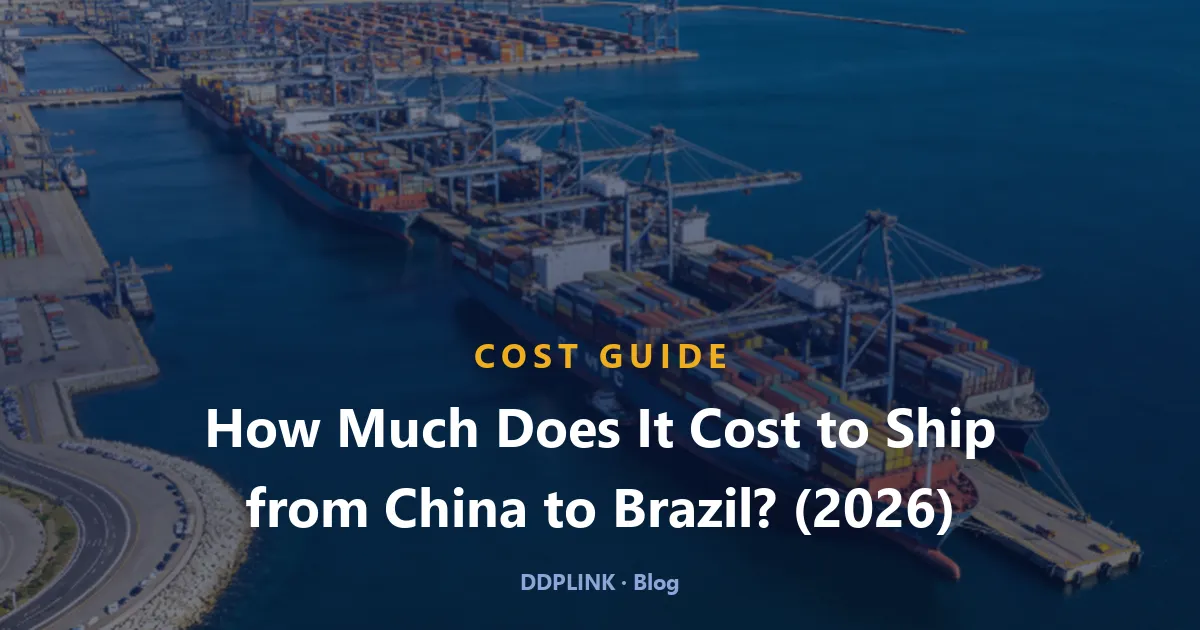

Shipping cost from China to Brazil in Q4 2026: sea, LCL and air bands, container rates, and the II, IPI, ICMS and AFRMM tax stack behind your landed cost.
Shipping cost from China to Brazil is two numbers that never appear on the same quote. A 20ft container from Ningbo to Santos prices at $2,350–$3,250 port to port; the same box, cleared and delivered near São Paulo, lands at 1.6 to 2 times its FOB value. The gap is not margin — it is II, IPI, PIS/COFINS, ICMS, AFRMM and the terminal lines in between.
Freight is the smallest part of a Brazil invoice. This guide prices the lane by mode for Q4 2026, then walks the tax cascade line by line: a worked container, the state ICMS table, the parcel rules that changed in May 2026, and the levers that move the total. Route overview first: Shipping from China to Brazil.
Quick Answer: Shipping Cost from China to Brazil in Q4 2026
Read the rows with their caliber in mind: sea and air figures are freight only, port to port or airport to airport, while DDP rows carry taxes and clearance inside.
| Method | Example route | Transit | Q4 2026 band |
|---|---|---|---|
| Sea FCL 20ft | Ningbo → Santos | 32–42 days | $2,350–$3,250 |
| Sea FCL 40ft | Ningbo → Santos | 32–42 days | $4,480–$5,860 |
| Sea LCL | Ningbo → Santos | 32–44 days | $430–$520 per CBM |
| Sea LCL | Shanghai → Itajaí | 36–50 days | $520–$620 per CBM |
| Air freight | Guangzhou (CAN) → São Paulo (GRU) | 5–8 days | $1,680–$2,160 at 100 kg; $9,900–$12,800 at 1,000 kg |
| Air freight | Hong Kong (HKG) → Rio (GIG) | 6–10 days | $1,760–$2,280 at 100 kg; $10,300–$13,300 at 1,000 kg |
| Express courier | Shenzhen → São Paulo | 5–10 days | Contract parcel rates |
| DDP air | Factory → São Paulo | 8–12 days | All-in per chargeable kg |
| DDP sea | Factory → São Paulo | 40–55 days | All-in per CBM or container |
Rates into Santos moved by double digits month over month in 2026, so a band without a date is a guess.
Our Industry Insight: When a Brazilian buyer sends a competing quote that looks 40% cheaper, it usually is not cheaper — it is shorter. One number is ocean freight with THC and documentation bundled; the other is the same sailing plus DUIMP, taxes and delivery. We now send every Brazil rate as two columns, freight to the port and the destination stack separately, so the buyer can see what they are comparing.
Sea Freight Cost from China to Brazil: FCL and LCL
Brazil’s container gateways sit on the Atlantic side, which is why transit runs longer than to Europe. Rates below are ocean freight on our contracted allocations, cut off in September 2026 for general commercial cargo.
| Route | Transit | 20ft FCL | 40ft FCL | LCL per CBM |
|---|---|---|---|---|
| Ningbo → Santos | 32–42 days | $2,350–$3,250 | $4,480–$5,860 | $430–$520 |
| Shanghai → Itajaí | 36–50 days | $2,680–$3,680 | $4,980–$6,450 | $520–$620 |
The lane spread is a routing fact: Ningbo has the deepest direct South America East Coast coverage, while Itajaí sailings often relay through Santos. Public pages in October 2026 quoted USD 5,000–6,400 for a 40ft into Santos, bundled with THC, BL and documentation — compare contents, not headlines. Service detail is on the Sea Freight from China page; most of our Brazil volume books out of Zhejiang, and lane options are in the Shipping from Ningbo guide.
20ft, 40ft or 40HQ
Usable volume is about 28–30 CBM in a 20ft and 65–68 CBM in a 40HQ. Per-CBM, our 20ft band works out to $84–$116 against $69–$90 for a filled 40HQ, and a 20ft can quote above a 40ft when equipment is tight, because handling cost barely changes and the small box carries a third of the volume. Above about 28 CBM, price the 40ft before you book the 20.
LCL: Per-CBM Rates and the Charges Around Them
LCL shares a container and bills by cubic metre, against a one-CBM minimum and under the W/M rule, which charges the greater of volume and weight (one cubic metre treated as 1,000 kg). A low headline CBM rate and a landed cost can differ by a multiple, because CFS unstuffing, documentation, the terminal minimum and the broker’s fee are per-shipment lines.
At $430–$520 per CBM, an 8-CBM consignment carries $3,440–$4,160 of ocean freight; a 20ft costs less in freight, but you cannot use 28 CBM of it. Between roughly 8 and 15 CBM, get both prices on the same cargo and compare delivered totals.
Air Freight Cost from China to Brazil by Weight Break
Air buys days, and rates fall steeply as the consignment grows.
| Route | Transit | 100 kg | 300 kg | 500 kg | 1,000 kg |
|---|---|---|---|---|---|
| Guangzhou (CAN) → São Paulo (GRU) | 5–8 days | $1,680–$2,160 | $3,520–$4,560 | $5,300–$6,850 | $9,900–$12,800 |
| Hong Kong (HKG) → Rio de Janeiro (GIG) | 6–10 days | $1,760–$2,280 | $3,680–$4,780 | $5,520–$7,150 | $10,300–$13,300 |
Per-kilogram economics: $16.80–$21.60 at a 100 kg booking from Guangzhou, $9.90–$12.80 at 1,000 kg. That is the airline’s weight break structure (45, 100, 300, 500 and 1,000 kg bands) plus fixed charges that never shrink — screening, AWB, terminal handling and minimum charges. Routing and clearance at GRU, VCP and Manaus are covered in Air Shipping from China to Brazil: Rates & Transit.
Chargeable Weight and the Break Ladder
Airlines bill the greater of actual and volumetric weight, where volume weight is length × width × height in centimetres divided by 6,000; an 80 × 60 × 60 cm carton at 8 kg bills at 48 kg. Because rates are stepped, more cargo can cost less: a 290 kg lot priced at the 100 kg break can cost more in total than the same lot declared at 300 kg, where the lower band applies to the whole consignment.
Sea is priced on space instead: at $430–$620 per CBM, dense cargo pays $2.58–$3.72 per kilogram when a cubic metre holds 166.67 kg — a fifth of the air rate. Air earns its premium under about 300 kg and for parts where a stoppage costs more than the freight.
The Brazilian Tax Stack: II, IPI, PIS/COFINS, AFRMM and ICMS
Most cost guides skip this section, and it is where most of a small importer’s landed cost sits: five taxes, one fee and several terminal lines stack on the customs value, each calculated on a base that includes the one before.
| Charge | Rate (2026) | Calculated on |
|---|---|---|
| II (Imposto de Importação) | Set by NCM in the Mercosur TEC; commonly 0–20%, 35% ceiling | Customs value (FOB + freight + insurance) |
| IPI | By NCM, commonly 0–15% | Customs value plus II |
| PIS-Importação | 2.1% | Customs value |
| COFINS-Importação | 9.65% | Customs value |
| AFRMM | 8% | Ocean freight, long-course voyages only |
| Taxa Siscomex | R$185 per declaration plus R$29.50 per addition | Per DUIMP/DI and per addition |
| ICMS | 17–22% by state | Everything above, grossed up |
PIS and COFINS add 11.75% to the customs value before ICMS is calculated, which is why the effective burden runs far above the headline duty rate.
ICMS “Por Dentro”: Why the State Rate Costs More Than Its Name
ICMS is not levied on top of the base; it is included in it. The formula is base = (customs value + II + IPI + PIS + COFINS + AFRMM + Siscomex + local charges) ÷ (1 − ICMS rate). At 18%, that gross-up turns a nominal 18% into about 22% of the pre-ICMS total.
| State | Standard ICMS | Note |
|---|---|---|
| São Paulo | 18% | Default clearance state for Santos cargo |
| Espírito Santo | 17% | Lowest in the southeast |
| Minas Gerais | 18% | Industrial belt around Belo Horizonte |
| Paraná | 19.5% | Curitiba and the south |
| Bahia | 20.5% | Salvador and the northeast |
| Rio de Janeiro | 22% | Highest large-market rate |
The state is not a free choice: ICMS is due where the importer is established and the goods are destined, so check the rate before pricing the sale.
A Worked Container, Line by Line
A 20ft of machine parts, FOB Ningbo $25,000, NCM duty 14%, IPI 5%, cleared in São Paulo at 18%. Figures in USD at the PTAX rate of the declaration date.
| Line | Amount |
|---|---|
| Product value (FOB Ningbo) | $25,000 |
| Ocean freight plus origin pickup | $2,850 |
| Insurance (0.3%) | $75 |
| Customs value | $27,925 |
| II at 14% | $3,910 |
| IPI at 5% on customs value plus II | $1,592 |
| PIS at 2.1% | $586 |
| COFINS at 9.65% | $2,695 |
| AFRMM at 8% of ocean freight | $208 |
| Taxa Siscomex (R$185 plus one addition) | $40 |
| Capatazia, THC and CFS | $480 |
| Despachante and SDA | $420 |
| Inland trucking Santos → São Paulo | $620 |
| Subtotal before ICMS | $38,475 |
| ICMS at 18%, grossed up (base $46,921) | $8,446 |
| Total landed cost | $46,921 |
That is 87.7% over FOB, with freight at 6.1% of the total. A bulky consumer-goods container at a 20% duty rate and a 5% IPI lands above 110%, which is why our destination data warns that landed cost often reaches 60–100% of FOB.
Real-Life Scenario: An importer of packaging machinery booked 8 CBM from Ningbo to Santos and budgeted on the freight line alone: $3,900 at about $487 per CBM. Duty at 16% and IPI at 5% were expected. What was not in the plan was PIS and COFINS at 11.75% of the customs value, AFRMM at 8% of the ocean freight, and ICMS at 18% calculated “por dentro” on a base that already contained all of it. The consignment landed at $24,044 on $9,600 of goods — 150% over FOB, with the tax lines alone at about 92% of the product value. Nothing on the invoice was wrong; the budget had priced the freight and treated the taxes as a rounding item.
Clearance Channels and Storage
AFRMM (8% of ocean freight) and the Taxa Siscomex are billed before the port releases cargo, and terminal handling (capatazia), CFS unstuffing and storage are set by the operator — storage bills per calendar day once the free window ends.
Then there is the channel lottery. Siscomex assigns a clearance channel by risk: green releases on payment, yellow reviews documents, red inspects the cargo, grey adds a valuation analysis. Red and grey are where a two-day clearance becomes a fifteen-day one, with storage charged for every day of it — which is why a despachante aduaneiro with a clean client history is worth more than a cheap one.
The 2026 Reform Layer: CBS and IBS in the Test Year
Brazil’s consumption-tax reform (LC 214/2025) is now visible on the declaration: in 2026 the DUIMP computes CBS at 0.9% and IBS at 0.1% per item alongside the existing taxes, but those amounts are not collected this year. CBS becomes operational in 2027 and IBS runs through 2033. Budget on today’s stack, and clean up your NCM now — the new base formally includes capatazia and the Siscomex fee.
DDP, DAP or CIF: What the All-In Number Contains
Every Brazil quote sits on a line from port to door, and the incoterm says where it stops.
| Term | Freight | Clearance | Duty and taxes | Delivery | Importer of record |
|---|---|---|---|---|---|
| CIF | Yes, to port | No | No | No | Buyer |
| DAP | Yes | Yes | No | Yes | Buyer |
| DDP | Yes | Yes | Yes, by agreement | Yes | Licensed Brazilian entity on our side |
One structural fact limits DDP here: only an entity with a CNPJ, an active RADAR habilitação in Siscomex and access to the Portal Único can be the importer of record and register the DUIMP. A foreign forwarder cannot declare in its own name, so a real DDP service to Brazil runs through a licensed importer of record, with taxes settled inside the agreed price. Our structure is described on the DDP Shipping from China page.
DDP also decides who recovers what: where the importer of record is not your company, the PIS/COFINS and IPI credits are not yours.
Remessa Conforme and the Small-Parcel Route
Brazil changed its parcel rules on 12 May 2026, and most cost pages still quote the old ones.
| Purchase value | II on certified platforms | Deduction | ICMS | Who qualifies |
|---|---|---|---|---|
| Up to $50 | 0% | — | 17–22% by state | Individuals on Remessa Conforme platforms |
| $50.01 to $3,000 | 60% | $30 per shipment | 17–22% by state | Individuals on Remessa Conforme platforms |
| Any value, not certified | 60% | None | 17–22% by state | General simplified regime |
| Commercial import under a CNPJ | Per NCM (TEC) | — | 17–22% by state | Companies, formal DUIMP route |
The simplified regime (RTS) exempts IPI, PIS and COFINS and caps customs value at $3,000, but it is built for individuals, not for resale. A company importing stock under its own CNPJ belongs on the formal route, where duty follows the NCM rather than a flat 60% — often a lower rate on machinery and inputs. Between 1 August 2024 and 11 May 2026 the under-$50 band carried 20% II, so quotes built on that are out of date; the current tables are published by the Receita Federal. Samples and first units under about 30 kg still suit the parcel route.
Five Levers That Move the Brazil Number
Freight negotiation moves the smallest line. These five move the invoice.
| Lever | Effect | Applies when |
|---|---|---|
| Price the next weight break | A 290 kg air lot priced at 300 kg can cost less in total | Air lots near a band |
| Quote LCL and FCL together | FCL wins on unit cost once you can fill it; LCL wins on total below it | 8–15 CBM |
| Compare 20ft, 40ft and 40HQ per CBM | A filled 40HQ is $69–$90 per CBM against $84–$116 in a 20ft | Cargo above 28 CBM |
| Confirm the NCM before booking | A wrong digit changes duty, IPI, licensing and the agency involved | Every shipment |
| Check SUFRAMA eligibility | II cut by 88% and IPI relief for qualifying goods in the Manaus zone | Electronics, appliances, motorcycles |
Manaus is the exception worth checking: the incentives are real but conditional on the product, the NCM and the beneficiary’s status inside the zone, and the paperwork travels with the cargo.
Our Industry Insight: Classification work happens once and pays for years. We run every new Brazil NCM against the TEC before quoting, ask the supplier for material composition rather than the marketing name, and record the code so the despachante, the DUIMP and the packing list tell the same story. Three times this year that check changed the duty rate on a repeat order; twice it changed the licensing requirement, which mattered more.
Ports, Inland Legs and the Last Mile
Gateway choice in Brazil is an inland-distance decision: the ocean spread between ports is small, the road leg is not.
| Gateway | Transit | Position | Best for |
|---|---|---|---|
| Santos | 32–42 days | About 40% of Brazil’s containers; 90 km from São Paulo | Full containers, nationwide distribution |
| Paranaguá | 34–44 days | Agribusiness and general cargo | Agricultural inputs, bulk, Santos overflow |
| Itajaí / Navegantes | 36–46 days | Southern gateway for eCommerce and apparel | Santa Catarina, Curitiba, Porto Alegre |
| Manaus | 40–50 days | Amazon river port inside the ZFM | Electronics and motorcycles with SUFRAMA treatment |
Two cost lines sit outside the freight rate. Demurrage and detention start when free time at the terminal and on the equipment runs out and bill per day, so an inspection that runs over a weekend pays for the weekend. Inland trucking from Santos to São Paulo runs $500–$900 per container; to Curitiba or Porto Alegre, budget two to three times that.
FAQ: China to Brazil Shipping Costs
How much does it cost to ship a container from China to Brazil?
Q4 2026 ocean freight runs $2,350–$3,250 for a 20ft and $4,480–$5,860 for a 40ft from Ningbo to Santos. Add the tax stack, terminal lines and delivery: our worked 20ft example landed at $46,921 on $25,000 FOB.
How much is LCL shipping from China to Brazil per CBM?
$430–$520 per CBM to Santos and $520–$620 to Itajaí on our lane. Check what a lower headline rate excludes: CFS unstuffing, documentation and the terminal minimum are flat per-shipment lines, so landed cost per CBM rises sharply on small volumes.
How much does air freight from China to Brazil cost per kg?
$16.80–$21.60 per kg at a 100 kg booking from Guangzhou to São Paulo, falling to $9.90–$12.80 at 1,000 kg. Under DDP the price is all-in per chargeable kilogram.
What import taxes apply when shipping from China to Brazil?
II at the NCM’s TEC rate, IPI by NCM, PIS at 2.1%, COFINS at 9.65%, AFRMM at 8% of ocean freight, the Taxa Siscomex, and ICMS at 17–22% calculated “por dentro”. On consumer goods the total often reaches 60–100% of FOB.
Do I need RADAR to import into Brazil?
Yes. Only a company with an active RADAR habilitação in Siscomex can be the importer of record and register the DUIMP, and the habilitação caps how much can be imported per period. If your buyer’s registration is capped, cargo stops whatever the sailing schedule says.
Is there a duty-free allowance for parcels from China to Brazil?
No. Since 12 May 2026, purchases up to $50 by individuals on Remessa Conforme platforms pay 0% II but still carry 17–22% ICMS; above $50 the rate is 60% with a $30 deduction. Companies importing for resale use the formal regime.
Conclusion: Price the Tax Stack, Then the Freight
Shipping cost from China to Brazil is a freight band of a few thousand dollars sitting under a tax and clearance stack that can double it. Price the mode by weight break and CBM, confirm the NCM, check the state ICMS rate and the buyer’s RADAR status, and date every rate before you quote your customer.
Send the goods description, the NCM if you have it, the volume or weight and the delivery city, and we will return both columns — freight to the port, and the destination stack line by line. A first estimate is available on the Freight Cost Calculator.
More articles
Air Shipping from China to Brazil: Rates & Transit
Air shipping from China to Brazil in Q4 2026: rates by weight break, routing into GRU and VCP, the DUIMP clearance clock, and air versus express at 30–150 kg.
Read Article →
Air Shipping from China to Kenya: Rates & Transit
Air shipping from China to Kenya in Q4 2026: rates by weight break into Nairobi, the JKIA clearance clock, and the Kenyan taxes outside the per-kilo price.
Read Article →
Air Shipping from China to Kuwait: 2026 Rates, Transit & Clearance
Air shipping from China to Kuwait in Q4 2026: rates by weight break into KWI, transit via Dubai and Doha, KUCAS clearance, and 5% duty with no VAT.
Read Article →